JULY 26, 2026 – Atmospheric conditions at the lake today reflected nature’s many moods in this neck of the woods. Well into daylight, I slipped out of bed and peered out the windows. A dense fog had descended over the woods, and I knew that a good many “photo ops” were to be had. I bypassed coffee and oatmeal and headed straight out to the dock for a better look at . . . oblivion. Not only the opposite (southern) side of the lake was obscured, but the shoreline running in each direction from our dock wore a veil of fog. The story on the north side of the Red Cabin was likewise fog-bound—another mystery, told by trees with constantly changing personalities as the density of the fog ebbed and flowed. I snapped a few photos, but in the main, I was in the moment—a figure inside a dynamic painting too vast for framing.
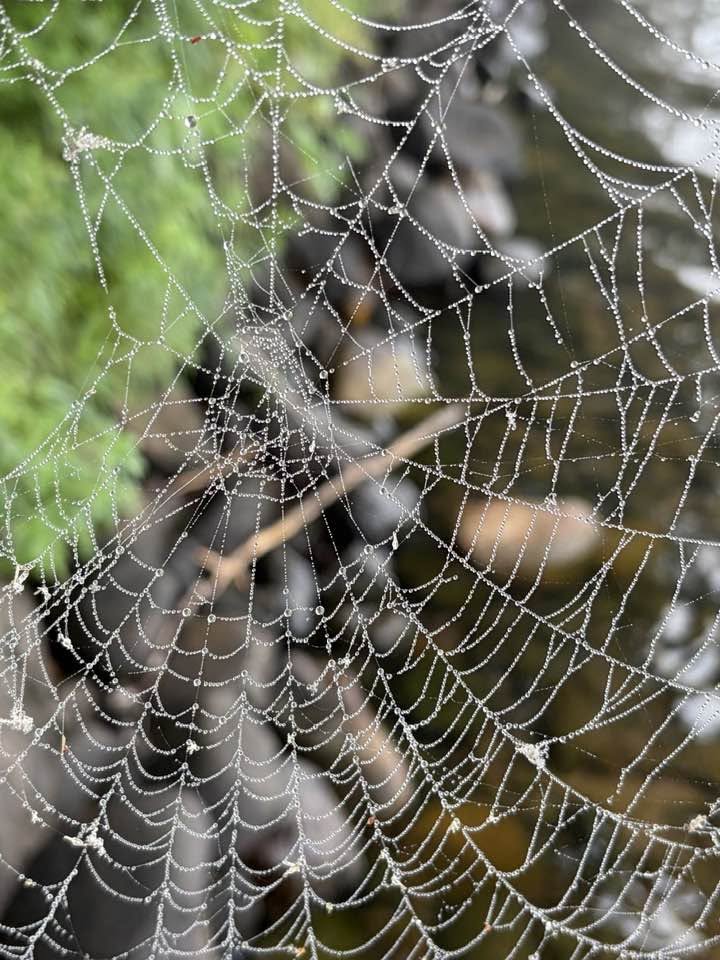
My stroll led me back to the lake and down the shoreline path of Björnholm. Soon I noticed the overnight work of the local spider community. Everywhere, arachnids on the A-team had been working overtime. In some places, large cobwebs—many a foot in diameter—were so intricate and numerous, they looked like goods in an embroidery bazaar.
As I tried to capture a few images of the spider webs, I chuckled over Illiana’s good fortune in not having come to the cabin this weekend. Our 10-year-old granddaughter shrieks upon sight of even the most innocuous spider, the daddy-long-legs. What struck me about all these webs this morning, however, is that I didn’t see a single spinner; not one spider checking for “dinner.” In fact, I saw no sign of “dinner” . . . or “breakfast,” for that matter. Each web seemed to be for show, not function. I took plenty of pictures, which I will present to Illiana and suggest to her—an artist—that these magnificent works of spiders are worthy of display at the Met.
After a half-hour tour of the cobweb exhibition in our own natural museum, I returned to the cabin for coffee and oatmeal—and an outstanding book (Our Declaration by Danielle Allen)—as the fog eventually lifted, overpowered by the sun.
Later in the day, the spider web extravaganza was matched by another miraculous display of nature: the hummingbird.
Just as we never take the eagles for granted, though in these parts they’re nearly as common as crows, I’m always “wowed” by the ruby-throated hummingbirds that frequent the feeders Beth hangs from the eave over the front of our screen porch. The appearance of the hummingbirds is signaled by the buzzing of their tiny wings—up to 1,250 times per minute, when hovering. Invariably, before I look up, I think I’m hearing a B-24 dragonfly or a bomber from Goering’s Luftwaffe (a big old ugly fly). But then . . . sure enough, it’s a hummingbird, hovering off to the side, then swinging around to the front, where with the skill of an Air Force pilot hooking up with a tanker in mid-air, the little creature sucks nectar from the red feeder—for a second, maybe two, before darting off at the speed of greenish iridescent light.
On many occasions I’d reach stealthily for my iPhone in hope of snapping a clandestine photo. Each time the bird would disappear the instant I withdraw the phone from my pocket. Now, I no longer make the attempt. I just sit—still and quiet—and watch this little miracle worker, the hummingbird.
Of course, nature is always performing everywhere. We notice an infinitesimal portion of the ongoing show. My dad used to say of Björnholm, “Even when I’m not here, I have great satisfaction just knowing this place exists.” The same can be said of nature: it makes us whole, even if we don’t know or notice it.
About this time—after twilight on a hot summer evening—is when we often hear the loons calling a short distance out from our shore in front. Their complex communications have all sorts of meaning. I can only guess at which call means what. But no matter. They are hauntingly beautiful, whether we understand them or not.
But here’s what I’d like to know: if an intelligent life form (“ILF”) from some far-off corner of the cosmos should find its way to earth, what would fascinate the ILF most: (a) the spider webs, (b) the hummingbird’s hover, (c) the loon calls, or (d) the American Declaration of Independence? If I were a betting man, I’d say (a), (b), or (c). But I’d want to explain to the ILF that in the course of human events, at least, our Declaration of Independence was an extraordinary piece of work—in human terms, the equivalent of a spider’s “dew catching” web, a hummingbird’s buzzing hover, and a loon’s tremolo echoing off the shoreline rocks of ages.
Subscribe to this blog and received notifications of new posts by email.
© 2026 by Eric Nilsson
