JULY 27, 2026 – This morning my wife and I attended to a bit of familial “crisis management.” The good news is that we were able to discharge our parental duties by phone from the porch of the Red Cabin. With this priority temporarily addressed, I was able to return to my next priority: earning my keep as my clients’ lawyer. By the time I’d dispensed with that business, I complied with the order of the day, which was to “get scarce” for Beth’s annual “cousin time at the cabin.”
I’ve been well-acclimated to this routine, and I harbor no unhappiness about it. My only desires in the matter are that felicitous weather prevails and that Beth and her guests enjoy good food, hearty laughs and rewarding conversations.
A notable exception to my “getting scarce” is my role as skipper of the pontoon for sunset excursions. The captain’s lodging is our old family cabin at the other end of Björnholm.
It is my custom during stays at our place—the Red Cabin—to take several daily hikes along the shoreline path up and down the two glacial eskers on the east half of trail that leads past the old cabin. Only when my sister and brother-in-law are on hand do I ever enter the cabin.
Today, however, given all my gear, including laptop, luggage, victuals, tools and my traveling shipyard for construction of my model sailboats, I drove from the Red Cabin around the back roads to the east access to the old cabin. The total distance is only about three miles, but somehow this modest trip took me across vast stretches of time. I rarely approach the old cabin by this route or means, and thus, the recollections that they prompted were much deeper and more detailed than the memories I experience on my daily hikes to the same destination. Moreover, instead of simply walking around the outside of the cabin, the point of today’s visit was to stay at the cabin while I’m to be “scarce.” Unloading my stuff, drinking the delicious tap water, and anticipating my overnight stay brought me much closer to cabin memories than do my daily hikes to past the cabin exterior.
Plus, I’m alone. My sister and brother-in-law decamped from here several days ago to journey to a reunion with my other two sisters at Hamburg Cove in Connecticut[1]. As I joked recently to a family friend, “I’d love to be in Connecticut because my three sisters will be there together, but I’m glad I won’t be in Connecticut because my three sisters will be there together.” I’m kidding, of course. I’d love to be with them, and last week I’d entertained half a notion to fly out to join them for a week of conversation, laughter, late-night Scrabble games, and the usual visits to favorite haunts.
But here I find myself, alone, at the old cabin where my sisters and I formed so many cherished memories in early youth. Here, now, there’s no conversation, no laughter, no Scrabble games—late-night or otherwise—and except to pilot the pontoon, I won’t be going off premises until my status is no longer “scarce.” For a short while, I’ll experience a monastic existence.
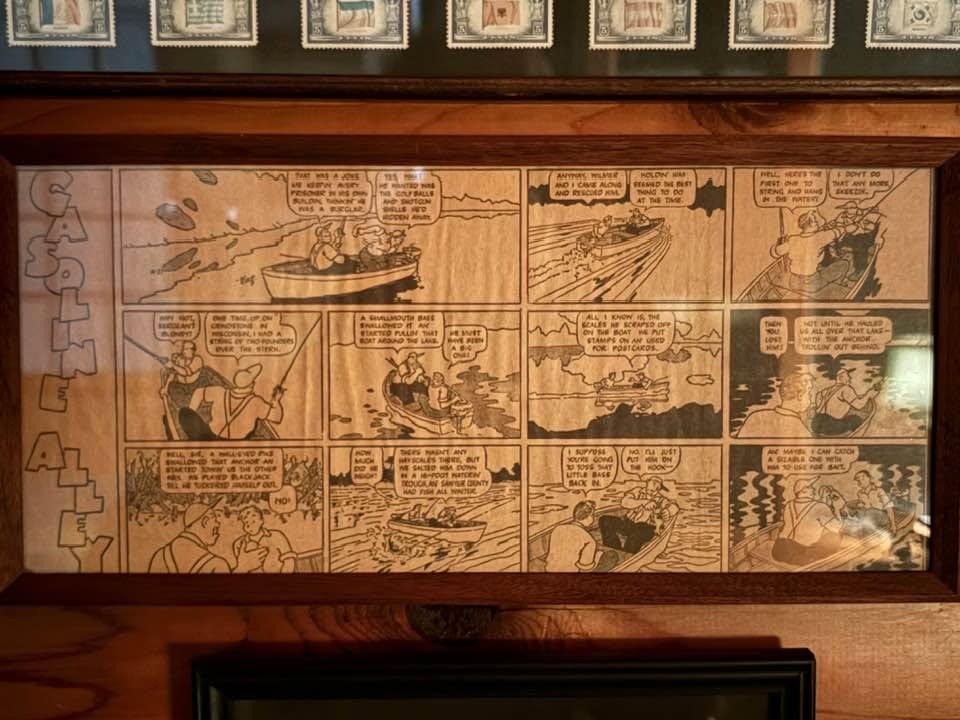
This alone time at the old cabin, allows—or “consigns”?—me to a kind of melancholic sentimentalism. The sister who, with her husband, maintains the place so meticulously, so true to its origins, nearly as a museum of our shared nostalgia, has left in place countless memory triggers: the painted hand-carved bust of King Gustav V of Sweden, in his signature huntsman’s cap and flannel shirt; the portrait of our Swedish great-great grandparents, a well-preserved photograph inside a nicely decorative antique frame; on the kitchen wall, the large framed photo of our ancestral farmstead, Husjönäs, in Småland, Sweden; beside the photo, a decorative wooden bread board bearing the poetic adage in Swedish, Smör och bröd gör kinden röd (“Butter and bread make the cheeks red”); the sturdily framed reproduction of The Bohemian by the Dutch Master, Frans Hals, which used to grace the wall at the head of the stairs of our family home in Anoka (MN); the RCA Victor cabinet radio from the 1930s, with a switch on the side that we’d flip to “on” during summer evenings, and tune to a rock-and-roll station from Little Rock, Arkansas—one of the two stations the receiver would pick up depending on clarity of the atmosphere; the ornate antique rocking chairs that were gifts to our grandmother by her wealthy benefactress during our grandmother’s early years as a “domestic” in her new country, America; the handsomely framed portraits of (left to right) Mozart, Beethoven, Schubert, Mendelssohn, Wagner, and Haydn[2] hanging above the Conover upright piano; neatly arranged on the music ledge of the piano, slightly overlapping, BEETHOVEN – Piano Concerto No. IV, MOZART – Sonata in D and Fugue in C minor, CZERNY – One Hundred and Ten Easy and Progressive Exercises, CHOPIN – Ballades, and “RUSTLE OF SPRING” – Frühlingsrauschen – Christian Sinding; next to the piano, the antique music stand we used as kids, with the decorative heavy metal base and stem and the wooden music holder attached to the stem by four short bolts, one of which always lacked a nut, and sitting on the stand, KREUTZER – 42 Studies for Violin, on which someone in the family printed, “CABIN COPY”; an antique ship lantern on the mantel of Carl Hanson’s masterwork – the split-rock chimney in the living room (Carl being a shirt-tail relative—a Swedish immigrant and master craftsman/builder, who built the old cabin); hanging on the front porch wall, Mother’s watercolor portrait of our collie, Björn, who gave his name to Björnholm; on another wall of the same porch, the framed (and faded) 11-panel Gasoline Alley comic strip in which Walt Wallet tells a fish story about the time he was fishing up “on Grindstone Lake in Wisconsin”; the Coronet magazines from the 1930s and 40s; the National Geographic magazines from the 19-teens into the 1940s . . . to name but a small fraction of all the reminders of life and lives long past.
My memories of this place span my lifetime (thus far). With each phase of life, my relationship to the cabin, its surroundings, and all the people associated with it, has evolved significantly. As I contemplate my 72nd birthday—most of which occasions have been celebrated here—I realize that I’m older than my parents and grandparents were at ages I thought were . . . “old.” Today, soon after entering the cabin, I happened to see my image in a mirror. My cap was slightly askew. On a younger person, it could’ve been deemed a “rakish angle.” On a middle-aged man, maybe “jaunty.” At my age, I had to acknowledge: the off-center arrangement of my cap made me look like a geezer on the cusp of losing another set of marbles. I tried to rationalize to myself. “I was in a rush. I just grabbed the hat on my way out the door [of the Red Cain]. Once settled, I would’ve straightened it out to cut a more dignified image . . . as, in fact, I’m doing this very instant.”
But I couldn’t fool myself. I knew there was no getting around the fact that I’m . . . “older than my parents and grandparents were at ages I thought were old.”
And that’s when a felt a tinge of melancholy. Of what relevance is my attachment to this place? What does it matter to the past? Nothing. What to the present? Something, maybe, but what? And to the future? How can the future even exist when I’m no longer present in it?
As I struggled with these questions, I remembered something I’d read recently about the contrast between how native people view occupancy of the land and how descendants of the conquerors see it. However much in earnest I might protest, I’m of the latter group—the group that thinks people can “own” land, which means “lord over it,” unfettered by the laws of nature and moral obligation of sound environmental stewardship. And here, now, isn’t my sentimental attachment to this place dependent on “ownership” as defined by the conquerors?
Yet, these very thoughts reflect a significant aspect of my attachment. From my early teens to my parents’ presence here for many years after their retirement, this was where we talked late into the night; where we debated ideas, new and old; where from a distance, we assessed the chaos and confusion of the world, trying the best we could to understand it—and attempting just as hard to convince each other that we did. In current times, where but here can I catch my breath, consider ideas and possibilities and restore my perspective on life, on the world?
As is the nature of such places and our relationships with them, eventually everything fades. This isn’t failure any more than the colors of autumn signal a “failure” of summer. Things come and go. People and places come and go. And throughout the cycles of life, the earth continues to turn—on its schedule, not ours.
Meanwhile, however, I’ll continue to draw essential inspiration from this place and my memories of it.
Subscribe to this blog and received notifications of new posts by email.
© 2026 by Eric Nilsson
[1] Our family’s “parallel universe” to Björnholm; “Lyme Light” on Hamburg Cove having its origins on our mother’s side; Björnholm having been handed down on our father’s side.
[2] The only time I’ve seen exactly the same line of composer portraits was in the movie Five Easy Pieces, starring Jack Nicholson—on the wall of his (character’s) girlfriend’s family home near Seattle, Washington.
