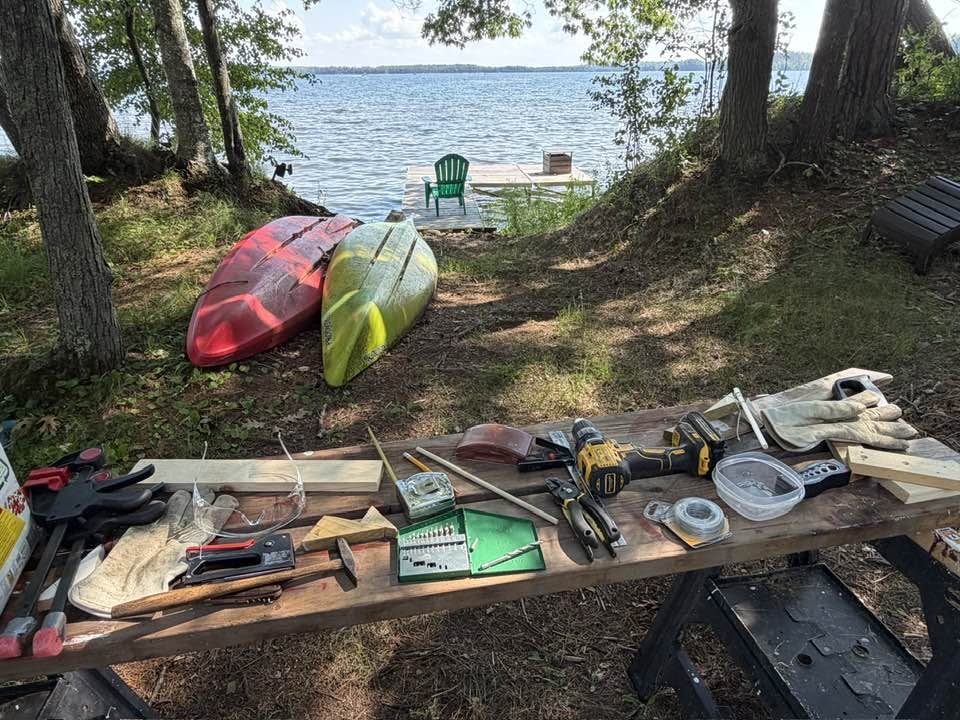
JULY 25, 2026 – It was an easy choice between reading beyond the morning headlines or reveling in nature’s magical majesty here in the lacustrine woodlands of northwestern Wisconsin. While Beth lounged in bed here at the Red Cabin, I stole downstairs, charged up the coffee apparatus, and fixed my usual breakfast. Soon I was out on the porch, taking fuller stock of the day’s atmospheric conditions—a slight breeze off the lake; temperature at 72.4F; lumpy overcast skies—adding a hint of non-threatening mystery to the unfolding day.
I spent much of it attending to my model sailboat project; specifically, cutting, carving and sanding small embellishments. It was painstaking work, much of it experimental as I refined techniques to conserve my limited supply of materials. I felt myself channeling my parents, now years gone.
Dad’s main activities at the cabin were (a) reading, (b) listening to recordings of the greatest artists of the 20th century performing timeless masterpieces of the 18th and 19th centuries, and (c) a wide array of “cabin projects,” from matters of pure maintenance to larger endeavors qualifying as “improvements” to grounds and cabin. Though he was certainly capable of whimsical undertakings that are at the center of my “cabin projects”, he drew great satisfaction from doing things that restored or advanced his concept of cabin “stewardship.”
Mother, meanwhile, was left to her own devices. While she still possessed the physical ability and confidence, she took herself out in the canoe, mainly along our shoreline. In her youth, she’d loved to sail with her cousins on the lower Connecticut River, and when she was able to crew on my sailboat on Grindstone Lake, she proved herself as an experienced yachtswoman. It was the one cabin activity that gave her unbridled joy. Her other pursuits at Björnholm were (a) reading, (b) listening to the music Dad listened to, (c) playing the piano, (d) painting, and (d) preparing meals. (Beth was scandalized one August Saturday at exactly noon, when Dad returned to the cabin from working in the woods and asked Mother, “It’s noon. Where’s lunch?” Mother, a tour de force in many pursuits—other than food preparation—complied out of habit and without (express) complaint or judgment, though she certainly had the right to engage in both.)
She appreciated the beauty of Björnholm—the environs found their way into her paintings, after all—but she never developed a sentimental attachment to the place. She saw it as one big ongoing chore. In her later years, she viewed it with tacit disdain, almost, and a ball and chain around Dad’s ankle. “It’s such a burden for Dad,” she’d say. What she didn’t understand was that for him, the cabin and all the work, tools and materials that were associated with it comprised his studio, his easel, his canvas, his paint set, his collection of brushes. A mundane plumbing problem that needed attention? In Dad’s mind it was an opportunity to solve a puzzle, and he never faced a puzzle, it seemed, that he couldn’t solve—to perfection. He transformed such tasks into an art form.
In any event, I thought about Dad and Mother today as I worked on miniature tillers, rudder posts and splashboards for my model sailboats. To be immersed in a such project reminded me of Dad; to be making sailboats reminded me of Mother.
My wood stock included nine leftover pinewood shims from a cabin construction project years ago. Being a saver (as any good DYI person is), I kept the shims and over three decades, transferred them from one box to another to another to a shelf back to a box then to an empty coffee can then back to the shelf and so on . . . until the start of the current project. The shims were of the exact graduated thickness that I wanted for embellishments to my sailboats. On a minor scale, perhaps, this convergence—need and saved pieces of wood—justified my hoarding instinct; let’s sand the sharp edges off that and call it, “saving tendency.”
The trick, however, was to cut very small pieces—some necessitating a thin-blade coping saw to make curves with the radius of a quarter—out of very thin wood. My initial technique was rather crude—as was the result. Limited experimentation led to a better result until . . . Snap! I busted the wood after 20 minutes of intense focus. Additional experimentation, however, brought improved outcomes to my dwindling stash of shims[1] to the point where I felt like Eli Whitney upon discovering the wonder of interchangeable parts—first for the cotton gin; later for muskets. My success wasn’t so much with interchangeable parts, but with interchangeable processes, from marking cutting lines to using a wood clamp to allow careful sawing without breaking the wood.
I doubt that the intended recipients of my sailboats will examine them closely enough to wonder aloud, now or in the future, “How, exactly did he make this?” (One of the recipients, for crying out loud (in actuality), is an infant; her brother is all of three. Only their 10-year-old cousin is currently capable of forming such a question.) They will see the sailboats as “things of the whole” and consider them as rustic symbols of the real thing; “impressionistic” works made by (quirky) Grandpaw while at the Red Cabin. (Specifically, while seated at the porch table and at other times, while standing at a makeshift “work bench” consisting of two six-foot cedar 2 x 6s resting on a couple of sawhorses.)
As I putter with these vessels, each a different color, each personalized with a “windswept” pennant flying from the top of the mast and bearing the owner’s name, I speculate how our grandchildren will see these little works as they—grandchildren and boats—sail through life. Will the boats wind up on a shelf, first in a bedroom at home, then away at school, in a “first” apartment, in a “starter home,” and so on? Or will each get swept into a box marked “Misc.” and consigned to a closet bin, then a basement shelf, eventually up to the attic, then, God forbid, into a dumpster?! Will one of the boats be anchored behind a bunch of tchotchkes between pantry and kitchen and forgotten by time until a snoopy visitor inspects the collection, espies the sailboat, picks it up, and asks, “Who made this?” . . . to which the grandchild, by then 42, will answer, “Oh, I wondered what’d happened to that! My grandpa made one of those for each of his grandchildren . . . Hey, I’m getting hungry, as I’m sure the rest of the household is too. Wanna stay for dinner? We can order Ethiopian and all watch holographic reruns of the comedy series, Final Days of the USA.”
At any rate, to avoid the scenario wherein the snoopy visitor poses the question—“Who made this?”—and my grandchild says, “I don’t know. I can’t remember where that came from. You want it?” I’m going to inscribe (in indelible ink) my name, presentation date and “To [Grandchild] with love.” on the bottom of each hull.
Okay. Now back to the “shipyard” to apply acrylic gesso to surfaces scheduled for tomorrow’s painting session.
Subscribe to this blog and received notifications of new posts by email.
© 2026 by Eric Nilsson
[1] Depending on how many more models I make to an expanded fleet, I’m preparing myself for the ironic eventuality of having to buy a couple of packages of new shims at the lumberyard. Any extras, of course, will be saved.
