NOVEMBER 1, 2026 – During today’s episode of “Project Hemlock,” I drove myself nearly nuts trying to conserve twine. Yes, ordinary, everyday, generic twine. To achieve a degree of efficiency, I’d stuffed a ball of what I call “straw string” in the right pouch of my carpenter’s apron, and pulled out and cut off a length each time I needed to tie together edges of deer netting around a hemlock. To prevent waste, each time I drew out a piece of twine, I’d keep it to the bare minimum. All too often, I misjudged, and the piece wound up being difficult to tie. Attempting to save twine, I wasted something far more valuable: time.
The crazy thing about my obsession with conserving twine is that I have no idea what it costs. That’s because for years we haven’t had any need to buy any: we have on hand more balls of twine than we’ll ever dream of using, even if we wasted three feet of our inventory for every foot we need.
As I assembled one “cage” after another—for a total of 26 today—surrounded by the calm beauty of our woods at the beginning of November, I contemplated my penchant for frugality. It’s related to an obsession with hoarding, which is related to some deep-seated psychological insecurity; like the habit of squirrels scurrying after acorns by the hundreds, only to store them in places the bird-feeder thieves can’t even remember. What’s the point—I’d ask a squirrel if I knew its language or the creature could understand mine—of “squirreling away” acorns you’re never going to eat?
On the other hand, in my case, maybe frugality—and hoarding—are simply learned behaviors, inculcated at such an early age and so routinely, that they’re fully integrated into my DNA.
My dad was the ultimate frugal hoarder, though he was so well organized, the hoarding never appeared to be out of control, and he was so attuned to quality and appropriately generous, the frugality never came off as “being cheap.” Moreover, Dad had a sense of humor about saving like a squirrel—or like a Småläning (a person from Småland, Sweden, the stony (and picturesque, though not from a farmer’s point of view) province to which the majority of Swedish-Americans can trace their roots). “Småläningar [plural of Småläning] are so frugal,” Dad would say, “they dilute their water.”
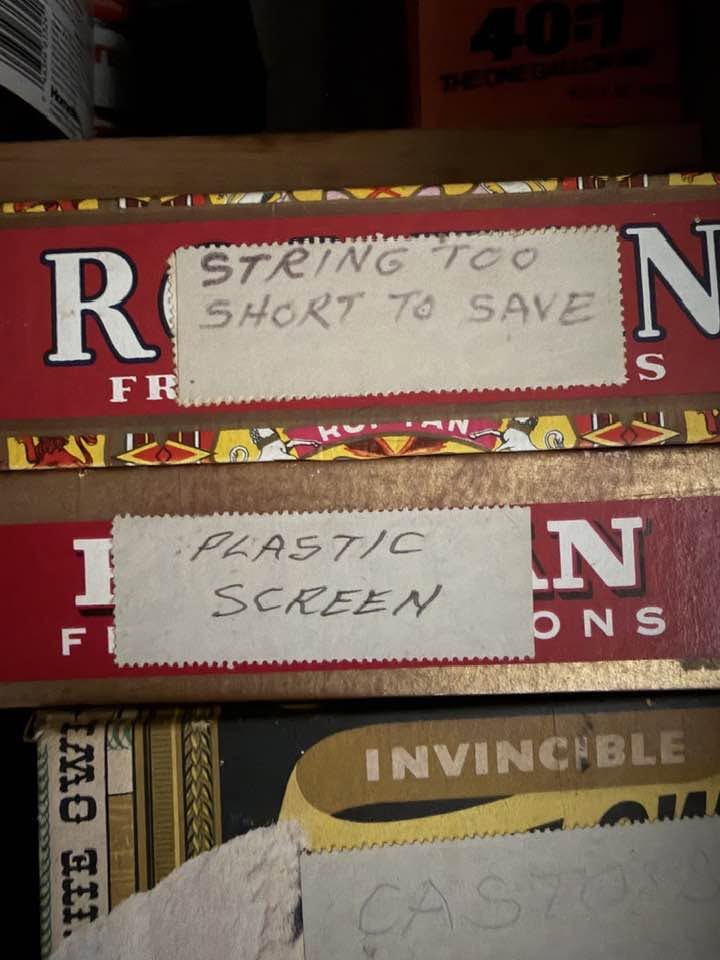
Today as I wrestled with pieces of twine too short to tie—but not too short to save (to the left pouch of my carpenter’s apron), I thought of another example of Dad’s sense of humor, this time exactly on point: one particular cigar box among the multiple stacks of them in the garage of the old cabin at Björnholm—boxes repurposed to hold miscellaneous pieces of odd hardware that might come in handy for numberless cabin projects. The cigar box pertinent here bears a label that reads, “STRING TOO SHORT TO SAVE.” Open the box and sure enough, inside are several strands of high-quality string, none more than three or four inches long.
Dad’s frugality was rooted in his abhorrence of waste. He hated it when any of us left lights on in a room that was no longer occupied. My mother was the worst offender, and I remember one evening after dusk when Dad and I returned to the house after walking the dog and every room of the big colonial house was illuminated—with Mother being the only person inside. “Gees,” he said, upon entering the house, “but do ya have ta have every light in the house turned on? From the street the house looks lit up like a Christmas tree.”
And when it came to food, waste was a special category of anathema. Dad never left a crumb, a pea or a grain of rice on his plate. Whenever we had pancakes or waffles, Dad exercised what I came to view as a sacred rite of the “Clean Plate Society.” After using the last bite to mop up as much of the syrup as he possibly could, Dad laid down his fork, picked up his plate and . . . yes, he licked the platter clean. As a young kid, I experienced a combination of shock and amusement. I’d never seen any other grown-up inside or outside our family do such a thing. As with every endeavor, Dad took a refined approach to licking his plate. He didn’t just lap up the syrup like a dog slurping up the dregs from its dish. No. Dad applied a method designed to work efficiently and thoroughly. After each lick, he’d eye the plate to ensure he wasn’t leaving anything unlicked. I thought of it as mowing the lawn and overlapping each pass so as not to leave any grass uncut.
Mother never commented on Dad licking the syrup off his plate. That right there tells you something about each of them. For her part, Mother was unflappable, like her father. Dad was exceedingly refined, like his mother, even when resorting to something as unrefined per se as licking the syrup off one’s plate. (For the record, however, his mother wouldn’t have been caught dead licking syrup from her plate.)
From his mother too, Dad acquired his frugality. After all, she was the original Småläning of our family. I know that when her (cotton) bedsheets wore out, she would sew together the remnants that still had some life left to them. And when Grandpa gave her grocery money, Dad told me, she never returned the change. She put it in the bank, because God only knew how Grandpa might decide to spend it.
As today wore on, I loosened up. I cast my frugality aside and felt the freedom of using longer pieces of twine and more of them. Why not? Why not make it easier on myself tying a million square knots? And in the process, why not make the hemlock cages impervious to browsing deer?
As earth’s rotation turned the horizon above the sun, I took my usual walk up and down the shoreline eskers to top off my daily quota of vertical feet. Atop “Blueberry Hill” I had a commanding view of the lake. Its calm waters reflected the beauty of this day and of memories prompted by . . . pieces of twine I’d made too short to use.
Subscribe to this blog and received notifications of new posts by email.
© 2026 by Eric Nilsson
