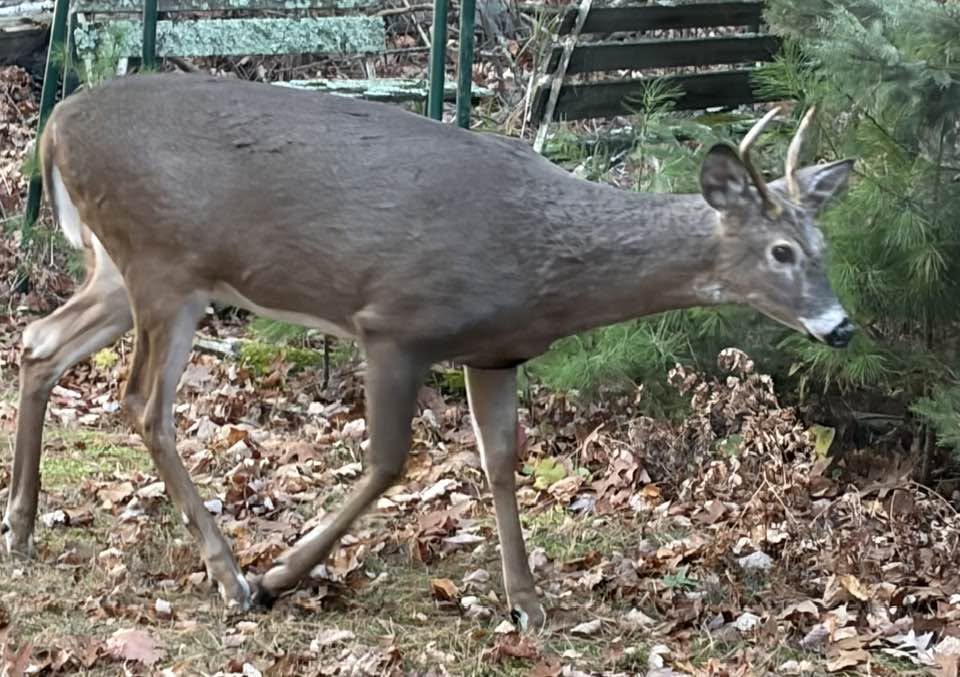
OCTOBER 31, 2026 – While most of the rest of the world went trick or treating or worried about what will happen next Tuesday (my wife, visiting our younger son’s young family in Connecticut, did both—trick or treating and worrying), I headed out of town to continue my “hemlock cage” project up in the tree garden. A primary challenge of the effort is that hemlock saplings imitate Bob Marley’s hair. In other words, hemlock foliage mimics the famous artist’s highly asymmetrical dreadlocks. Accordingly, designing, building and installing proper “cages” against the browsing deer tests the limits of human creativity, not to mention patience. Over the past week, I’ve devoted most of my daily walk time to working out a better “cage” design for the hemlocks that are in the intermediate size range of the 52 that I planted.
I finally settled on an experimental tripod design, consisting of five- and six-foot long sturdy plastic garden stakes with deer netting wrapped around them. This necessitated yet another stop at the Menard’s store in St. Croix Falls, Wisconsin, just over the border from Taylors Falls and right off the road on the way to Björnholm—and the tree garden.
I knew precisely what I needed and exactly where to go inside the big store. Surely I could be “outta there” in less than 10 minutes, I thought—after returning a roll of plastic snow fencing. Little had I banked on having a half-hour conversation with a retired anesthesiologist.
But first came my 15-minute conversation with what turned out to be a “Jesus man” in the interminable line at the returns and exchange counter. He looked as if he’d recently emerged from a modern version of a Dickensian novel. He was probably pushing 80 and had a shock of thick white hair. Except for his lower incisors, which looked as if they hadn’t seen a dentist in a couple of decades, he was a dead-ringer for Michelangelo’s depiction of God on the ceiling of the Sistine Chapel. Oh, and except for the guy’s garb: He wasn’t wearing a white robe—or body wrap. He wore tired baggy black trousers and an old dark blue blazer dusted with dandruff across the shoulders. His shoes, I noticed, were badly worn soft leather, perhaps black many years ago but now a scruffy gray.
When I joined him at the back of the queue, he murmured in a very soft voice that the line hadn’t moved for quite a while. He then told me the detailed story of the exterior light bulbs he was returning, the tale boiling down to “they were the wrong size.” When he asked me why I was returning the snow-fencing, I obliged him, and he surprised me just a tad when he said, “You might have better luck inviting deer hunters to solve your problem.”
At a later point, I noticed him checking his phone—the technology incongruous with his shabby attire. He then informed me that his wife was “hooked up” to an app that told him when her blood sugar was spiking, and that he’d just received such a notice.
When it was his turn at the counter, he gave the clerk the lengthy explanation behind his return of the light bulbs. Though I thought I’d been in a hurry, I decided he deserved to be given some slack. Who knows what his “story” was, but I guessed that he’d not had a particularly easy or lucky life. In any event, I was curious and would like to have learned what his worldview was and what influences had shaped it. After being handed a return receipt at the counter, he turned back toward me as I stepped forward. He smiled and said softly, “Have a good day.” It was then that I saw he was wearing a black necktie with white lettering on it. The top word was “Jesus.”
After returning the snow fencing, I hiked straight back to the garden center for my “cage” materials. As I was pulling out 15 six-foot stakes from the bin, another customer, pushing a cart, rounded the corner and stopped at the fencing shelves opposite the stake side of the aisle. He looked about my age, wore eyeglasses, jeans, a clean North Face sweatshirt and no cap or beard. In combination, these features distinguished him from 99% of the clientele of that particular Menard’s; a very rural Wisconsin crowd, where work clothes, a beard and a hunting cap or one sporting some version of an American flag or a combination of prey and flag—along with a pickup truck in the parking lot—are de rigueur.
“Let me guess,” I said to the man. “You’re building defense against the deer.”
“Yeah, in fact I am!” he said, as a smile flashed across his studious face.
Thus started a long conversation, first about methods of fending off deer, then sylviculture, conservation, bee-keeping, bald eagles, the supremely edifying experience of walking through woodlands, the state of the world, what a tough time a lot of young people are having finding work as they come out of college, the future of AI, and how AI will never be able to produce a live performance by a human being playing the Brahms violin concerto (for instance). It was a mutually delightful conversation, and I was naturally compelled to ask what his vocation was. “I’m retired,” he said, requiring me to ask the logical follow-up question, whereupon I learned he’d served as an anesthesiologist. He and his wife still live back in the cities but spend considerable time at their lake home on nearby Deer Lake.
An hour passed since I’d arrived at Menard’s. I had no regrets about my delayed departure, however. By the time I did reach my destination, the mercury had risen to a point that allowed me to work comfortably with bare hands. The tree garden was as still and quiet as I’ve ever experienced it. Though my tripod design was good in concept, I got hopelessly tangled up in the deer netting. Moreover, applying a rectangle (the netting) to a triangle (each side of the tripod set-up) presents geometric challenges. The first tripod took me well over an hour to construct. By lessons learned, I cut my time in half on the next tripod.
That was all I could reasonably accomplish before total darkness fell. Well short of my daily quota of “stair climbs,” I returned my tools and materials to the Red Cabin, then set out on a hike up and down the glacial eskers to the east end of Björnholm and back—all on the dark edge of dusk, but with enough ambient light remaining to make out any nocturnal wildlife, of which there was none . . . at least that I noticed.
Tomorrow I aim to make much faster progress. But I wonder . . . will my hemlocks survive? Will they flourish? Will they one day tower above the forest floor? Only the trees of the tree garden in their infinite wisdom know.
Subscribe to this blog and receive notifications of new posts by email.
© 2026 by Eric Nilsson
