JUNE 11, 2026 – (Cont.) After the service, one of our “sustainability” classmates, Ellen Shuman (see my 6/8 post), asked if I’d been “nervous” playing my violin up there at the front of the chapel nave crowded with heavy hearts and meditative minds.
“No,” I said. Which is not to say that in the months leading up to the service I hadn’t been anxious about all sorts of matters pertinent to my participation. Among these sources of anxiety—and my methods for resolution—were the following:
- Anxiety: The adequacy of my playing. After Jeffrey McCallum had suggested to Nancy Collins that she call me about providing some music for the service, I had no idea that after majoring in music (and religion) at Bowdoin, she’d proceeded to New England Conservatory (NEC) to pursue a masters in voice performance. This was very similar to the path followed by my oldest sister—a music major (violin) at Connecticut College, who then also pursued a masters degree at NEC—and as I can attest, my sister is no slouch. Nor are my other two sisters, who, emulating sister #1, pursued the conservatory route and became nationally recognized paragons of the violin (sister #3 eventually switching to viola). I’d always played in their shadows. Now, through no fault of my own, except to assent to Jeffrey McCallum’s suggestion, I found myself under the direction of an unofficial “sister #4.” Would my violin playing satisfy her standards and expectations? And if they didn’t, what then? How could I best facilitate Nancy’s “change of plans,” if things came to that, without creating a mess of things?
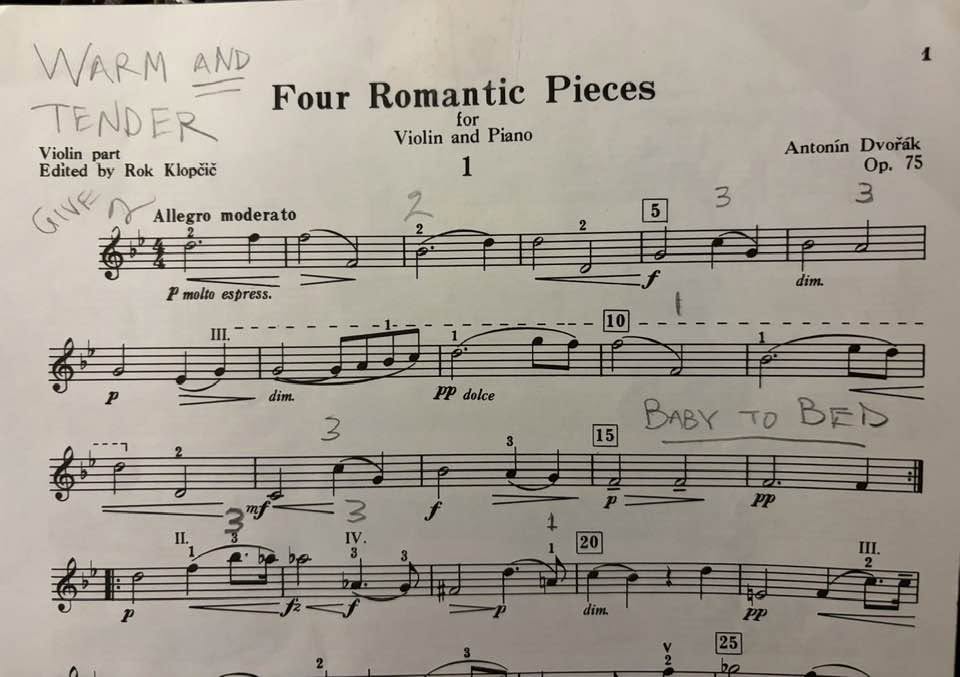
Resolution: Once I’d settled on a piece (I’d sent Nancy half a dozen suggestions, and she concurred with my first pick—a sweet piece by the quintessentially Czech composer Antonín Dvořák), I imposed on my long-time piano collaborator at home, Sally S. We’d performed the piece on one of our decade-long winter house concert series, “Fiddler Under the Roof,” so for both of us it was “old hat.” I asked if she could help me bring the piece back to life. She agreed. We dusted it off, but my initial run was less than stellar. Sally managed to increase my anxiety and simultaneously provide encouragement when she said, “You know, I’ve heard you play this with much more feeling than you just did.” Things worsened when after round two, she said, “Okay, you know—this phrase that fades softly at the double bar? You can do so much better there—I mean, just pretend you’re putting the baby to bed.”
“‘Putting the baby to bed’? Sally—What great imagery!”
“Only if it works,” she said. “Okay, let’s try it again. Remember, all you have to do is make this music warm and tender. Really, that’s all. And I know you can.”
I grabbed a pencil out of my case, and over the fading phrase she’d called out, I wrote, “BABY TO BED,” and at the top of the piece I wrote, “WARM AND TENDER.”
I then “lit the candle” by channeling the sum of my musical influencers, and we were soon off to the races. Sally gave both the choice of music and my interpretation of it her credible stamp of approval. I’d “put the baby to bed.”
- Anxiety: My Pianist Collaborator. My role in the service would require a pianist-collaborator, and unfortunately, Sally S. wasn’t a Bowdoin alumna. Besides her son had graduated from Bates College 15 years ago, and she no longer had any ties to Maine, 1,200 miles from home. Alternatively, Nancy said she knew “just the person”—our classmate Lisa Schneider. But though I could vaguely remember her, I had no idea Lisa played piano or how well. When Nancy assured me, “Extremely And she was a music major at Bowdoin” my initial question about Lisa’s suitability shifted back to anxiety over my own qualifications: What if Lisa thought I wasn’t up to the task?
Resolution: Through the exchange of several email, Lisa presented herself as a thoughtful person whose boat maintained an even keel. What came across were musical and personality profiles much like Sally’s—smart, sensible, understanding, and accommodating. But the most miraculous aspect of our collaboration was how well Lisa would dove-tail her playing with mine. Over a decade (2010 through 2019), Sally and I had played close to 30 recitals together. For every minute of performance time, it seemed we’d logged an hour of rehearsal effort. Consequently, Sally knew my strengths and weaknesses, my quirks and departures from script, as well as anyone in my musical life. It would be impossible to replicate that level of collaboration with Lisa. Yet, at our first run-through reunion weekend, Lisa sat down at the keyboard (of an unfamiliar “monster” Steinway), and in no time flat and as sharp as a tack, she channeled Sally, though the two had never met! Within a few practice runs we were sailing on a broad reach in a perfect breeze, riding the laughing crests of friendly waves. I felt as though Olympus had sent one of its favorites to ferry Dvorak himself back from Hades. How much luckier could we possibly be?
I should add that the Dvorak was the perfect piece for the service. It contained multiple pleasant modulations between minor and major keys—the “sad” and “happy” modes, respectively, in Western music. In simple lyrical fashion it mimicked the “clouds” and the “sunshine” of life—in metaphorical perfection for a service of remembrance and celebration of lives no longer with us.
(Cont.)
Subscribe to this blog and received notifications of new posts by email.
© 2026 by Eric Nilsson
