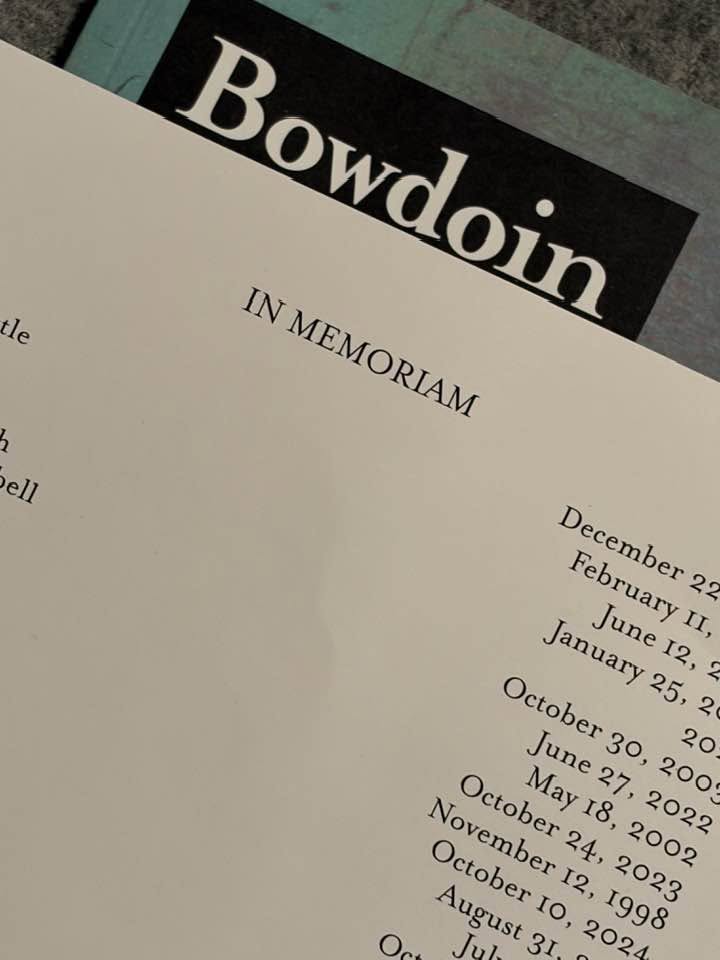
JUNE 10, 2026 – (Cont.) I trust that readers who’ve stayed aboard the good ship Reunion for this extended cruise will leave the flares where they’re stowed and indulge me further—through this pre-penultimate “Reunion” post and the concluding two posts, as I describe the full “denouement” of my 50th college class reunion. The Remembrance and Celebration of Lives was a capstone event for me, not only regarding the reunion but my life more broadly. By itself, my participation—three minutes on the violin—was brief and insignificant by objective measure. In integration with the service as a whole, however, those three minutes will live forever in my soul.
With less than a fortnight to reflect on the service, I’m still uncovering its deeper meaning. Each stratum of consideration leads inexorably to yet another layer. I’m beginning to feel like Heinrich Schliemann in his quest to find the bottom of Troy: “What treasures does Ilion have yet to yield?” he surely wondered as he troweled (or shoveled) his way to the seventh level. I likewise ponder the effect of that service.
Outside of my own three-minute piece, the hour-long-or-so ceremony comprised the music, prose and poetry—succor and wisdom—of fellow classmates (in order of appearance):
The Rev’d Carla Valentine Pryne, now retired but hardly retiring, who, following Yale Divinity School, became an Episcopal priest and eventually pursued a ministry in which Mother Earth as much as Father Time assumed center stage, and whose eminently ecumenical approach to the service gave us all a sense of inclusion;
Jerry Bryant, a life-long über-hiker of New England persuasion and likewise “forever” prolific musician on multiple instruments, churning out an enormous repertoire of songs from sea chanteys to the piece he performed at the service in joinder with his graying classmates (thanks to lyrics printed in appropriately sized font on the back of the program)—“Forever Young”;
Deborah Boe, ob., among the deceased but whose published poetry lives—including, “The Edict,” which was read by her partner from the Bowdoin Class of ’74;
Deacon Hank Bristol, a former Bowdoin wrestler and sailor, then a student of architecture in Italy, next a middle school teacher, now an Episcopal deacon who paints and sails and at the service, drew for us imagery in beautiful prose inspired by poetry—Alfred Lord Tennyson’s work, “Crossing the Bar”;
Lisa Schneider, supremely gifted, not only at the piano (on which she performed Brahms’ Intermezzo Opus 118, No. 2), but at making the world a better place in multitudinous ways (more about Lisa in tomorrow’s post);
Presbyterian Pastor Stew Pattison, now retired, who also attended Yale Divinity School, and whose career-long focus was Christian spirituality—with side gigs in choir and conservation—and who, from the well of remembrance of the 47, brought tears to his words and to our eyes;
Bill Owen, who, as organist par excellence, opened and closed the service—another “Yalebird” after Bowdoin but of the Yale School of Music, not Divinity, retired from a distinguished career, yet without any decline in his all-stops-pulled performance chops and no retreat from his extensive life-long conservation efforts in his home state of Virginia.
Then there were the voices of the necrology: Bill Clark, Tom Little, Chris Freme, Jeff Oppenheim, Marjorie Turner and Dave Sherman . . . and following them . . .
. . . my three-minute musical stint with Lisa Schneider’s wonderfully essential collaboration.
I acknowledge that most people have no more interest in the “background” noise preceding a musical performance than they have in the pre-game stretching routines of their hometown football team. This lack of interest in the “backstage story” applies most certainly to a musical performance within a memorial service, where music might be the center of peace but rarely the centerpiece—unless we’re talking a requiem à la Brahms or a choral passion à la Bach, which we’re definitely not. I mean, you sit in the appointed venue, you glance (again) at the program, waiting either for the service to get underway or for it to move along more quickly once it has gotten underway, and you see [MUSICAL PIECE] to be performed by [SOLOIST]. The details behind the piece and the soloist are of little interest; only the sound generated by the latter in a rendering of the former merits your attention—depending on the quality of the sound.
But in the case at hand—the Remembrance and Celebration of Lives at our 50th college class reunion—aspects of the back story, if not the backstage, deserve attention, I trust, in the interest of stirring, then satiating, the reader’s curiosity and appetite for amusement, if not edification. But patience, my dear readers! You must hold on—and return to this site tomorrow—for the lowdown on the highlights of that “back story.” (Cont.)
Subscribe to this blog and received notifications of new posts by email.
© 2026 by Eric Nilsson
