JUNE 12, 2026 –
(Cont.)
- Anxiety: My Violin – Part I. Back in January I noticed an imperfection in my A string[1]. Often this is a sign the fine-wire binding around the string is about to unravel. When this occurs, nothing can be done except to replace the string. Easy enough, except . . . it’s a pain. For the first couple of practice sessions thereafter, the string needs to be re-tuned constantly until it’s adequately stretched. It’s never convenient, but it’s especially not if replacement occurs just before a performance—unless the performer and the audience are tone deaf. Upon a microscopic inspection of the defect, however, I concluded that the wire binding was not coming undone. The defect—a tiny dent in the string—didn’t appear to be worsening nor did it interfere with my playing. I decided it was more of a benign aberration than a fatal flaw. As a card-carrying member of the “Don’t Fix What’s Not Broken Association – Inertia Division,” I let the string be—through the rest of winter and into spring. As our departure date for the reunion approached, however, I realized that my membership in “DFWNBA – ID” could jeopardize my performance: what if the string gave way the day before or worst of all cases, the day of the service?
Resolution: I worked out a strategic compromise with myself: (a) I made sure a backup A string was in my case, since in an emergency an unstretched backup would be better than a none; and (b) I crossed my fingers—at least when I wasn’t practicing.
- Anxiety: My Violin – Part II. Early in the morning on Day-One of the reunion, a Yellow Cab appeared at our house for the ride to the airport. After our luggage was stowed in the back of the brand new hatchback vehicle, I placed my violin case on top and made sure it was secure for the 20-minute drive. When we pulled up to the departure level, the driver popped open the liftgate, then hopped out. As he did, I heard the sound that no violinist ever wants to hear: the violinist’s own case falling with a resounding “thud” onto unforgiving concrete contemptuous of all things fragile. The second word to enter my thoughts was “insurance.” The first, was “reunion.” Our flight to Logan departed in less than two hours. What if the violin was now in shambles?
Resolution: First, I grabbed my case off the pavement, as if alacrity would retroactively reduce the force of impact. Second, I took a deep breath. Third, when the cab driver apologized, genuinely, I thanked him but added that whatever damage was done was done. Fourth, inside the terminal I found a suitable place to open the case, remove the covers and inspect the instrument. Remarkably, the “Italian model,” as I affectionately refer to my violin, had sustained no visible damage. Moreover, the bridge remained straight and secure. Better yet, the sound post (inside the instrument) appeared to be in position, undisturbed. Most amazingly, the pegs even hadn’t moved. The strings remained in tune. The “Italian Model,” isn’t merely beautiful; she’s one tough woman. And me? I’m. One. Lucky. Consort.
- Anxiety: Weather Conditions and Reynaud’s Syndrome: I’m plagued by Reynaud’s Syndrome, a fairly common nerve “situation” that weirdly strikes when the ambient outdoor temperature is between 30F and around 55F. (It doesn’t occur when I’m skiing, even in extreme conditions.) Temps forecast for reunion weekend—most particularly Saturday, the day of the service—fell within that range. When Reynaud’s hits, my fingers go snow white, with diminished feeling; not good for playing the violin. The only antidote is to sink my hands into a bowl of very hot water for 5 to 10 minutes. What if I should experience an attack during the service?
Resolution: I packed plenty of activated-charcoal hand warmers into my violin case. During the service, I wore (black dress) gloves to ward off Reynaud’s. I kept them on until just before I played—but periodically removed them briefly to prevent my hands from sweating, another condition to be avoided.
********
When the long-anticipated time of my effort arrived, I removed my gloves and stepped forward. Whatever “performance anxiety” I might’ve felt in previous engagements was wholly absent. In its place was a divine calm of the sort I’d never experienced. Compressed into this calm were thoughts and emotions suffused with the collective soul of everyone present. Despite my failings as a member of the species, I occupied time and space favored by the divine. However short I’d fallen of aspirations and expectations, here, now, in harmony with the gift of Lisa’s talent and mindfulness at the piano, I had the fleeting ability, capacity, and opportunity to “express the inexpressible.”[2]
For three minutes I lived suspended in the zen of nirvana.
As the last note faded into oblivion, the silence that followed—in lieu of applause—was an added touch of divinity. Bells then tolled, once for each of the deceased. The unintended departure from perfect execution echoed the frequent dissonance between the ideal and the reality in life—the imperfection that proves a beautiful floral arrangement is real, not synthetic.
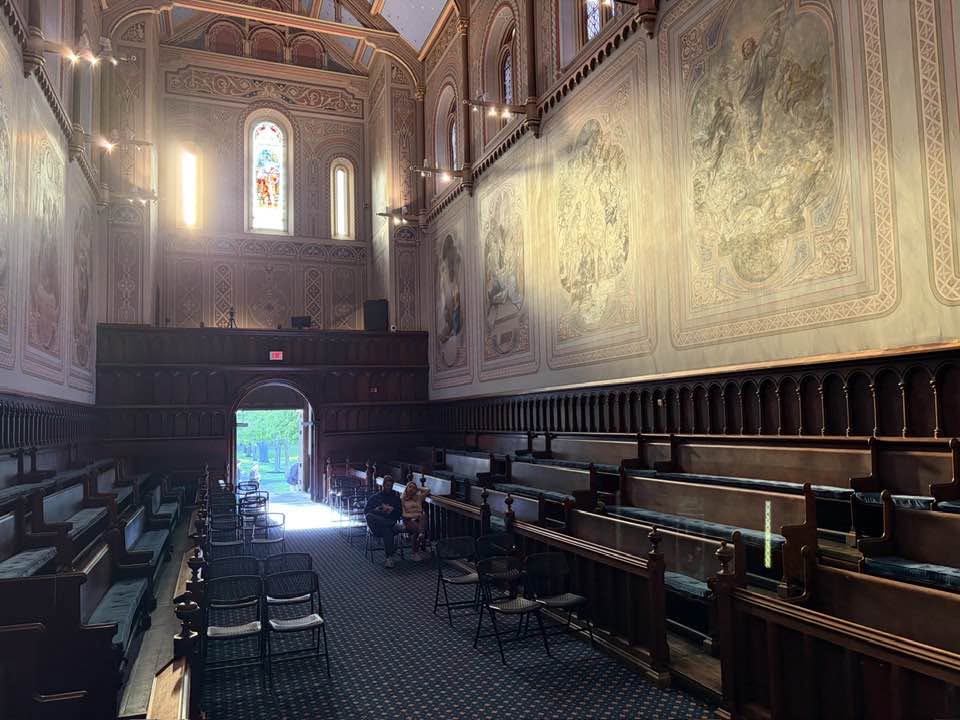
But in the final frame of our reunion’s denouement was a scene that will never fade, even when the last remnants of my memory are absorbed by eternity. From where I sat at the raised front of the nave, I had a direct view of the entrance at the other end of the chapel. As the end of the postlude drifted above us, reunion “ambassadors” opened the stalwart wooden doors. In washed bright sunshine after a mostly cloudy day. Right outside I could see fresh spring foliage, so full of hope, stirring gently in the breeze. It was a gorgeous sight—one I wished to capture on canvas with a brush and paints. But I jettisoned that fantasy as swiftly as it had appeared. The fleeting image was beyond tangible capture. It was a moment . . . to be folded into the grand mix of all the other moments of the reunion, to be experienced in the never ending yet always elusive . . . present.
THE END OF ONE THING BEGETS THE START OF ANOTHER
Subscribe to this blog and received notifications of new posts by email.
© 2026 by Eric Nilsson
[1] A violin has four strings—G (below middle C) at the bottom of the instrument’s register, then D, A, and E above (in pitch, each a perfect fifth from its neighbors). The fingerboard has no frets, so each fingered note (other than the “open” strings) is up for grabs, which is why intonation on a violin (and viola, cello and bass) is so problematic.
[2]One aspect of every performance (that goes well, anyway) for me is the redemptive aspect of the experience. To understand this, the reader must be apprised of an incident that occurred when I was about nine years old. My father and I were home alone on a weeknight. I don’t know where my mother and sisters were—it doesn’t matter; what does matter is that what unfolded most likely wouldn’t have occurred had the rest of the family been at home. After they’d left. Dad told me to practice my violin for “a solid half hour” up in my bedroom. He then settled into the living room to read the evening newspaper. I went upstairs to my bedroom but refused to practice. Soon Dad appeared. Harsh words were exchanged, among them being “I hate the violin and don’t want to practice.” More words were exchanged. Dad exited the room, closed the door none too quietly behind him, and descended the staircase. A few minutes later I heard strange sounds emanating from downstairs. It sounded like a wounded animal, stoic but in pain. I quietly opened my bedroom door. The sound continued. I crept silently down the top half of the stairway to a point where I could see over the banister and into the living room. Seated there on the sofa, his elbows on his knees, his face in his hands, was Dad—sobbing. I’d never seen him cry before. Never. But I knew: He was sobbing over my refusal to play the violin. No one I’ve ever known—including scores of music lovers—loved classical music more than Dad. And no one beyond Dad wanted more for me to play the violin; not even his dad, my grandpa, who’d started my sisters and me on the violin and was forever lecturing me about how one day I’d be glad I played the violin. I’d hurt Dad terribly. Fortunately, we both lived long enough for my musical redemption.

2 Comments
Eric, I’ve just caught up on all your latest reunion blogs. You are a wonderful writer ~ what a wise, humorous, thought provoking chronicle you’ve provided us. I appreciate your kind words re our musical collaboration. It was an honor to play with you, and I’m delighted that together we could meet the moment for our dear classmates, present and departed. Thanks for all ~ Lisa
Lisa, for me, our collaboration was definitely a highlight of the reunion. And bonus territory was meeting Philo and visiting with him–albeit via “truncated” conversations. — Eric