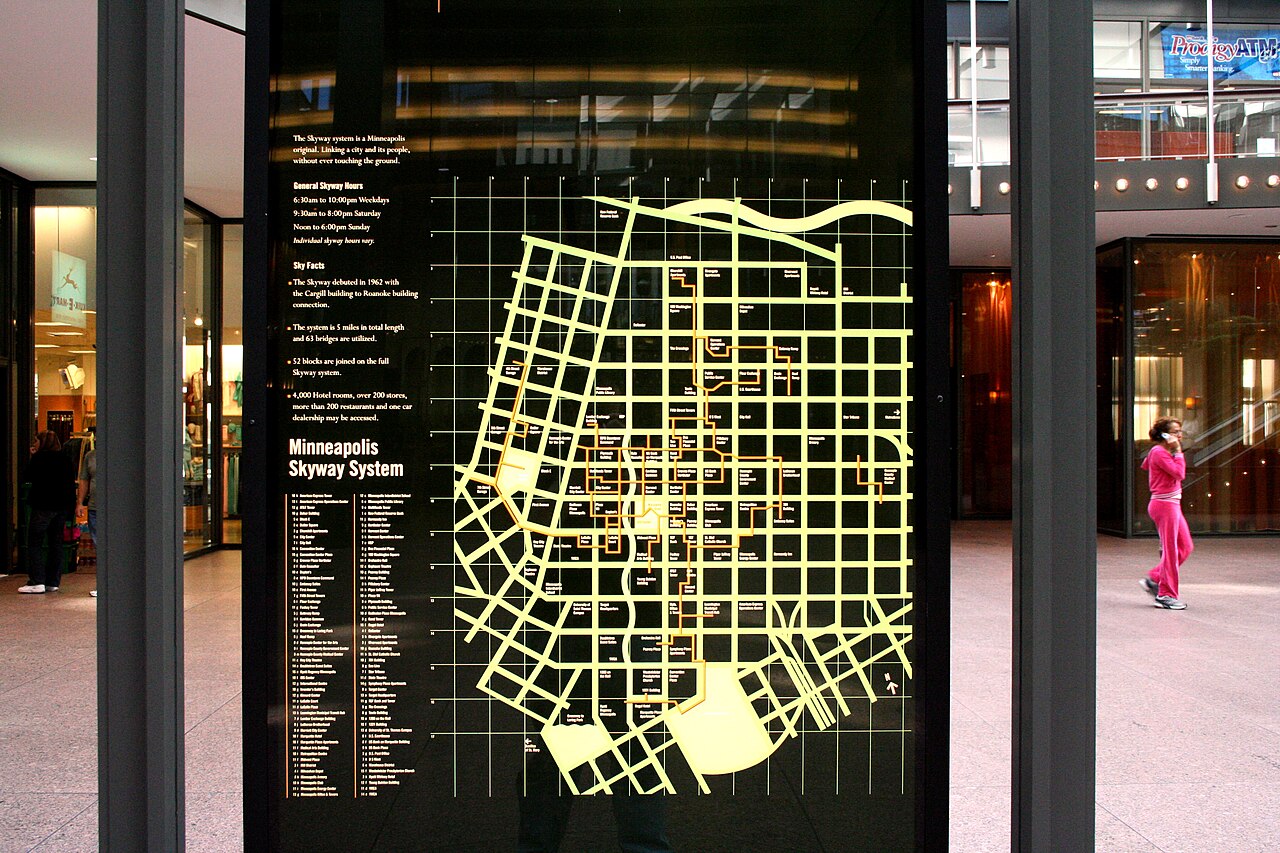
SEPTEMBER 25, 2026 – (Cont.) For out-of-towners visitors, the skyways throughout downtown Minneapolis (and St. Paul, though St. Paul is a hollowed-out remnant of its more vibrant condition a generation or more ago) are an unusual and interesting feature. These second-floor walkways over downtown streets connect 150 buildings on nearly 80 blocks and are over nine miles in total distance. An entire city within a city exists along the many tentacles of the skyway system.
In inclement weather the skyways allow pedestrians to walk throughout the entire downtown without having to rely on sartorial defenses against rain, snow, heat and cold. This system served us well yesterday as I led Jim on a long tour of Minneapolis while the sidewalks outside and below us glistened from intermittent showers. On such days back in the day, I’d join thousands of other downtown office workers rushing hither and thither through the skyways on the way to and from work and in search of a quick lunch at midday. But until yesterday, I hadn’t walked these elevated pedestrian biways since March 11, 2020, the last day before the Covid-19 shutdown.
Thus, for me, yesterday’s tour was a trip down déjà vu lane. Some of the old restaurants, I noticed, had survived the pandemic; others had vanished. Some office and retail areas were still occupied. In other buildings, those areas, once thriving, were now vacant with large “Available” signs parked conspicuously in the center of hollow space. Since we were hiking around well after lunchtime but before people were heading home, most eating establishments were closed and the skyways were free of traffic. Of the people we did see, only one did I know—a banker/friend whom I hadn’t seen and with whom I hadn’t communicated in over six years. The happenstance encounter was brief but delightful. The only other people I recognized were a couple of very tired old lawyers with whom I wasn’t personally familiar; neither acknowledged me in my jeans, casual jacket and “Paris – est. 1889” baseball cap, walking with my good friend Jim—a fellow member of the bar but retired and being a man from Maine; quite the stranger to Minnesota. The one other person I recognized was a member of the staff at the Hennepin County Law Library—a tall, shy, bookish sort, who used to ride my bus and alight and disembark in historic St. Anthony Park, the “village of professors” near the University of Minnesota – St. Paul Campus. I’d never actually met the guy, but he awarded me a faint smile of acknowledgment as we passed in the skyway.
As Jim and I hiked around, I provided a running narrative of one thing and another about my 30-year “career” in downtown Minneapolis. The recollections felt like passages from a book about someone else’s life; someone other than my present self—tales of an adventurer of sorts in the legal and business worlds of a time long gone. Thus, my reminiscences didn’t trigger sentimentality as much as they served as a reminder that I’d grown . . . old. I’m now indistinguishable from the “grandfathers” of my former firms, who’d retired from the frenetically active practice of law and then as “of counsel,” appeared only occasionally and shuffled when they did—papers as well as footsteps. But, I told myself, they still wore suits; I, on the other hand, am wearing jeans and a “Paris – est. 1889” baseball cap—at an unintentionally “rakish” angle, as I later discovered in my reflection on the glass of “Available” space along the skyway.
Though fully retired, my good college friend/classmate Jim displayed his usual spirit and curiosity. He was “sold” on the city.
We then proceeded to the city’s underbelly—the Good and Pretti Memorials and George Floyd Square. By disposition and experience, Jim is a Democrat. When I asked him if it’s possible for a consumer bankruptcy lawyer (his specialty) to be anything but a Democrat, he laughed and affirmed: “Definitely naht.” He was thus much interested in making the pilgrimages to the sites that “put Minneapolis on the map” for all the wrong reasons. Our stops reminded me not only of the tragic circumstances that precipitated the Good, Pretti and Floyd killings but the systemic failings of our society that had given rise to those conditions in the first place.
At George Floyd Square our encounter with Monsieur Marquise Bowie (see yesterday’s post), the self-designated “tourist interpreter,” I revisited my long-standing frustration with the issue of “police brutality.” Whether from the perspective of the abused or the abusers, the reactions were focused predominantly on the tip of the spear of “racism” in all its definitions and perceptions, with little to no attention to the shaft behind the spearhead; to the issues of affordable and accessible housing, education and medical care; to addressing the growing disparities of wealth, income and thus, of opportunity in this country; to understanding the historical, cultural and economic factors that led to those disparities in the first place; to developing, debating, deciding, then implementing policies with half a chance of creating break-throughs. But such a process requires hard work, persistence and commitment of resources that extend far beyond one or two election cycles. For such an effort to gain support and momentum, it must begin with acknowledgment of the past; of a long and cumulative trail of sordid facts.
After dinner at the Union Depot Place in downtown St. Paul, we returned home, where I finished building a model sailboat for Jim—this one boasting black and white stripes on both the mainsail and the jib, black and white being the “colors” of our alma mater. We both decided that that combination worked splendidly for the little vessel (the hull being white; splashboard, tiller and outside edge of the gunwales being black). As an extra feature, I glued a small version of “Bowdoin” onto each side of the mainsail—versions I’d cut out from recent fund-raising materials from the college development office. Jim’s delight gave me great delight, given how much I enjoy crafting these make-believe boats. Back in Saco Bay on the coast of Maine, Jim sails his own real boat—a 26-foot keel boat with splendid accommodations below deck.
This morning after a quick excursion throughout nearby Como Park, I drove Jim to the airport. In keeping with the spirit of our entire visit, we found lots to laugh about in our endless exchange of stories. But as much as Jim can laugh and make me laugh, he’s the living example of the value of a liberal arts education: a half century after that cloistered four-year experience, his curiosity and constant effort to gain a better understanding of the world are as intense as ever. With an abiding interest in politics and world history, Jim is an inspiration in learning. Moreover, though, he’s a person with heart, soul and character.
I like to think that if we should shun the charge of guilt by association with ne’er-do-wells, we might claim some credit by way of friendship with people of exemplary attributes. In the latter instance, I am blessed with an abundance of credits by way of my friendships among the Bowdoin Class of ’76; friendships such as I enjoy with Jim Molleur of Maine.
Subscribe to this blog and received notifications of new posts by email.
© 2026 by Eric Nilsson
