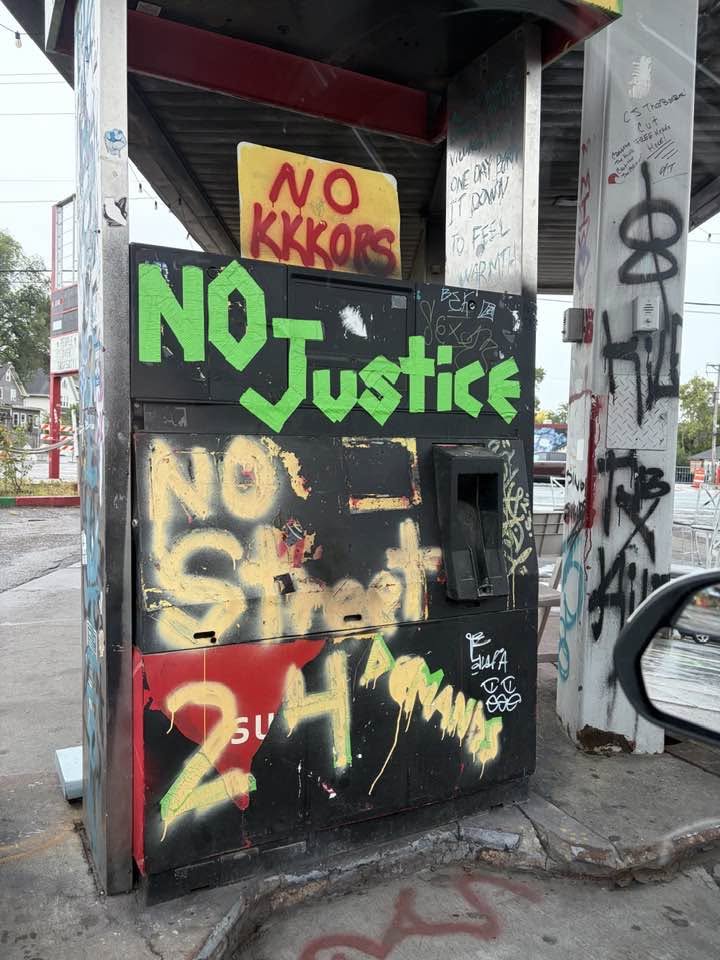
SEPTEMBER 24, 2026 – (Cont.) This morning Jim and I left the Red Cabin and headed back to the Twin Cities for a whirlwind tour of a few highlights. Jim’s wife (not with us) had requested that he visit and photograph three sites: 1. The Mary Tyler Moore statue on Nicollet Mall; 2. The Renee Good Memorial; and 3. The Alex Pretti Memorial. To these three, I suggested a fourth: George Floyd Square. We saw a lot more than these four designated landmarks—namely, much of downtown Minneapolis via the sprawling skyway system; a “fly-by” tour of the University of Minnesota main campus; a drive past the University of St. Thomas campus in St. Paul and up Summit Avenue past all the old fancy homes to the St. Paul Cathedral and the capitol, down into downtown St. Paul for a quick tour of the Union Depot and dinner at the 1881 Eating House in the original main waiting room, then a drive home through Como Park.
This itinerary made our heads spin. The memorials were gut-wrenching reminders of the horrors committed by ICE last winter. As I surveyed all the mementoes and tributes, I felt a surge of sadness. Both deaths were wholly unnecessary; the tragic result of out-of-control agents directed by irresponsible leaders.
It was at George Floyd Square, however, where we were confronted by the harsh realities of the marginalized among us. The location of the man’s murder is a raw reminder of the disruption caused by his murder; a giant hole in the heart and soul of Minneapolis.
Under gloomy skies and a persistent drizzle, we pulled into the pump area of an abandoned gas station; three other cars were parked there, and a few Black men were standing around. We called out to one, who approached our car. Soon we were engaged in a rewarding conversation with one Marquise Bowie, who turned out to be a prominent community activist; an ex-con who turned his life around and now serves as the “tourist interpreter” of George Floyd Square. For the next 20 minutes we found ourselves face-to-face with an articulate voice of the “zone,” striving to educate and elevate people like us who appear at the site of what he insists was not the arrest of a man who’d violated the law, but a personal vendetta by a cop against an acquaintance—both the cop (Chauvin) and his victim had known each other; had served together as security guards. The cop had had it out for Floyd, and when the chance arose to put a knee on Floyd’s neck, the cop seized the opportunity. The brutal murder set off a series of violent reactions, starkly memorable to all Twin Citians.
At first Bowie was somewhat confrontational—“Why are you visiting this site?” he asked. “What’s so special about this site?” His point was that injustice of the sort that was visited upon George Floyd—as well as on Renee Good, he said, and Alex Petti—happens to people across the marginalized part of our community, and we should be as focused on caring for those people as much as we do on victims such as Good, Petti and Floyd. The more we talked, however, his attitude toward us softened. I wound up buying his book, The Last Drop of Maddog 30/30, an account of his tumultuous life. His bottom line was this: the system we think the current regime and its enablers/enthusiasts have abused “is working exactly as it was originally intended,” meaning the system that’s now under attack has been the machine of oppression for the past 400 years. (Cont.)
Subscribe to this blog and received notifications of new posts by email.
© 2026 by Eric Nilsson
