SEPTEMBER 26, 2026 – While Beth is with cousins touring the Maritime Provinces, I’ve been left to my own devices back here on the mother ship. My principal assignment is to keep the place ship-shape—no dirty dishes abandoned in the sink or on the counter; shoes off at points of ingress and egress; take-out Chinese containers disposed of properly and in a timely fashion; packages removed from the front step; junk mail collected, sorted and distributed appropriately; house door to the back porch closed and locked each night before bedtime; et cetera. But my reward for maintaining our primary abode, which I pretend is a very large yacht permanently moored at a saltwater marina, is the opportunity to solo-grandparent our fifth grader granddaughter.
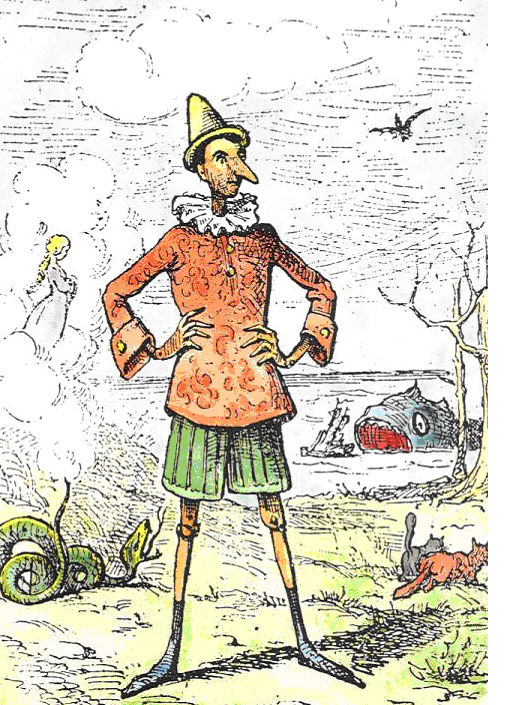
Yesterday I took full advantage of a perfect alignment of the stars: our granddaughter’s availability and her acceptance of my invitation to a sushi dinner (her favorite food at her favorite place), followed by a production of Pinocchio at Children’s Theater in Minneapolis.
We had a blast.
Illiana has advanced to a new phase of learning and conversation. Hitherto she’s been delightful company: creative, engaging, observant and articulate ahead of her young years. Now having completed her third week of fifth grade, however, she’s leaped to a new level of intellectual and emotional maturity. As I told her over sushi, I now view her not as a kid but as a much older person.
“How old?” she asked.
“Oh, I’d say, someone in their late 30s.”
“Thirties!” she said, with incredulity. “What makes you say that?”
“Your observations about life and people. You have an extremely high E.Q. You have a take on things that is way beyond your years, and you always say something to ponder long after you say good-bye . . . plus,” I added, “your vocabulary is well beyond what mine was at a much older age.”
But I’m getting ahead of the story. Part of the “grandpa time with Illiana” package involved my picking her up from school. This is always a joy, because the 10-minute drive from school to our house is filled invariably with conversation—the highlights of her school day, how her cats are doing and a summary of her latest work on an ongoing adventure story (with a thousand characters it seems) that she wants to convert into a Netflix series. (The title is very clever, but in the interest of protecting Illiana’s intellectual property, I’m withholding disclosure for now.) She also mentioned her observation that some people don’t know how to accept other people’s opinions. “Some people think they’re totally right about something,” she said, “when in fact it’s just an opinion.” Also, she said rather ominously that she had the feeling that something bad was going to happen in the world but—critically—she thought that we would “get through it, and once we do, we’ll be much better off.” When I probed her thoughts on this, I learned that she was concerned about the upcoming mid-term elections and what might happen. Her long-term optimism, however, gave me hope.
Because we had some time to kill before heading to dinner, we hung out in the sitting room; sending texts to Beth and chatting with Illiana’s Uncle Byron in CT on his way home from work. Just before Byron’s call, Illiana had spontaneously recited a poem she’d made up.
Immediately following the call, she returned to poetry, saying, “I think I’m entering a poetry phase.” Since I had easy access to my laptop, on impulse I queried randomly, “Wordsworth.” After giving Illiana the poet’s biographical sketch on the Poetry Foundation’s site, I pulled up, “I Wandered as a Lonely Cloud.” We recited it together. Next up was Joyce Kilmer’s “Trees”—no surprise to Illiana, since she’s well acquainted with my arboreal interest. This time I read it solo while she listened.
At 5:00 we departed for downtown Minneapolis.
Having been to Sushi Train many times before, Illiana knew the drill: ordering from the cheerful waitperson, miso soup and strawberry-flavored ramune (a Japanese beverage served in a small glass bottle, the opening of which is a learned skill), then lifting a plate of salmon and a plate of raw tuna sushi off the conveyor belt that chugs past the many customer booths in the establishment. This time, however, to my surprise she also chose a plate of tobiko gunkan maki—maki topped with fish roe. To this point, Illiana—in the manner of many young people—hasn’t been venturesome in trying new foods. She’d never had tobiko gunkan maki before, but here now she was ready to give it a try and most significantly, completely on her own volition. Though she didn’t express special enthusiasm for it, she did eat the entire generous serving and announced that it was “Okay.” For dessert we selected the usual macarons. Illiana ate the strawberry one; I took the pistachio and told her she could have the vanilla. We were wholly satisfied with our repast and thankfully, not stuffed.
In keeping with our Sushi Train ritual, before departing the place, Illiana took a few minutes to draw a couple of her signature characters on the wall-to-wall, floor-to-ceiling chalkboard that customers routinely fill with colorful artwork. We were then off to the theater.
Thirty-some years before, I told Illiana, Grandma and I had taken Illiana’s dad to a production of Pinocchio—a more traditional one than the version we were about to experience. It had been too scary for him, forcing us to remove ourselves to the “crying room” at the back of the theater. I then described the Disney version of Pinocchio that was re-released in 1962—when I was in third grade. When that film came to Anoka, I remember, the initial screening (on a Saturday afternoon) drew a crowd that lined the sidewalk all the way down to the end of the theater block, past the armory and around the corner. We had to return for a subsequent screening.
“It was one of my favorite movies,” I said to Illiana. To my shock and dismay, she responded by telling me she didn’t know anything about Pinocchio. “What?” I said, incredulous. “How can that be? I think you’ve been deprived!”
Yet, upon saying this, I realized that my own grasp of Pinocchio was rather light, based on the highly abridged version in a Golden Book I’d read a few times to Illiana’s father and uncle and what little I could remember from the Disney film version I’d seen back when dinosaurs roamed the earth. After fumbling around a bit, I consulted my iPhone to provide Illiana a general outline of Pinocchio’s adventures. This due diligence revealed that the story hadn’t originated with Golden Books or Walt Disney. I knew this, of course, but without research on point, another 63 million years could pass, and I wouldn’t be any closer to naming Carlo Lorenzini, a/k/a Carlo Collodi, the Florentine who in 1885 published the children’s novel, The Adventures of Pinocchio.
Collodi was an author, journalist and satirist in the tradition of Jonathan Swift. In the original serialized children’s magazine version, Pinocchio (then entitled, “The Story of a Puppet”) was a tragedy, intended as a warning to naïve Tuscan peasants headed for industrialized areas to find work and economic advancement: get mixed up with the wrong people, make the wrong choices, and you could wind up on the bad side of fortune. By popular demand, however, Collodi was compelled to continue the serialized version to a happier conclusion, and that was preserved in the novel published two years later.
The Children’s Theater adaptation departed substantially from Collodi’s novel, the Golden Book version, and the Disney treatment. Although the production we saw captured the essence of the original story, Children’s Theater applied remarkable originality. The small cadre of actors appeared initially not as characters in the story but simply as backstage theater workers. The entire set was a rigged up construction zone for theater props, with the center of attention being a 12-foot-high scaffold surrounded by stepladders, planks, and a large paint locker. After the “supervisor” (also playing the role of Jiminy Cricket) served as “head of casting” and “director” of a kind of backstage play for us who sat in the real theater.
We recognized a couple of the actors from previous plays—Dean Holt and Reed Sigmund, who turned out amazing performances. In contrast to the (traditional) version that had scared Illiana’s father into the crying room when he was four, the current adaptation was mostly comedy. Much of it involved slapstick, which I generally don’t like, but as executed by Holt and Sigmund, the expert and highly practiced dispatch of lines and actions sent me howling in concert with the rest of the audience.
Illiana, I noticed, didn’t laugh or giggle as much as the other children. In fact, she was quite serious throughout the production. She was attentive, however, with eyes and ears riveted to the actors throughout the play. When I asked her at intermission and the end what she thought of the play, she answered spontaneously with considerable enthusiasm. Not surprisingly, she was mining it more for meaning than for comedic entertainment. Of Pinocchio, very well played by Antonisia Collins, Illiana said, “I think there was excellent character development.” In talking more about it on the way home, Illiana noted the story’s emphasis on truth-telling and the mutual power of love in Pinocchio’s relationship with Geppetto.
By the time the play ended the hour was too late to find any place suitable for dessert, so I asked what Illiana thought of stopping at a grocery store to buy some ice-cream treats. She was all in. We then repaired to our house to enjoy our dessert while we talked more about the play.
At 10:00 I drove Illiana back to her house. It was all too short a drive for our conversation, during which the main topic was one she’d first raised last March, to-wit: “How is life to be led?” Her take was that the most important thing was being with and caring about other people.
“Bingo,” I said. “If you lead your life by that guiding principle, you’ll be living a good life.” When Cory came out to the driveway to meet Illiana as she alighted from the car, I told him what a delightful time we’d had—and what an exceptional daughter he has. But he knows that, and everything he does for her proves it.
Subscribe to this blog and received notifications of new posts by email.
© 2026 by Eric Nilsson
