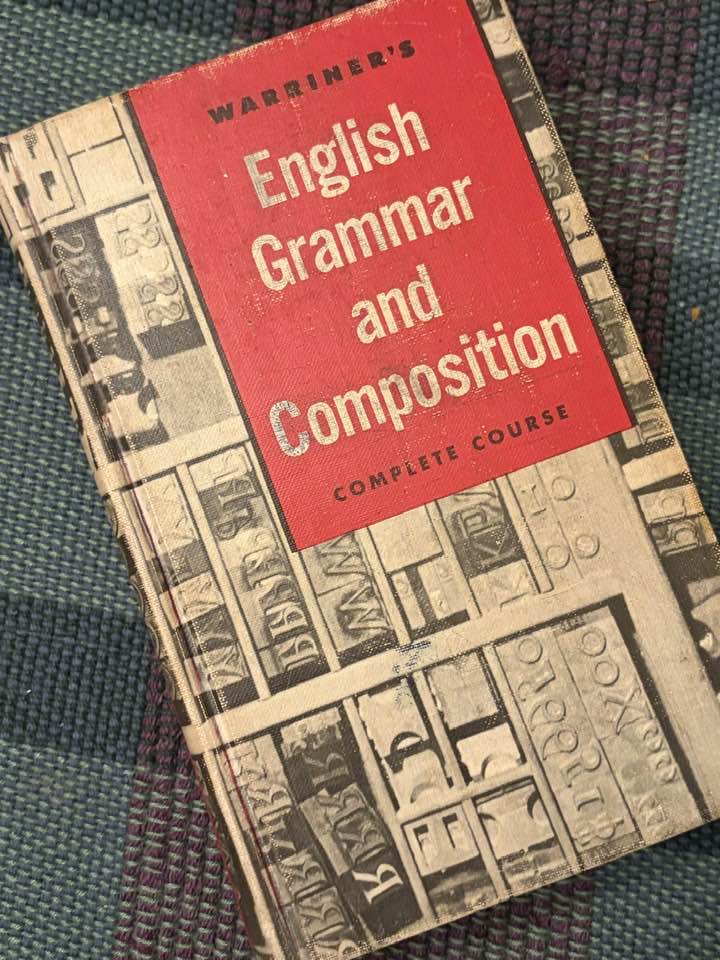
MAY 26, 2026 – I don’t know what I did to wind up in a family full of grammarians, but that’s what happened to me. One of my most searing memories as a teenager away at school was receiving from a certain family member, a Xeroxed (back when such was a word) version of one of my letters to said family member—heavily edited for misspellings and grammatical and syntactical offenses. My initial reaction was as you might imagine: “[Said family member] sure has a lot of nerve!” Once I’d recovered my equilibrium, however, I felt a measure of gratitude. How many kids in my English class came from a family of virtual English majors (though not a one was an actual English major)?
Over time I was able to put things into perspective. If the family grammarians were like hawks on a tree branch, just waiting for someone to drop their guard and break a rule of usage chiseled in stone, I noticed that not everyone was “perfect.”
My dad, for instance, one of the leading grammar hawks, was wont to say, “real good,” when the context clearly called for “really well.” For instance, he’d say, “Once you’ve dumped the dirt into the hole, you have to pack it in real good.” This bothered me to no end. In the first place, he was one of the hawks and knew better. Second, “real good” grated on my ears. Every time it did, I wanted to say, “You mean, ‘really well,’” but in fact, out of respect, I said nothing.
But then there was my dad’s dad, Grandpa Nilsson. He’d not had much of a formal education, though he loved to read and work on crossword puzzles. Up at the cabin were stashes of mail order books, pamphlets and other materials appealing to people such as Grandpa, whose lack of formal education combined with his natural curiosity drove a strong desire to become self-educated. His spoken language, as well as his writing, were quite good (“He spoke and wrote quite well”), but the skunk was a double negative that crept into his speech every so often; the “He don’t like to fish” or “She don’t like to drive.” Whenever this occurred, it felt as though he’d slammed on the brakes for no reason at all while cruising down the highway.
Our Grandmother Nilsson didn’t have much formal education either, but soon after arriving in New York from Sweden, she landed a job as a cook’s assistant in the household of a Yale English professor. As a condition of continued employment, she had to learn the King’s English—and she did. Her grammar was as good as anyone’s in the family, except she spoke with an accent. But pronouncing “toothbrush,” “tootbrush” wasn’t grammatically incorrect. It was simply endearing. In my judgment, her musical rendition of English pronunciation was a sign of refinement.
The grammar hawks, meanwhile, had good company across the street: the Moores. Fred and Ruth were good friends of my parents, and often on hot summer evenings, we—my parents, my kid sister Jenny and I (who in my teens, served as Moore’s groundskeeper)—would be invited to their well-appointed home overlooking the Mississippi. Not only was it a beautiful home—or maybe because it was a beautiful home—it was air-conditioned. Over Ruth’s latest dessert extravaganza, I’d hear the grown-ups grouse about their favorite subjects: Democrats; falling standards in the school district; and inevitably, the Decline and Fall of the English Language.
Of all the grammatical matters the hawks insisted upon, at or near the top of the list was proper usage of “lie” and “lay.” I have mixed feelings about this category. On the one hand, the rules pertinent to these verbs were well established in our household—so, good for us. On the other hand, I could swear that those rules are overlooked in 99% of other American households. Consequently, we of the “1%,” that is, we who’ve been trained not to scrape our fingers across the chalkboard must experience the nearly daily torture of other people doing so.
Several years ago, one of the family’s grammar hawks who’d been through a series of medical appointments half-joked that “You’d think that in a profession where lying down is so much a part of the work—at least on the part of patients—that more doctors and nurses would know how to use ‘lie’ and ‘lay.’” I’d been thinking the same thing throughout my own medical ordeal in 2022.
The most amusing anecdote about “lie” and “lay,” though, involved my sister Jenny. Every bit as gifted at storytelling as her English-major husband, she speaks and writes with grammatical correctness (most of the time), but when it comes to laying down the law, she’s more of a wren than a hawk. Besides, when she was a kid, our dad called her, “Jenny Wren,” for reasons unrelated to English usage.
When it came to “lie” and “lay,” she was a late bloomer, at least by the standards of our household. Her status in this regard was manifested one sunny summer afternoon down in Minneapolis. The occasion was her weekly violin lesson with Mary West, one of the best known and most beloved violin teachers in the Twin Cities during her 50-year teaching career. Normally, the grand pedagogue taught at the U of MN’s MacPhail School of Music, but during the summer she taught at her home studio in a leafy part of Minneapolis.
In any event, on the subject day, Mother drove us down to the lesson. We arrived with plenty of time to spare, so Mother, Jenny and I and maybe our sister Elsa, I forget, hung out at a nearby park. It was so deliciously sunny out, Jenny and Elsa lay in the sun, soaking up rays. At the appointed lesson time, Jenny made her way to Mary West’s house.
After the lesson Jenny asked us for a run-down of the rules governing “lie” and “lay.” Of course, Mother, the math major who was a utility player when it came to all other academics, fielded that question like an All-Star shortstop on the double play.
“Why do you ask?” Mother then asked.
“When Mary West asked me what we did before the lesson,” Jenny said, “I wanted to tell her that we were—you know—doing what we do on the sundeck at home, only in the park, but I realized I didn’t know whether to use ‘lie’ or ‘lay’ and I got all mixed up in my head but I knew one thing: that ‘did lie’ was correct. So I said, ‘We did lie in the sun.’” Jenny laughed at her clumsy solution to the problem.
“I think Mary West thinks I’m very weird,” said Jenny.
But as the grammar hawks would squawk, “At least she was grammatically correct.” I don’t remember Mother’s exact response, but I’m sure she found Jenny’s solution as amusing as it was technically correct and expressed full support for her creativity. Though Mother could hold her own among the hawks, as an exemplifier she was more of a songbird.
Subscribe to this blog and received notifications of new post by email.
© 2026 by Eric Nilsson

4 Comments
My grandma and my mom always said, “You lay something or someone.” And I remember the story of the woman who placed a bet with a gambler by telling him, “I’ll lay you 17 to 1.” He replied, ”Well, that’s an odd time, but I’ll be there!”
GREAT one!!!
My Mother taught other people’s children English grammar in public middle school. She taught English grammar to her 5 boys at home, written and verbal grammar. Always. Even to her dying day she was a grammarian.
Mom incurred a fatal head injury. While in a local ER, her head bleeding and brain swelling, the ER doc, surrounded by nurses, said to Mom, “Lay down on that bed over there. ” She rose, looked at that doc and said, ” Lie down. Lie down on that bed. Chickens lay eggs, people lie down.” Nurses chuckled and the doctor fixed his mistake. A grammarian to the end.
My oldest child inherited that, as she does a yearly social media post on proper use of the Oxford comma.
I LOVE this story!!!!!! Good to know our alleyway is “grammatically certified.” (Don’t forget, our resident Honors English teacher resides at your end.)