MAY 25, 2026 – This morning after breakfast and Java, I sat at the log dining table at the Red Cabin, pecking away at correspondence on my laptop. Facing the lake exactly 75 feet from the windows, I periodically looked up to check on the scenery. A splendid breeze frolicked across the two-mile fetch from the islands, which at that distance, always seem smaller on a windy day than they do when the air and water are still. Apollo’s chariot had just cleared the bend to the east, and the brilliance of his late May morning ascent scattered into diamonds on the waves. Just then, a huge winged shadow the size of a low-flying Piper Cub passed over the trees guarding the berm in front of the Red Cabin. Except . . . no invention of humankind with a human at the controls was close overhead. I knew, of course, it was one of the eagles that guard the pines that guard the shore.
I read the shadow as a good omen but one with a directive: Put down the (figurative) pen and breath deep the free and fresh springtime air. After checking with Beth to see if she needed any help with her plantings and mulching, I headed down the path into the woods of Björnholm.
Though I’ve hiked the route more times than a pedometer could track, I never tire of the scenery any more than I’d grow bored or weary of a crowd of dear friends and acquaintances. Trees and people are forever dynamic, changing by the season and in reaction to the weather in its many moods. No two hikes along the path are exactly the same. From season to season, year to year, decade to decade, trees and people follow ever changing destinies.
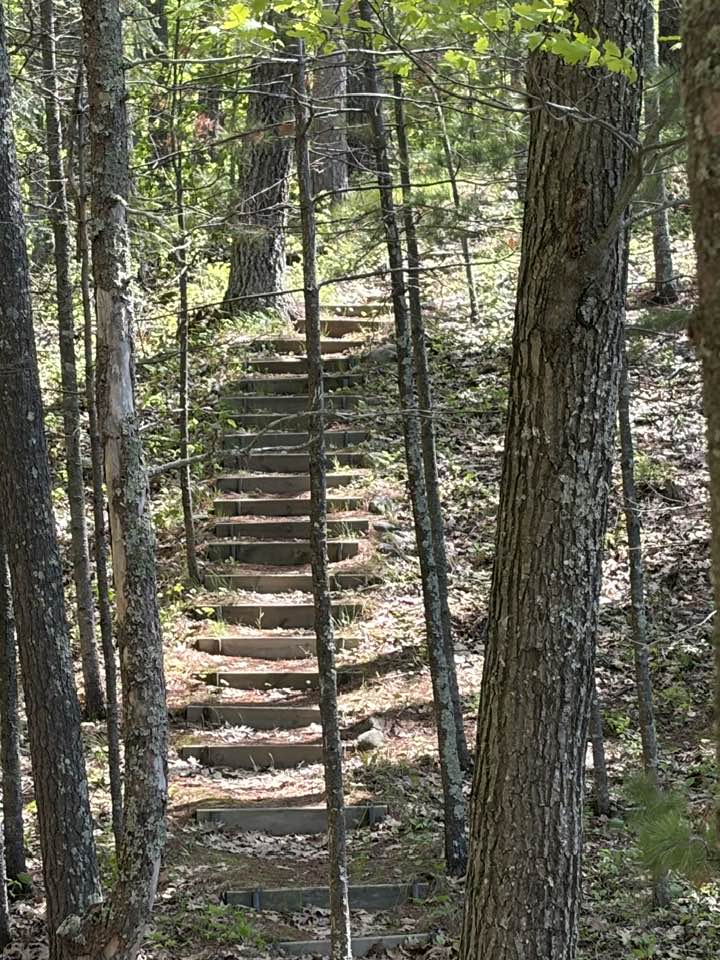
As I descended the esker just west of the old dock area, I caught a glimpse of the earthen staircase on the side of the opposite hill east of the dock—the hill where the old cabin sits high above the lake. The sight of Dad’s summer project 50 years ago was unusual at this time of year: the woods are still greening but not to the stage of blocking my view from that particular vantage point. I stopped, pulled out my camera and framed a shot. Click! Continuing down the esker ridge, I contemplated my desire to “seize the scene” . . . or was it a need—a compulsion, perhaps, to stop time and its role in our mortality?
I once read somewhere that the main difference between a cat and a human is that a cat can’t contemplate its demise—except, probably, in the nano-second before it meets its doom. We humans, of course, are constantly thinking about our mortality. Well, that’s not quite right. The “Pyramid Pharaohs” of the Fourth Dynasty (3000 B.C.E.)—Grandpaw Khufu, Daddy Khafre, and Grandsonny Menkaure—were constantly thinking about their immortality, as do a good many members of various religious faiths to this day.
But today, walking in Nirvanaland, I wasn’t dwelling so much on mortality vs. immortality as I was entertaining a passing thought simply on the fleeting nature of time—for all of nature and all of time. What did any of it matter—mortality, immortality, fleeting time, constant change? These concepts, if we can call them that, are mere constructs of the human mind and imagination. But what are those, exactly, in the Grand Cosmic Scheme of Things?
I released my thoughts to the wind and drank in the moment—and the next and the one after that, as I experienced something all too rare in life: contentment. After all, I was walking in Nirvanaland.
Up in the yard of the cabin I nearly stepped on a full-grown garter snake sunning itself in the grass. It must’ve been snoozing, because it didn’t flinch at whatever disturbance my approach might have signaled. I walked around it, pleased that it had perceived no danger from me. When I circled back a few minutes later, the snake was nowhere to be seen, its disappearance being wholly consistent, I thought, with the self-preservation instincts of . . . a snake.
On the west side of the cabin, I admired the surviving “twin” of what Dad and Grandpa called the “Twin White Pines.” And they were. Towering trees of identical girth, height and character. They even leaned in parallel and at the very same angle. One succumbed to disease—about 15 years ago, a year after their chief admirer’s death. Again, because the foliage on surrounding oaks and maples still has some unfolding to do, I had a splendid view of the upper third of the big white pine. About 16 feet below the very top of the tree, a large second trunk has curved out from the main trunk. Years ago this second trunk doubtless developed in response to disease or a storm injury. When exposed, as it was today, that trunk appears as a deformity. But during the summer and into the fall, the impairment is hidden from view. The tree stands as stalwart and perfect as can be.
Today, the tree seemed to symbolize humanity—broken and disfigured, yet majestic in its defiant resilience. As it swayed in the wind in concert with its local entourage, its susurration sang in my ears as some kind of ode to . . . life . . . here on this precious planet of ours. If we just seize the moment—carpe momentum—and notice what’s in plain sight, we can find meaning there too.
Subscribe to this blog and received notifications of new post by email.
© 2026 by Eric Nilsson
