MAY 24, 2026 – My parents, bless their souls, were philhellenes and to a lesser extent, Romanophiles—lesser because as I remember my dad explaining when I was quite young, for the most part, the Ancient Romans were “copycats,” the Ancient Greeks having been the source of so much that later evolved in the hands and minds of the Romans. The den housed various books on the art and life of Ancient Greece, but the most memorable details of my parents’ philhellenism was Dad’s detailed knowledge and praise of the Parthenon, and Mother’s parallel affinity for Xenophon’s Cyropaedia—(The Education of Cyrus). If my parents weren’t influential in my choice of a college (they relied on my uncle’s recommendation, since he was the one who’d taken me on the traditional “college tour”), they did weigh in on my choice of a major—Classics. It wasn’t a case of “You must,” but they convinced me that I’d benefit from a solid grounding in Greek and Latin (both Mother and Dad were proficient in the latter, since they’d benefited from educations in an era when Latin was de rigueur in many high school curricula). (Eventually and inevitably, I doubled majored in American history.)
As I anticipate my 50th college class reunion—a four-day affair starting next Thursday—I’ve found myself reflecting regularly about my undergraduate experience and how much of it I squandered. My solace resides in believing that surely I wasn’t the only living proof of George Bernard Shaw’s famous and unflattering observation about youth.
My professors in the Classics Department—John Ambrose, Erik Nielsen (phonetically, my namesake), and the legendary Nathan “Nate” Dane II—were a memorable triumvirate. I enjoyed every minute of every class. These three professors didn’t simply teach dead languages. They breathed life into them, with infectious humor and enthusiasm.
Some of my classmates—the ones far more talented than I—pursued careers in ancient history, language, archeology and anthropology. Me? I followed the set who went on to law school—which I later realized leaves its graduates less well prepared for the “real thing” (actual practice) than does the training ground for any other profession.
As the years passed, much of what I’d learned of Greek and Latin literature dissipated to make room for all sorts of “know-how” and knowledge, until the connection between my daily work and my education seemed no more relevant than the framed pictures and posters that adorned my office walls, strictly for decorative purposes. Lost among them was my college diploma—all in Latin.
Then one day a year and a half ago, my good friend Linda Lovas Hoeschler graciously gave me access to the library of her late husband, Jack (also a dear friend of mine), to “take whatever I wanted.” A consummate student of history, Jack had accumulated countless books I would like to have taken, but realistically, time and space considerations discouraged me from running off with more than a few bags’ worth.
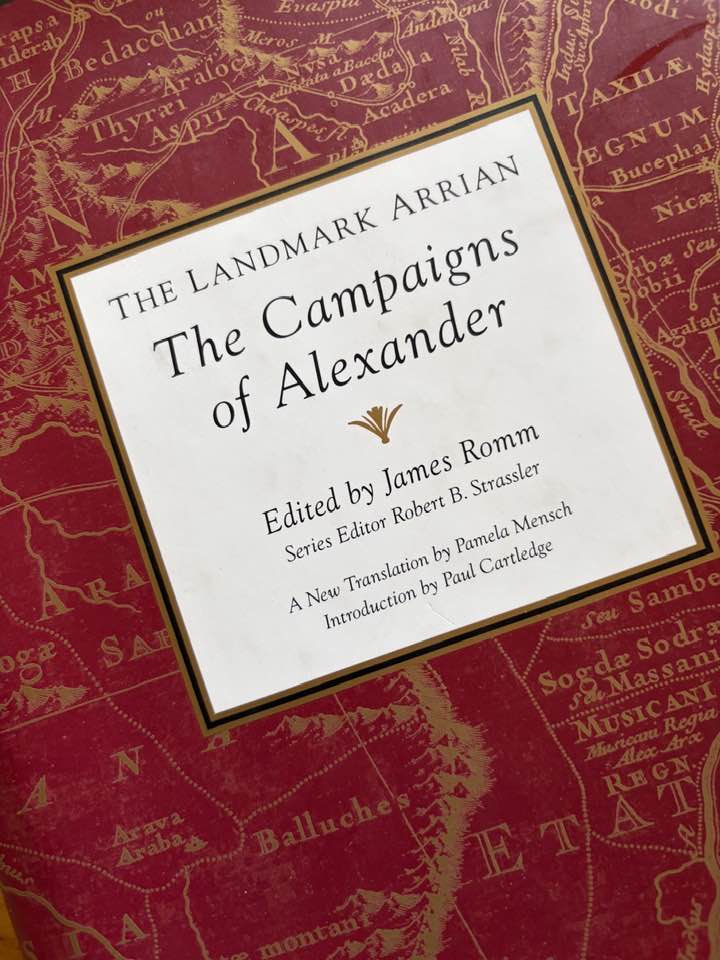
As I was preparing to leave Linda house, however, she introduced me to “The Landmark Series,” a four-volume set of books (Pantheon Books, a division of Random House – 2010; $160 for the collection) devoted to the works of four of the most famous historians of Ancient Greece: Arrian, Xenophon, Herodotus, and Thucydides. As I thumbed through two of the volumes, I was awestruck by the density of the scholarship they contained in the form of analyses, dissections, detailed cartography, and annotations in addition to the featured original works (in translation).
In any event, Linda wanted to retain the four books for her own library but was willing to let me have them on loan. I could see that it might take four years to read the whole impressive set, so I limited myself to just one volume—The Landmark Arrian – The Campaigns of Alexander.
Flattered and grateful that Linda would allow me to borrow the book, I was nonetheless intimidated by it. As I dove into the other books from Jack’s collection—a biography of Mao; a history of the Crimean War; a book about Joseph Needham (the eccentric Cambridge scholar who “loved China”); and most recently, a gem of a book about the Dakota War of 1862—The Landmark Arrian waited patiently at the end of a bookshelf.
Then came Trump’s “excursion” in the Persian Gulf. If I know infinitely more about Persia—Iran—than Trump knows or is capable of knowing, the superiority of my knowledge over his fails to reveal my own considerable ignorance by any objective standard. An ancient art class in college, taught by the legendary Bowdoin professor—Phillip Beam, of the Art History Department—had provided a fascinating introduction to ancient Persia, but it was hardly enough to qualify me as a student of Persia. What I did know, however, was that Ancient Persia and Ancient Greece were perennial rivals. And from my mother’s endless enthusiasm for Cyropaedia, I knew that Cyrus the Great was a darned well educated Persian. By way of general osmosis from my study of history, I knew that Alexander the Great played a pivotal role in the history of Persia. But the details were vague. Against the backdrop of the war in Iran, it was now time to dig deep into Alexandar’s rip-roaring conquests as he led his army east from his home in Macedonia.
Alexander indeed! I pulled The Landmark Arrian off the shelf. The jacket features “Retraite des Dix Mille,” by Guillaume de Lisle (1723)—a map of the “retreat of the Ten Thousand,” a reference to Xenophon’s Anabasis—parts of which I’d read in Greek in my sophomore year. One part of the map jumped out at me: The Strait of Hormuz.
I djumped into the deep end of the pool. It’s so deep, in fact, that I’ve read the 28-page introduction three times to ensure a solid grasp of Arrian’s sources and the contextual framework for Alexander’s anabasis (Greek for, “going forth”). Now that I’ve “put my head underwater”; now that I’ve tasted the scholarship that went into this book, I am hooked. I cannot put the book down or interrupt my mission to join Alexander on his “anabasis” through Ancient Persia, as told by a second century C.E. historian, Lucius Flavius Arrianus (or just plain “Arrian,” in English).
At the outset of this latest adventure, I’m reminded of the introductory lecture by the inimitable Theofanis Stavrou, my 92-year-old Professor of Russian History (last year at the U of MN), who told us, “After completing the first two stages of learning—required and practical—if you’re really lucky, you’ll reach the third level: learning for the sheer joy of it!” His two-and-a-half-hour lectures every Monday evening of the semester were all of that—sheer joy.
As I aim for the Bowdoin campus for four days next week, joining my classmates from hither and yon, not only geographically, but from disparate life experiences over a half century, I now see the essence of my four years there as an undergraduate: catching the spark that lit the candle that lit other candles throughout life and in abundance, illuminating the way to that third level of learning: learning for the sheer joy of it.
Subscribe to this blog and received notifications of new post by email.
© 2026 by Eric Nilsson
