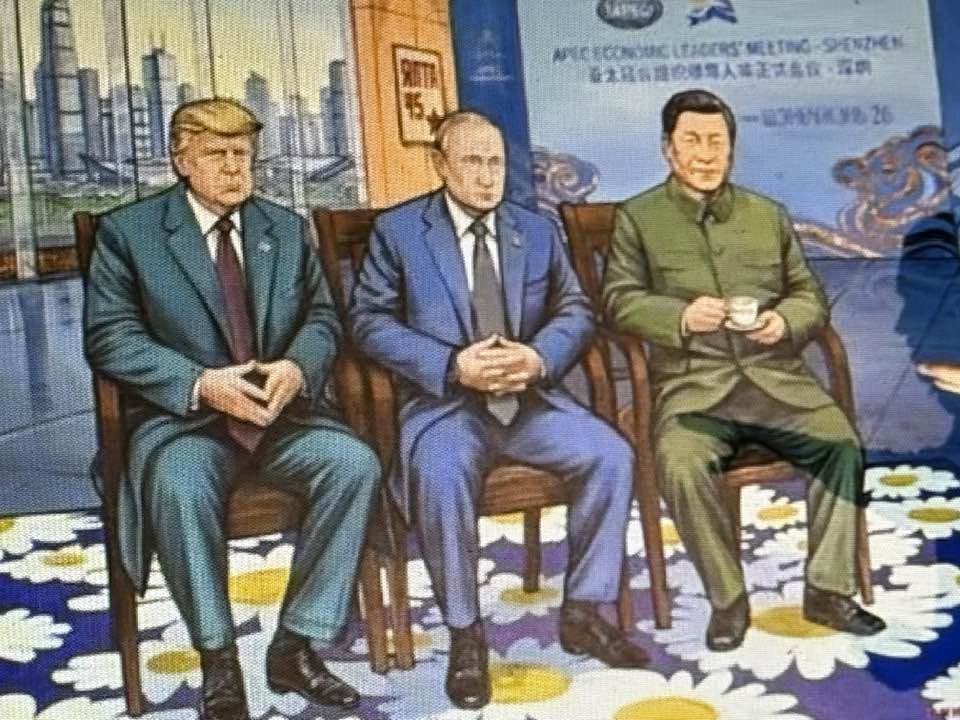
NOVEMBER 17, 2026 – This morning brought news about Thursday’s whopper meeting of the world’s Big Two Autocrats—Xi and Putin—plus the Big Wannabe One, our very own inimitable Trump. At the center of American media reporting was the mural painted by Alexey Vladimirovich Sergienko showing the Two Big + One Wannabe—Putin in the middle—seated in emulation of the famous photo of the Big Three (Churchill, FDR, Stalin, in that order) at the Yalta conference from February 4 to 11, 1945. I burst out laughing when I saw the painting. Called Shenzhen 26, it’s by the “Russian” millionaire pop artist Sergienko, who drives around his hometown of St. Petersburg in his Beamer X6, which is totally covered by a transferred print of his work, “Chamomile.”
Americans have every right to feel scandalized by the mural—at least if they have a passing familiarity with World War II. FDR, after all, sat in the middle at Yalta. Russians, of course, who are the target market for Sergienko’s propagandistic “art” should celebrate their MRGA moment, which features their current day Tsar at the center of things. The Chinese? They should sigh with relief that the proverb, “A picture is worth a thousand words” is not, in fact, attributable to Confucius but to American newspaper man and real estate magnate, Arthur Brisbane, who coined the phrase when he worked it into his 1911 speech at a meeting of the Syracuse Advertising Men’s Club.
If advertising is still America’s forte, irony has long been the signature feature of countries and cultures around the world. Though the artist was born in Leningrad, now St. Petersburg, Russia, his surname (ending in “-enko”) is blatantly . . . Ukrainian.[1]
In the case of Shenzhen 26, the painting, the illustration, the depiction, the enlarged comic book panel—whatever word(s) you might choose to describe it[2]—was a classic example of “advertising,” er, “propaganda,” designed to ingratiate the artist with the Russian ruler, the former KGB officer-turned-Tsar. Xi, meanwhile, the most powerful man in China, is secure enough to be unaffected by Putin’s insecurity complex. The Chinese Emperor takes a much longer view of things, though he’s the elder autocrat of the bunch. A piece of pop art for domestic consumption by Putin’s sorry subjects is of no consequence to the Chief Architect of BRI or “Belt and Road Initiative,” China’s grand plan for global economic domination. After all, apart from oil and gas and rare earth minerals, when’s the last time anyone anywhere bought anything with the label, “Made in Russia”—apart from Vodka and nesting dolls featuring the Romanovs + Putin?
Then there’s Trump. In his case, a picture is most certainly worth a thousand words. Make that 10,000 words or even a million, because no matter how many words come out of his mouth, they’ll never suborn his own narcissism to our national interests. His image is all one needs for a reminder that his words—and the “thoughts” that feed them—are simply squares of T.P. on a roll of cardboard.
Upon seeing Shenzhen 26, Trump no doubt would not see “Churchill, FDR and Stalin.” He’d see himself in the company of two strongmen who are his idols; doesn’t matter that he’s to one side. In his mind, he’s seated with them elbow-to-elbow, and that fact alone satiates his twisted need for attention.
What we Americans should worry about is all that will transpire in the sequence of comic strip panels following “Yalta redux,” as Putin and Xi outwit and out-maneuver Trump, who is clearly way out of his (sandlot) league. Waiting in the wings for an audience with Trump is Kim Jong Un—after the latter has been fully briefed and coached by Tsar Putin and Emperor Xi. The comic strip panel featuring the North Korean dictator and our Wannabe King will have to be extra wide to accommodate the width of their egos and the breadth of their waistlines. Let’s all cringe in advance to reduce the jarring effect of Trump’s inevitable “they’re all a bunch of nice guys” assessment of the leaders he envies.
In any event, the story of America’s decline under Trump is worth a thousand cartoons, starting with Shenzhen 26.
Subscribe to this blog and receive notifications of new posts by email.
© 2026 by Eric Nilsson
[1] This reminds me of “Alexander,” the guide we had on a grand tour of battle sites in the Siege of Leningrad during WW II. The young historian par excellence made no attempt to veil his vehemently anti-German sentiments. After hearing a full day of his pathological diatribes, I asked for his card. When I saw his surname, I nearly choked: “Schmidtke.” –“Why,” I said, “you’re of German ancestry!” –“Uh huh,” he acknowledged, without batting an eyelash. Now there’s a story, I thought. But I didn’t have the chance to hear it. Our ship’s captain was keen on a timely departure.
[2] The American computer scientist known for his witty quips, modified the “A picture is worth . . .” proverb to, “As the Chinese say, 1001 words is worth more than a picture.” The Dutch mathematician/computer scientist, meanwhile, borrowed from Brisbane’s original line to say, “A picture may be worth a thousand words, [but] a formula is worth a thousand pictures.”
