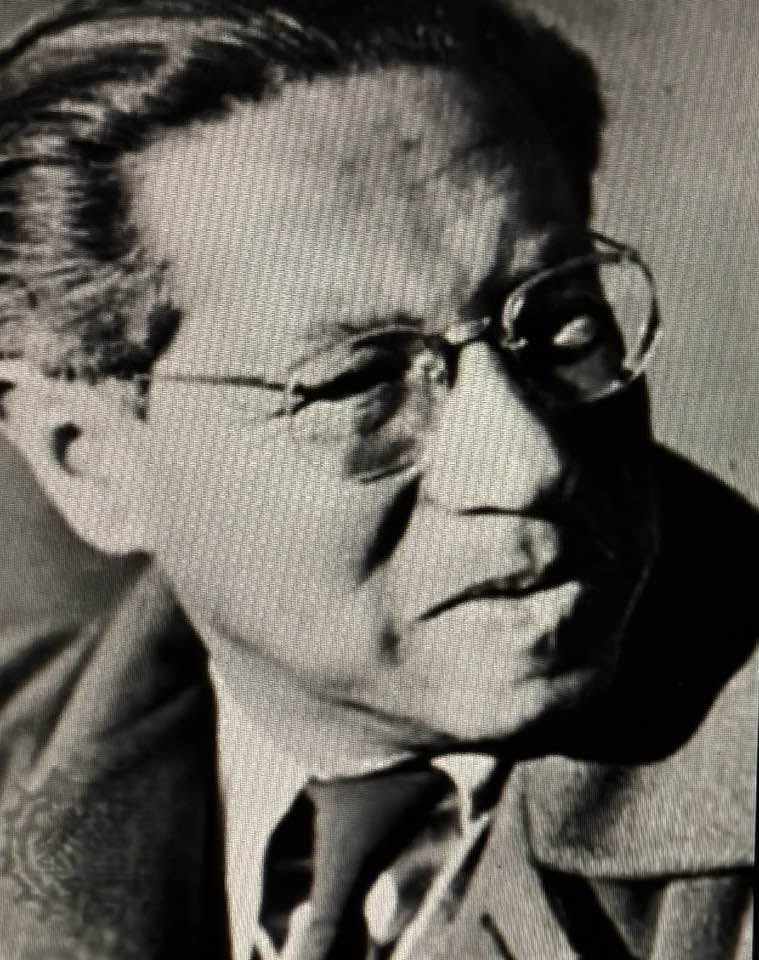
JULY 6, 2026 – (Cont.) As is the case with most great art and literature, The Oppermanns is art reflecting life—specifically, a critical phase of the life of the author, Lion Feuchtwanger. Much of what shapes the outlook of Gustav Oppermann, a central character in the book, the artistic mirror, is the writer reflecting on his own experience. Gustav is one of the four siblings (a fifth, we are informed, had died in World War I fighting for the Fatherland) featured in the novel. Three brothers and a sister, they are the older-middle-aged grandchildren of Immanuel Oppermann, who’d built up a highly successful furniture business based in Berlin.
More about Gustav and his sibs (and other characters) in due course, but for present purposes, Gustav was the man-of-letters in the family; the scholar and intellectual, whose primary effort at the end of 1932 and beginning of 1933, was completing a biography of Gotthold Ephraim Lessing, a leading writer/philosopher of the German Enlightenment. Having signed a petition critical of the Nationalist Socialists, Gustav soon finds himself in the crosshairs of the brutish stormtroopers. His lawyer-friend Mühlheim—with convenient ties to high-ranking party members—urges Gustav to pack up and leave Germany before it’s too late. Gustav resists, frustrating Mühlheim to no end, until finally, finally, Gustav relents, thanks to Mühlheim’s arrangements down to the last detail—buying a train ticket to Switzerland; reserving a sleeping car, etc. (When Gustav turns the table and asks Mühlheim why he doesn’t leave, the lawyer says he must finish “just one more case” on behalf of an enemy of the state, but with Mühlheim, there’s always one more case.)
Gustav’s “escape,” however, is not the end of his story in the novel—any more than Feuchtwanger’s exile in mid-1933 was the end of his story in real life. As far back as 1920, the author had published works critical of the National Socialists. In 1930 he published Success, a work of fiction that nonetheless portrayed the rise and ultimate fall of the National Socialists. This literary effort didn’t ingratiate him with the fascists. But it did bring him international recognition, and early 1933 found him on a speaking tour in the United States.
In keeping with irony as an essential element of literature, not to mention life in general, on January 30, 1933, our author friend was the guest of honor at a dinner hosted by Ambassador Friedrich Wilhelm von Prittwitz und Gaffron (in case you thought the Prussian aristocracy was at all efficient in naming themselves) the German Embassy in Washington, D.C. As the reader learned in Part I, on that same date back in Berlin, Adolf Hitler was appointed chancellor of the German Reich. Apprised of this disturbing development, the Ambassador—read, Mühlheim—resigned and advised Feuchtwanger, id est, “Gustav,” not to return to Germany. But the author did—just as Gustav does in the novel.
From a subsequent foreign tour, Freuchtwanger returned to a ransacked house and library—which, lo and behold, Gustav experiences as well. Nevertheless, the author proceeded with publication of The Oppermanns—and the regime proceeded with its notorious book burnings across Germany, which included works by Freuchtwanger.
By late summer 1933, the novelist was deemed a “Number One Enemy of the State.” Before the ax fell on his neck or he dangled from the end of a hanging rope or, as happened with so many early victims of the brutal regime, he “died of heart failure while in captivity,” Feuchtwanger now knew he had to exit Germany for good.
He and his wife Marta fled to Sanary-sur-Mer in Southern France, where they lived a good life on the earnings of his literary works, including The Oppermanns, which soon was published in nine languages. Then came The War—World War II—and, ever so ironically, the arrest of the Freuchtwangers as “enemy aliens.” Freuchtwanger’s French publisher paid a bribe to spring him from detention, but then the writer was re-arrested.
In the next round of a veritable Netflix series, the Germans invaded France and Marta Freuchtwanger escaped from her internment camp. She contacted the American Journalist in Marseille, Varian Fry, who in turn sought crucial aid from the heroic American vice consul in Marseilles, Hiram Bingham, who, by the end of the war, would be responsible for spiriting 2,500 Jews to safety by way of an “American visa factory.”[1]
Bingham and a colleague with the improbable name, Myles Standish, arranged for Freuchtwanger’s “escape” from the internment camp by having him dress as a woman and pose as the mother-in-law of Myles Standish. The ploy actually worked.
Under aliases, Lion and Marta were escorted to Lisbon by the American Unitarian minister, Waitstill Sharp, who, with his wife Martha, led high-risk relief efforts in Czechoslovakia and France after the German onslaught.[2]
From neutral Portugal, Feuchtwangers found passage to the United States, where they were granted political asylum. They settled in L.A., then Pacific Palisades, where they fraternized often with Freuchtwanger’s old buddy . . . Bertold Brecht. . . . and the Manns, Heinrich and Thomas.
In sum, the reader can be sure that the novelist’s masterpiece, The Oppermanns, grew from garden soil real and rich with firsthand experience. Moreover, the work is watered and fertilized generously with the questions of a philosopher and the refinement of an artist.
But there was a baffling—and troubling—twist to our novelist’s political sentiments and sympathies, which I shall address after reviewing the book itself. Stay tuned. (Cont.)
Subscribe to this blog and received notifications of new posts by email.
© 2026 by Eric Nilsson
[1] In 2023, I stumbled across the Netflix series, Transatlantic, which was a theatrical treatment of Bingham’s initiative, aided and abetted by Vavian Fry and financed by a renegade socialite from Chicago. Among the more famous personalities rescued by the effort (besides Lion and Marta Feuchtwanger) were artists Max Ernst and Marc Chagall, historian/philosopher Hannah Arendt, and writer Franz Werfel. See the three-part review of Transatlantic, starting with my 4/15/2023 post.
[2] They were the second and third Americans to be named as Righteous among the Nations by Yad Vashem. The first American? Varian Fry.
