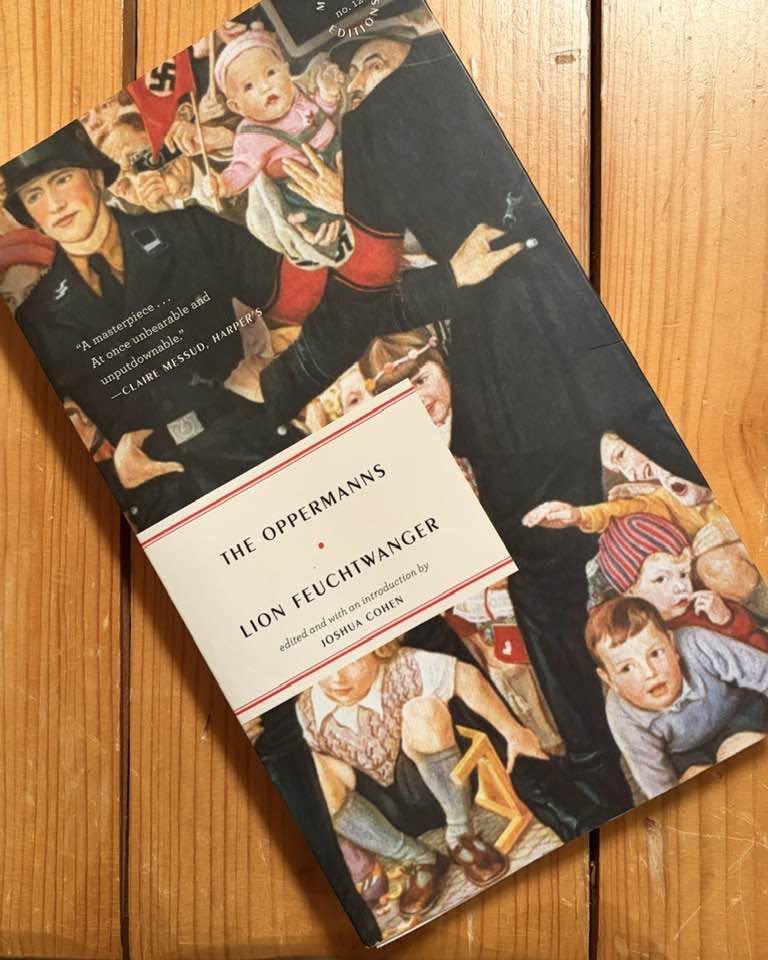
JULY 7, 2026 – (Cont.) As mentioned above, the Oppermanns are a family of achievers, whose inspiration was their paternal grandfather, a successful furniture manufacturer and retailer in Berlin, whose modest straightforward company motto was, “Oppermann customers buy good goods cheaply.” He’d gotten his start as a supplier of goods to the German armies during the Franco-Prussian War. His efforts won the praise of Field Marshal Helmuth Karl Bernhard von Moltke (the “Elder”), a hero among the aristocracy of German militarists, who issued to Immanuel Oppermann a certificate of recognition—signed by the Field Marshal himself. It hung prominently in the main offices of the Oppermann Furniture Company.
The principal figures of the family in the story are Martin Oppermann, who now heads up the company. Next: Gustav, whom we’ve already met—formerly active in the firm but now retired from day-to-day operations so he can pursue a life of letters. He enters the story on his 50th birthday, surrounded by his impressive library and attended by one of his two “significant others,” who might represent amorous affairs, though their relationships with Gustav seem to be more platonic than romantic. Third is the workaholic brother Edgar, who never assumed an active role in the business but instead became a famous and highly respected throat surgeon, who’d invented a special surgical known internationally as, “the Oppermann treatment.” Then there’s the sister Klara, married to Jacques Lavendel, “an Eastern Jew,” whose frankness often grates on his brothers-in-law. Though Jacques and Klara live in Berlin, somehow Jacques in his apparently earlier, worldly exploits, obtained American citizenship. He is more of a realist than any of the Oppermanns of his generation.
Figuring prominently in the story, are the Oppermann cousins—Berthold, son of Martin and his wife, Lisotte; Heinrich, son of Jacques and Klara; Ruth, daughter of Edgar. Other primary characters include Dr. (Rector) François, a philologist and champion of High German, headmaster of the Queen Louise School attended by Berthold and Heinrich; Rector François’s nemesis, Dr. Bern Vogelsang, bursting at the seams with Nationalist Socialist sentiments, foisted upon the Queen Louise School by the Ministry of Education to replace a beloved instructor of literature after the latter’s sudden death. Many other characters interact significantly with these main figures and reflect various attitudes and reactions to swift-moving events following Hitler’s rise to power.
The basic plot boils down to the characters’ reactions—and in the case of the “bad apples,” exploitation—of the brutish, primitive expansion of National Socialist power. The reader, of course, knows the horrific outcome of the contextual epoch. Yet for the “players,” the characters so meticulously developed by Lion Freuchtwanger, Kristallnacht[1] is still five years away from when the deeply disturbing story of The Oppermanns leaves off. The Blitzkrieg (the opening of World War II by Germany’s invasion of Poland) is half a dozen years out, and Hitler’s break with Stalin—and invasion of the Soviet Union, is eight years down the line. The full extent of the Holocaust has yet a dozen years to descend across Europe.
How the characters deal with the rising storm clouds covers the spectrum. Ruth Opperman, for example, a young, perspicacious and strong-willed woman can foresee ahead of her elders. Not only is she determined to leave Germany; she heads for Palestine. Her Uncle Jacques too senses the approach of danger, though given his American citizenship, he and family perhaps have more time than the rest of the Oppermanns. But the brothers Oppermann are fully vested Germans first and Jewish second—none of them being particularly religious (though that begins to change as conditions worsen). They have the highest appreciation for high German language, literature, and culture. Goethe is a common reference point. Brahms and Beethoven are composers of choice[2].
And lest the reader forget, the fifth brother, Ludwig Oppermann, gave his life for Germany in the Great War, and Grandfather Immanuel was singled out for praise by von Moltke.
In other words, these people who are fast becoming scapegoats, the “other,” are more German than most Germans. Having broken free of earlier bonds of anti-Semitism after the Revolution of 1848, the Oppermann parents and grandparents succeeded in life, and now Martin, Gustav, and Edgar and their children pursue careers in commerce, medicine/science, and literature. Understandably, they can’t fathom how a party of crude, cruel, unrefined thugs, with no appeal beyond a third of the population, could ever succeed in taking over the whole country.
And to put the “scapegoat factor” into perspective, Freuchtwanger reminds us that in 1933, the Jewish population in Germany is slightly more than half a million—less than 1% of the total population of slightly more than 65 million. This extreme minority factor plays into the general disposition that something as crazy as a complete Nazi takeover in Germany is simply very remote.
In one conversation after another between and among characters, the reader is impelled to weigh in; to reach out to the Oppermanns and others and yell and scream, “Get out! None of this will end well—for you, for Germany, for the world!”
One of the central points of conflict in the book concerns a class speech that Berthold gives under the critical eyes and ears of the aforementioned Dr. Vogelsang. The instructor rips into Berthold for taking a position critical of the Germanic face-off against the Romans in the Nationalist Socialists’ version of early history. The upshot is that Berthold is forced to retract his arguments; to issue an apology or face expulsion. Berthold’s family—parents and aunts/uncles—press him to comply, and they present compelling reasons, which distilled to their essence amount to, “This too will pass.”
Berthold struggles mightily with the ultimatum but eventually decides not to surrender. He does so at tremendous cost: suicide. The reader—let alone the parents, family, and Dr. François—is crushed.
Gustav, long captive to his magnum opus on the life and works of Lessing and a conviction that “this [Nationalist Socialist nonsense] too shall pass,” winds up washing out from Germany, thanks to the good offices of his lawyer friend, Mühlheim. But from the safety of France, Gustav is moved to do something as quixotic as it is necessary. He returns to Germany incognito in an attempt to join an underground effort to document Nazi crimes, but he’s caught and nearly winds up paying with his life. He’s rescued—again by Mühlheim—and leaves Germany a second time, albeit for good. By this stage, however, he’s a broken man physically. The end awaits him—close by. (Cont.)
Subscribe to this blog and received notifications of new posts by email.
© 2026 by Eric Nilsson
[1] “Night of Broken Glass”—November 9-10, 1938, when anti-Semitic riots broke out all over Germany, resulting in the shattering of glass storefronts of Jewish-owned businesses. In her memoir, Beyond Survival, Ruth Oppenheim, the late mother of my good college friend and classmate, Jeff Oppenheim, captured in great detail, the horrors of that night, which she experienced firsthand 18 days before she turned 11.
[2] In one scene, Berthold, Martin and Lisotte’s son, prepares to attend a Sunday afternoon dress rehearsal of Carl Flesch, the famous Hungarian violinist and pedagogue (whose famous “Scale System” was the violinist’s bible of technique when I was a student) and the Berlin Philharmoniker conducted by Wilhelm Furtwängler. When his cousin Ruth calls, however, to talk in earnest about what’s happening around them, he opts out of the quasi-concert. Martin and Lisotte, however, plan to attend the actual concert the following evening. Featured on the program is Brahms Fourth Symphony and his violin concerto.
