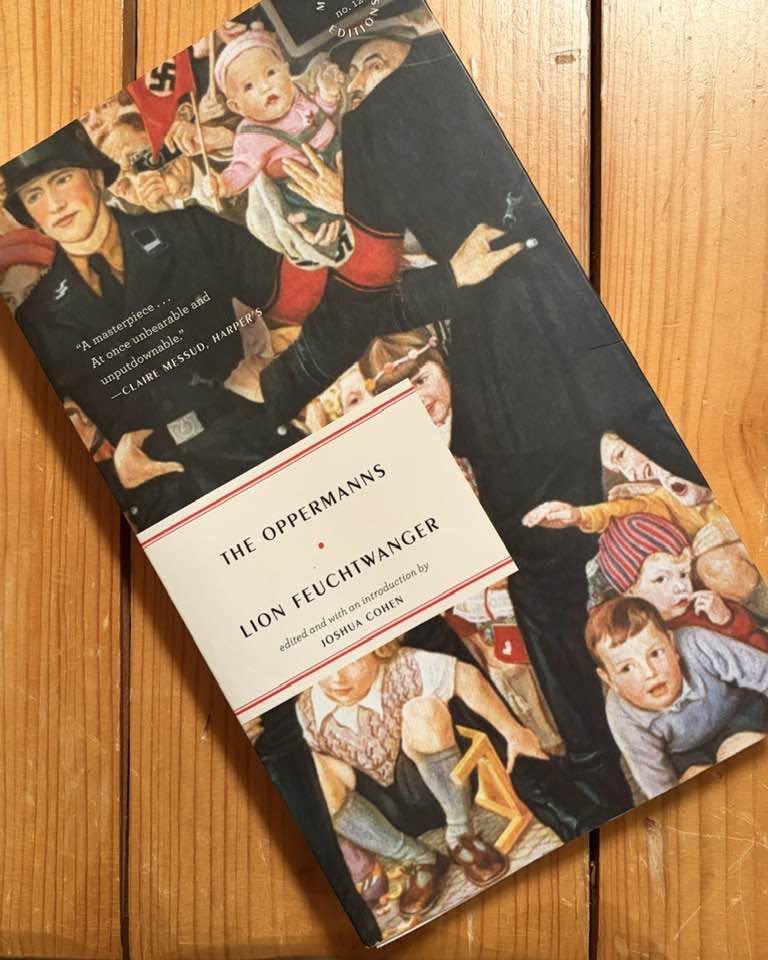
JULY 5, 2026 – Today I completed my reading of The Oppermanns, a masterfully conceived and crafted novel by the inimitable German-Jewish novelist and playwright, Lion Feuchtwanger (1884 – 1958). It was one of those books that leaves one breathless—and knowing that the work deserves to be reread, and more deeply analyzed, with the likely result will be further adjustment of one’s worldview.
The book itself is a wonder, but equally compelling is the life story of its author. Before my sister Jenny had recommended the novel—several times and with unbridled enthusiasm—I’d never heard of it or its famous (during his lifetime, anyway) author.
With its nine-month setting from November 1932 to September 1933, the book was first published in Amsterdam in November 1933. In the same month, an English translation was published in the United States. As the informed reader can readily deduce, the book centers on the rise of horror wrought by German fascism in the early 1930s. The story is for neither the faint-hearted nor the shallow-minded. It’s a rather heavy slog even for the diligent reader, but not because the novel isn’t a page-turner from start to finish. In fact, the challenge of this work is that it is at once both dense and fast-moving.
Most critically for Americans just four months away from a turning point in our own story, The Oppermanns is a clarion call to recognize what’s happening around us in our place, in our times and to begin the arduous work of recovering what we’ve lost. Feuchtwanger’s oft-repeated dictum, inspired by the Talmud, is “It is upon us to being the work. It is not upon us to complete it.”[1]
The work’s origins can be traced to a screenplay, which the author—also a playwright, remember—had dictated over the span of just a couple of weeks in May 1933. That undertaking had been the outcome of efforts originating with Feuchtwanger’s fellow countryman, Hermann Fellner, a well-known German movie producer, who’d been forced into exile (to London) soon after the Nationalists[2] came to full power after the March 5 elections that followed Hitler’s appointment as chancellor on January 30, 1933. Intent on calling the world’s attention to Germany’s fascist transformation, Fallner had found a sympathetic audience with Prime Minister Ramsey MacDonald, who also promised financial backing for the film. Fallner then enlisted Feuchtwanger to write the screenplay, with the assistance of the more experienced (English speaking) scriptwriter, Sidney Gilliat (who later wrote scripts for Alfred Hitchcock).
Ironically, Prime Minister MacDonald, head of the Labor Party, bailed under pressure from British conservatives, who at the time favored appeasement of the Nazi dragon out of fear of retaliation for a patently anti-Nazi film. Feuchtwanger, by this time living in exile himself after being blacklisted in Germany for his other works critical of the Nazis, was incensed. He immediately turned to converting the screenplay into a novel. The novel, then, assumed two historically critical features: 1. It was ready for publication just five months later—in the “real time” of fast-developing events in Germany, and 2. It captured the essence of those events between May and October 1933—as with any volatile political era, an eternity when juxtaposed to the timeframe of the May 1933 screenplay.
Before describing the outline of the story, its setting, characters and plot and its relevance to our political crisis in America today, I must remit a bit more about the author himself and his journey in exile. Viewed together, Feuchtwanger’s personal story and his novel are a reminder of the essence of what kind of country we Americans have often been—or at least to which we’ve aspired—but also, the country that we’ve allowed ourselves to become in departure from our aspirations. (Cont.)
Subscribe to this blog and received notifications of new posts by email.
© 2026 by Eric Nilsson
[1] The original text from the “Ethics of our Fathers,” is, “It is not your duty to finish the work, but neither are you free to neglect it.”
[2] The term Feuchtwanger used for “Nazi.” That latter term“ doesn’t appear anywhere in the book, except in the special notes by Richard J. Evans, a prominent British scholar of 19th and 20th century Europe, with a focus on Nazi Germany. According to Evans, “Nazi” was vulgar slang and was never used in “polite German” and is even avoided today, especially in German language history books, which use the official name, “National Socialists.” Churchill popularized the derogatory English term, “Nazi,” by intentionally mispronouncing it, “Naysee.”
