NOVEMBER 5, 2026 – Today was my last appointment with the good doctor Bhaskar Kolla, since January 2022 the oncologist with oversight of my treatment for multiple myeloma. To accommodate an extraordinary education opportunity for his daughter, his family is moving far beyond local horizons. When he told me this news—with genuine apology—at my latest previous appointment, my reaction was mixed. On the one hand, I was in shock that I would no longer be under his astute and successful care. On the other hand, I told him that his decision to relocate, putting his daughter’s future ahead of his own professional aspirations, spoke volumes about the kind of person he is—and bolstered my hope for the future of humanity.
Several weeks ago, I happened to riffle through a box of family mementoes. Among the keepsakes was a “draft” stamp album that Grandpa Nilsson had assembled when I was barely in kindergarten. He’d undergone some surgical procedure—an “operation,” as all such medical encounters were called back in that day, and he was as grateful toward his surgeon as he was relieved to be in the convalescent phase of the ordeal. With clarity I remember our family’s visit with him a day or two after his discharge from the hospital. He was seated in his dedicated easy chair in the living room of my grandparents’ big old house near the main campus of the University of Minnesota. Clad in his pj’s and wrapped in a flannel robe, his face glowed and his blue eyes sparkled as he sang the praises of his physician.
But Grandpa did more than talk generously. Once he was able to navigate the stairs, he spent much time in his small, second floor office poring over his extensive stamp collection, selecting postage from around the world that featured medical doctors, researchers, scientists and humanitarians. As an expert philatelist (for years he published and edited an international magazine dedicated to stamp and coin collecting), he had a considerable inventory from which to choose. Once the “finalists” were selected, he typed out a narrative about each of the featured individuals, then constructed an album. The version I uncovered recently was a “dress rehearsal” for the snappy version that he ultimately presented to his doctor as a token of Grandpa’s deep appreciation. I remember hearing about it later; how surprised and touched the doctor was upon presentment of the album.
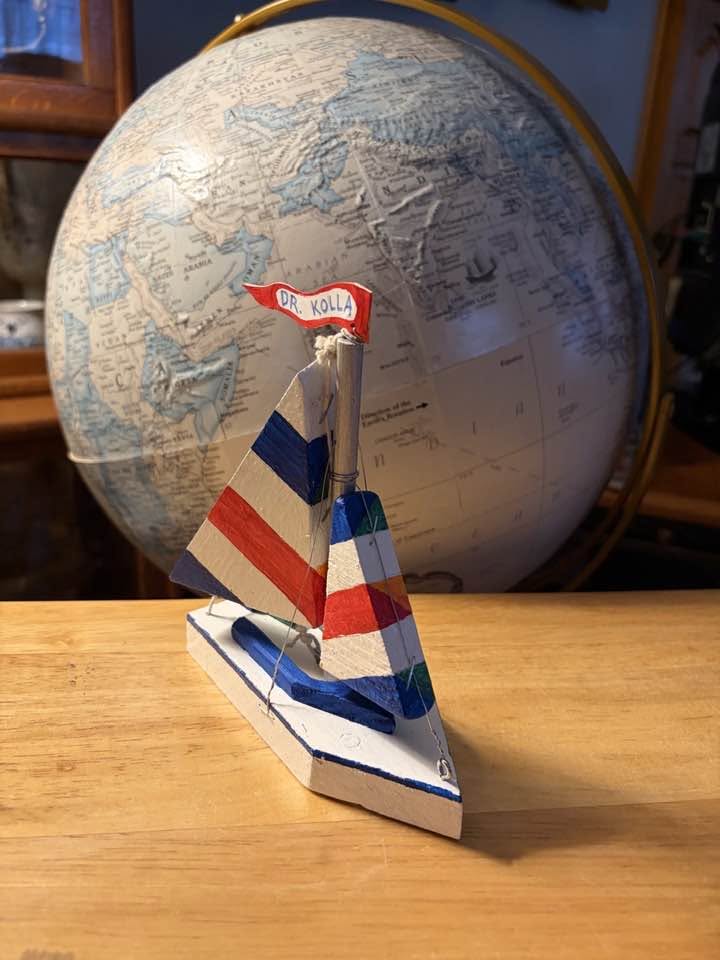
When I recently opened the “draft” album, it released the long dormant but still vivid memory of Grandpa’s gratitude. Instantaneously, the recollection triggered an inspiration: presenting Dr. Kolla with a special gift in expression of my gratitude for having brought my life back from the edge of mortality’s abyss. I’d made 13 model sailboats from wood scraps. I still had on hand enough materials to construct two more. Number 14 would Dr. Kolla’s.
I set about painting and rigging the wooden sails. The project took me a couple of weeks, and I made finishing touches early this morning, just two hours ahead of my appointment.
Meanwhile, I put words to paper, expressing my thanks and adding reflections that had occupied my thoughts during construction of the model:
Dear Dr. Kolla,
This letter accompanies a small token of my boundless appreciation for your kindness, your genuine caring, and of course, your medical expertise so generously extended to me over these past nearly four years. Below I’ll add a measure of amusement regarding the origins of this token and its symbolism. But first I’m compelled to provide an account of my inspiration . . .
I then told of Grandpa’s example and went on to describe how white painted wood scraps in the form of (orthogonal) triangles had sparked the idea of building small sailboats with wooden sails. After providing this background, I mentioned my sailing background and addressed the metaphorical aspect of the model vessel.
. . . For decades I enjoyed sailing on our lake, but over the past eight or nine years, I’d grown lazy. Launching the boat each spring and hauling it out each fall was a chore; plus, rigging ahead of every “cruise” took considerable time and effort, and all too often I had no crew. Eventually, the boat never left “dry dock” and became a “lichen garden.”
But I miss those halcyon days of free-spirited sailing hither and yon over our sizable lake (I pretended it was “the world”; in favorable winds, I’d sail the inner circumference of the approximate oblong shape of the lake and treat the excursion as circumnavigation of the globe).
By building model sailboats, I could connect with that past. Soon the “boat project” came to symbolize something more than an obsession of my youth. Now it represented my worldview; that as much as we see the world as flat and often treat it so, the primary beauty of humanity’s home is its spherical form: no matter what course you set, if you travel far enough, you’ll wind up where you started—your beginning is your end; your end is a new beginning—ad infinitum. A correlative concept is that when you travel on the surface of a sphere, the horizon is illusory, no matter how definitive it might appear.
This leads to a paradox: as you travel on a sphere, you continuously see both the horizon and what’s beyond it, yet you never actually reach the horizon.
So it is with life. It’s a grand paradox of horizons that surround us and that we can exceed but never reach. As I worked on your model sailboat, I pondered these ideas, and smiled at the notion that you, a person very much of the “spherical world,” could doubtless relate to them. For extra symbolism, I painted one side of the sails red, white and blue, representing our common country, and the other side, saffron and green, in honor of your far off (from here, anyway!) land of origin—and the place, as it turns out, that produced the doctor who would allow my boat to sail beyond the horizon, beyond what seemed at the time to be the very close edge of a very flat earth!
I’ve learned much from my journey with MM. You have served as the best helmsman the gods could have summoned for me, Dr. Kolla, and I shall be forever grateful for what you have done on my behalf. May this model sailboat serve as a symbol of that gratitude, but also of friendship and encouragement, as your life, your family, your profession, your contributions to humanity carry you past one horizon after another. May your “boat” carry you to wondrous and bounteous places, and in the tradition of nautical farewells, “Fair winds and following seas.”
Kind regards,
/s/
In keeping with the themes of the letter, I wrapped the sailboat in the very same blue (as in ocean blue) tissue and cardboard that my good friend Erik Hansen had used on the model sailboat he’d presented to me just two days ago (see my 11/3 post). After printing the letter, I rolled it up, bound it with green twine and placed letter and boat into a perfectly sized box in which Beth’s monthly bouquet vase had been delivered to our house yesterday. Off to the appointment I drove.
Coincidentally, during the 15-minute drive I listened to a discussion on MPR about dealing with “political grief.” Wise voices spoke of the need to focus on what a person can and can’t control and influence, and above all, to cultivate gratitude.
The appointment with Dr. Kolla spawned a memorable conversation; a mix of reassurance based on the latest labs (all good), reminiscences, aspirations, promising treatment developments, and the seamless transition to Dr. Jahagirdar, head of HealthPartners Oncology Group, Dr. Kolla’s mentor, and by all accounts, “The Doctor who Walks on Water.”
Dr. Kolla then pulled out a business card and used it to jot down his personal mobile number and email address. He drew a second card and asked me to do the same. “I want to stay in touch,” he said.
“Same.” At every encounter with this miracle worker, from the very first—a phone call to introduce himself the week before my initial in-person appointment the first week of January 2022—through to the passing of phone numbers and email addresses, Dr. Kolla has proved himself a paragon of humanity.
* * *
Now here comes the really, truly, amazingly “cool” part of the story . . . When I recounted it for Illiana on the way home from school today, she said, “I don’t think that’s a coincidence.” She was right, as she is about so many of her insights into human interactions.
When Dr. Kolla unwrapped the ocean-blue paper, bringing the sailboat to the surface, his face lit up. “Did you know I like to sail?” he asked. Until hearing the question, I’d had no idea, no inkling that he’d ever boarded a sailboat—or any kind of vessel, for that matter.
“I love sailboats,” he said. “I love just going with the wind, no motor. I hate motorboats . . . Well,” he caught himself, “it’s not that I hate them, but I much prefer sailboats, especially simple ones.”
He went on to tell me how he’d taken sailing lessons at nearby Lake Phalen. I was familiar with the program and know others who’ve taken instruction there.
We both were quite flabbergasted over our shared affinity for inland sailing. “I’m going to put this on the mantel,” he said with his trademark smile. The meaning aboard the simple little model sailboat with wooden sails was now greater than I had imagined.
It was time for Dr. Kolla to move on to his next patient; time for us to say good-bye. We stood up, and as I gathered my cap and coat, he said, “I’ve got to give you a big hug.”
“Yes,” I said. “Now stay in touch. I mean that.”
“I will,” he said.
Subscribe to this blog and receive notifications of new posts by email.
© 2026 by Eric Nilsson
