MAY 2, 2026 – This morning I put all concerns about the larger world aside—along with most of my personal worries—and drove straight to the Red Cabin. Well, not exactly straight there. In Cumberland, Wisconsin I encountered a detour, which took me straight east, not north, all the way to Rice Lake, halfway across Wisconsin, it seemed, and a veritable metropolis compared to the wide spots that we usually pass through on the more direct way to the lake—the towns of Turtle Lake, Cumberland, Shell Lake and Spooner, and the unincorporated hamlets of Range, Comstock, Baronett, and Stone Lake.
As I followed the detour through Cumberland, I thought about my first day of class in my Western History survey course my freshman year of college in another small town—Brunswick, but in the far off state of Maine. The course was led by Roger Howell, President of the College, and Paul Nyhus, Dean of Students and Dean of the College. The first order of business was for our esteemed leaders to introduce themselves and describe their backgrounds and academic credentials. Dean Nyhus identified his hometown as Cumberland, Wisconsin. This fact surprised me back then, and it returned to me today, as I wondered what life in that town was like when Dean Nyhus was growing up back in the late 30s, during the war years and into the 50s before he left town for Augsburg University, a Lutheran school in Minneapolis, then Harvard Divinity School and Harvard Graduate School in Arts and Sciences, for his PhD. Who were his parents, I wondered. Was his father perhaps pastor of the Lutheran church that we pass each time in Cumberland? (Nyhus is an eminently Swedish name, and most Swedes of yesteryear were Lutheran.)
As I drove east along the detour through rural northern Wisconsin, I felt regret that I hadn’t interacted more with Dean Nyhus. However busy he probably was, between teaching and discharging his administrative duties, he was approachable and accessible. Moreover, he was an impressive scholar, and had I been more deserving of admission to the college, surely I would’ve profited more from his lectures and academic insights. Oh how now I would like to sit down with him over coffee or a meal talk about the study of history and its guidepost qualities for interpreting events of our own times. He was only 37 when he co-taught that course fall semester 1972—with President Howell, who was all of 36. How could that be, I thought, as my classmates and I anticipate our 50th college class reunion later this month.
My figurative and physical detours didn’t materially alter my originally anticipated arrival time at the Red Cabin—11:20. The one personal worry that I’d carried to my destination was the possibility of frozen pipes, given our non-functioning furnace, the condition of which I’d discovered on my most recent previous visit 11 days ago, and in the interim, several overnight lows in the deep freeze.
If I’m not Irish, I’ve got their luck. My one worry was now reduced to a far lesser concern: how much additional wood would I need to split to keep the wood-burning stove in business for my guests—my niece Linnea and Brad? (Beth had opted out of the trip, given the lack of a functioning furnace and the forecast of cool temps overnight.)
Linnea and Brad arrived about an hour after me. Two months ago they’d volunteered to help with installation of one of our three docks—the one too wonky to try to explain to the marina that installs the other two. I readily accepted Brad and Linnea’s offer in light of the irrefutable reality that I’m a year older, not a year younger than I was last year. If I want to live to install the wonky dock (with help) in 2027 and beyond, I figured acceptance of help this year would be good training and good insurance.
In the event, the wonky dock installation went perfectly. My two assistants were quick learners with high standards and provided proficient and efficient help every step of the way. We completed the task in record time, with a total absence of snafus and “re-do’s.” Emblematic of our mastery of the art and engineering of wonky dock installation was the extraordinary fact that only one simple shim was required among three sections of dock. Normally, the level bubble requires that I deploy multiple shims.
I was ecstatic. To avoid falling short of expectations, I’d planned on installing only the stairs leading down the bank to the dock and the first section of dock. With hours to spare before sunset we staged a ceremonial selfie marking the early finish. Best of all, no one suffered any injury, though Linnea snagged a small non-problematic splinter.
To celebrate, we ate dinner out at Trail’s End on the east bay of Lac Courte d’Oreilles, Grindstone’s sister lake. For dessert before returning to the Red Cabin, we watched the running of the Kentucky Derby.
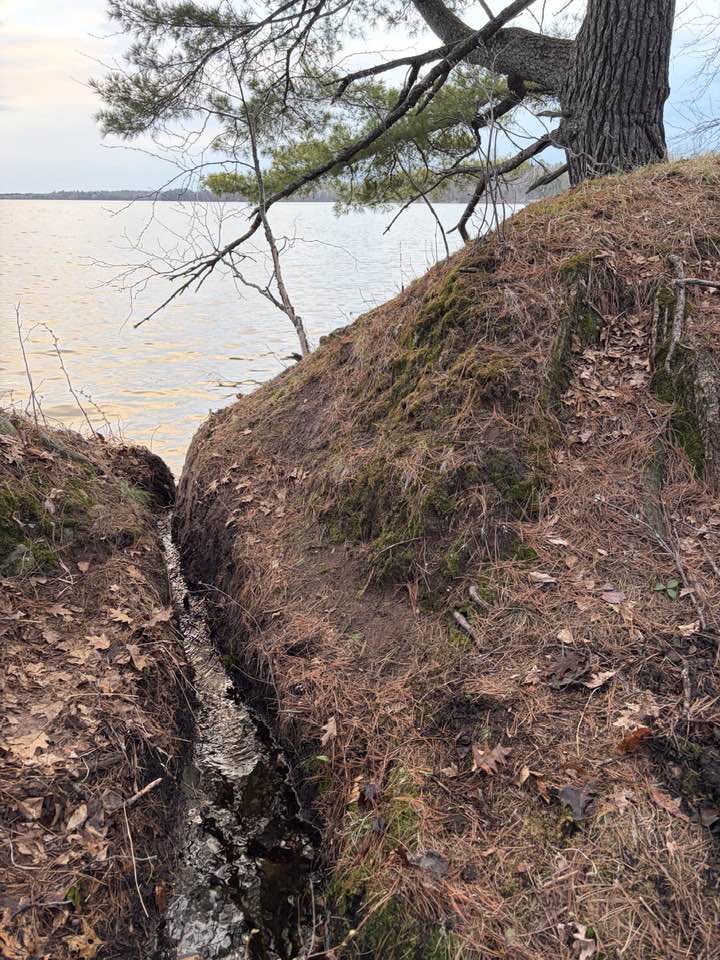
Without really intending to do any more work, I watched, then helped Brad clear the narrow channel west of the Red Cabin. I told him that for all his efforts, and Linnea’s too, the couple would be rewarded a special camp badge yet to be designed—and a standing invitation for return visits to the Red Cabin. The very best guests are those who leave with work camp badges.
Subscribe to this blog and received notifications of new posts by email.
© 2026 by Eric Nilsson
