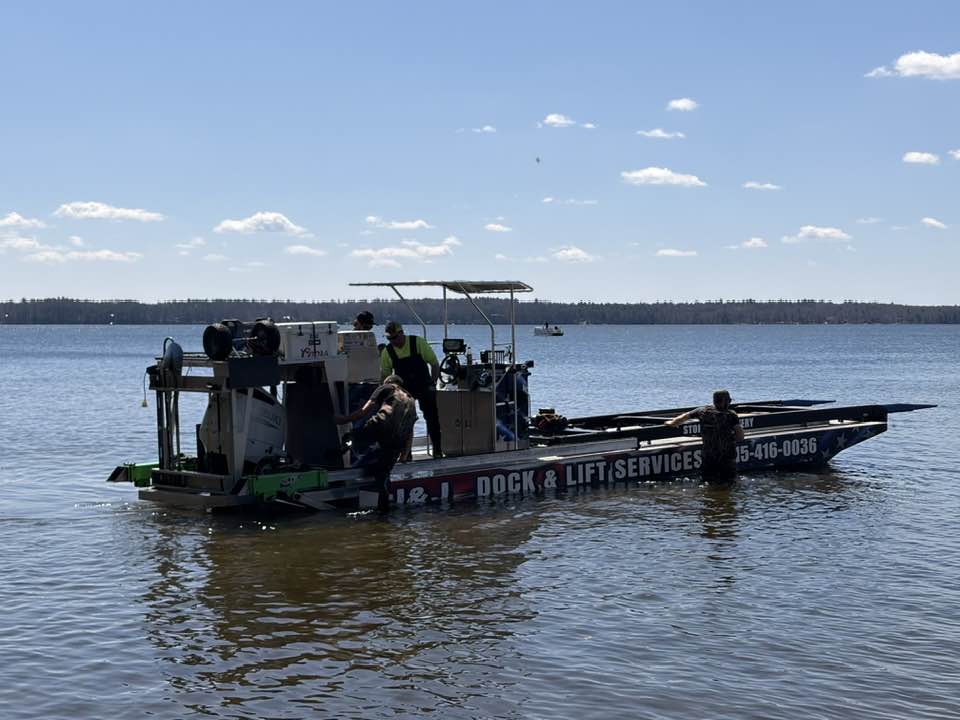
MAY 3, 2026 – This morning we—the two “work camp badge winners” from yesterday, and I as work camp director—wrestled with a first world problem while the rest of the world wrangled with real world problems. Our “first world problem” was the broken but still attached tree trunk dangling like the sword of Damocles or, depending on how it might ultimately fall, the club of Heracles.
The five-inch-thick maple—one of a set of 85-year-old triplets right outside the front bedroom of the old cabin at Björnholm—had snapped in an ice storm in March. Apart from the violent tear that had left the upper third of the tree dangling over the ground, there was nothing wrong with the wood. Two weeks ago I’d pruned and trimmed as much as I could from the suspended trunk and had then tried to twist it to the breaking point—mindful that if it gave way, I’d need to run fast to avoid serious damage to my precious self. (I made sure my potential escape paths were free of obstructions—how ironic, I thought, to dash away from a tree trunk flying toward me, only to knock myself out by running into another tree.) Despite arduous effort, I’d been unable to wrest free the sword from its “threads,” which were more like ropes. As I knew from pruning and cutting maples, their sapwood and heartwood is unusually sinewy, and no matter how much I turned and twisted the broken trunk, the remaining fibers held with extraordinary tenacity.
I led the “work camp badge winners” to the site, tied a long rope to the bottom of the dangling trunk/sword/club and again tried to twist it free. Brad took charge after a while, but he was no more successful than I had been. Plan B: I chased back to the Red Cabin to fetch my pole saw and returned with added confidence that we could triumph. I managed to find a narrow vantage point on the other side of the maple triplets where access with the pole saw could be achieved yet by standing behind the undamaged trees the sawyer could attain protection. About 20 pulls of the saw solved our first world problem—without bodily injury.
Shortly thereafter, another first world problem—then another—were solved, this time by complete serendipity.
Upon returning to the Red Cabin after dealing successfully with the sword of Damocles, I was visiting with Linnea in the living room (Brad was outside working on another “work camp badge.”). There came a juncture in our conversation when she peered out the window at the lake, distracted, I sensed (I was looking away from the lake), by some unusual sight. I looked for it and saw not far out from shore, a dock and lift installation barge of the sort one often sees in lake country in spring and fall. Having just installed our landing dock yesterday, I was eager to have our lift put in but hadn’t yet gotten around to calling the marina that does the work for us. In the last contact with the marina, the word was that if the dock wasn’t in by last Monday, I’d have to wait until after Memorial Day to have the lift installed. Yet here now was their barge (equipped with a front-end forklift), passing right by!
I jumped to and flew out of the cabin and to the top of the berm directly in front. I had no idea I could still move so fast. Waving my arms wildly, I yelled, “Hey! Hey! Hey!” to the crew of four as they motored along our shore. They saw me, and the skipper then slowed and turned toward the shore. I now dashed the 150 feet to the landing dock and awaited their approach.
It turned out they were not from the marina. They were competitors, just two guys, Jason and Jeremy, and their barge and crew of two. It took less than 15 seconds to make a deal, and for half the price charged by the fancy marina, I had arranged for the lift to be installed—as I watched, then and there—and, to have them redo the marina’s unsatisfactory installation of our other dock back in front of the Red Cabin. I explained my dissatisfaction, and with impressive efficiency and proficiency, Jeremy and Jason—“J & J Dock and Lift Services”—re-set the dock to perfection. I was thrilled.
Like any old person, I watched with a critical eye, but I could see that the J & J personnel knew what they were doing—and cared about their work—so I was careful not to get in the way. In the course of operations, Jason mentioned the “missing canoeist” on Grindstone yesterday. Two sheriff deputies had stopped by when we were putting in the landing dock, and I’d noticed a small plane circling very low along our shore. One of the assistants then commented, “I think it was probably a tribal member.” (As of this late hour, I’ve found no news and wonder if the “missing canoeist” was nothing more than a “runaway canoe” (slipping off the shore) that someone spotted out on the lake.) The way this was put—“a tribal member”—suggested to me that the crew assistant (and perhaps all four guys) were also tribal members. Rarely have a heard a white person refer to local Indigenous residents as “tribal members.”
I couldn’t help myself. “You know,” I said, as the guys worked, “I’ve been reading a lot of history lately, about Native people, and of course, I always knew that back in the day they were treated horribly, but just how horribly and how often . . . I really had no idea.” I was thinking of Ned Blackhawk’s book.
“You got that right!” said the crew member spontaneously. Something told me that a northwoods white guy wouldn’t be so quick with that response. Again, my experience among local whites is that often they’re critical of the local Native people and rarely empathetic.
“As an older white guy,” I said, “I have to wonder what I can do about history besides acknowledge it.” The crew guy—who, by the way, had been working his tail off, carrying double loads of decking, and helping shim the dock leg pads—expressed agreement.
The rest of the crew was silent, but the young man with whom I’d carried on the exchange was perfectly comfortable talking about it in front of the others, which suggested to me that all four shared common views and were themselves “tribal members” or had close ties with those who were. I could be all wrong in my perceptions, but in any event, as a result of my recent plunge into Native American history, I’m far more aware now than I had been. And yet, I’ve been in such close geographic proximity to the local tribe my entire life. Why has it taken so long for this curiosity to surface?
One of my goals this year is to learn more; meet more people from the Lac Courte d’Oreilles tribe; visit their resource center; establish contacts; bridge the enormous void between my culture and theirs.
Having helped solve the above-described first-world problems, the “work camp badge winners” bade farewell to me and the Red Cabin. I then hiked up to the “Pergola-on-a-Platform,” where in splendid weather conditions I measured, cut and fitted the last two pieces of the project—the 1 x 6 tops to the platform railings. The foliage has yet to unfold in this part of our planet, but the birdsong of spring has returned. From the platform, I could see across the lake and over the opposite shore. In another week or two, that vista will be replaced by a curtain of green. In the calm air and warm sunshine, I found nirvana; satisfaction with life aboard a vessel with an even keel—in the moment, at least, removed from nature’s tempests and humankind’s disturbances.
Subscribe to this blog and received notifications of new posts by email.
© 2026 by Eric Nilsson
