APRIL 9, 2026 – By way of background for new subscribers who are most unacquainted with me, I hail from a family of professional violinists. It all started with our Grandfather, whose mother had died when he was an infant, and whose father, a Swedish immigrant who worked ungodly hours as a Minneapolis streetcar conductor, arranged for Grandpa to study the violin—as an alternative to getting himself into regular jams as an unsupervised roving young kid.
Grandpa went on to make something of himself on the violin, and as a young man, he made his living playing in the pit orchestras of the movie houses along Hennepin Avenue in Minneapolis. When America entered the Great War (as WW I was then called), Grandpa was first drafted into the army, and once in France within earshot of daily bombardments, he was drafted into providing evening entertainment for military brass enjoying the good life in chateaux a safe distance behind the front. (This gig, however, didn’t exempt Grandpa from having to rejoin his ammunition supply unit and facing the attendant dangers of war.)
After the Armistice, Grandpa returned to Minneapolis and eventually established a music school where for years he taught the violin—doing just fine even in the depths of the Great Depression, thanks to his entrepreneurial door-to-door campaign to round up students (and rent and sell them violins).
When my sisters and I came along, he launched each of us on the violin as well—no door-to-door sales pitch required. My sisters were naturals. But more critically, they were disciplined and had a burning desire to become great violinists. They never had to be told to practice. For each of them, playing the violin became a storied career.
Then there was me.
At five I was eager to join the fun. The novelty of drawing the bow across the E-string (four times, then taking a rest before another four times) and thus teasing sound out of the starter violin, left me giddy. But since the violin is the easiest instrument to sound bad on, the novelty soon wore off. Out of deference to Grandpa, whose scowl and disapproving voice could set you straight if need be, I stuck with the program, but practicing was a chore. It wasn’t long before I joined the Resistance . . . of one, as it was to be in our household.
It’s a wonder—but more so, it’s a testament to my parents’ iron will—that I continued with lessons right through elementary school and into what was then “junior high.”
As Grandpa aged, we were handed off to Mr. Swanson, who taught us from a collection of music books by one “Merle Isaac,” whose portrait graced the front cover. If I’m not mistaken, Mr. Swanson had been one of Grandpa’s students. My clearest memory of Mr. Swanson and Merle Isaac was learning the notes to “Long, Long Ago.”
Merle Isaac and Mr. Swanson could take us only so far, however, and they were soon succeeded by Anthony Gilombardo, a former member of the Minneapolis Symphony and mainstay of the Golden Strings—a string ensemble of former symphony players who provided live, strolling entertainment in the posh Flame Room restaurant of the old Radisson Hotel in downtown Minneapolis—who had also established the “Gilombardo School of Music” near the main campus of the University of Minnesota.[1]
Gilombardo cut a dashing figure—a virile dark-eyed Italian-American from Staten Island, with an angular face that reminded me of pictures I’d seen of New Hampshire’s Old Man in the Mountain. In his youth, he’d been a Golden Gloves national champion; in his early 20s, he was a tail-gunner on a B-17, shot down after a bombing run over Germany, but parachuting safely into the hands of friendly forces just over the line. His dark suits were well tailored, and his fedora was always positioned to perfection. He drove a black Fleetwood Cadillac, and when he pulled into the driveway, then stepped forth and pulled out his violin case from the back seat, he looked as though he’d arrived from central casting.
Gilombardo was the paragon of posture, and when he put his rare Amati[2] under his chin and played licks from “war horse” concerti as I was pulled the violin and bow from my case, our teacher looked and sounded like Heifetz.[3]
In any event, Gilombardo stood on his head to heighten my interest in the violin, but my career in the Resistance eventually led to my exile sans violon to a boarding school in Vermont. As long-time blog subscribers know, however, that school turned me around. It was there where I rediscovered classical music—and the violin—on my own terms.
The summer following that year of school in Vermont, my sister Elsa arranged for her sometime boyfriend and classmate at Interlochen Arts Academy, I-Fu Wang, to give me lessons to prepare for a taped audition for Interlochen. Elsa and I-Fu had just graduated from the Academy. Headed for the Curtis Institute in the fall, for the summer, instead of traveling back home to Taiwan, I-Fu stayed with the family of another Interlochen friend, Mike Antonello, who lived not far from Anoka. I-Fu played with great technique, and he was the first teacher I’d had who required scale work. I didn’t enjoy it, but in time I realized how critical it was to mastery of violin technique overall.
After practicing up a storm, as if I’d been swept up by a tornado of desire and discipline, I was admitted to Interlochen, where I plunged headlong into what would be an intense, three-year commitment to the violin. My first teacher at the Academy was Luis Grinhauz from Argentina. I don’t remember much about his instruction except that his English was hard to understand, leaving me to decode his exhortations by way of demonstrations on his violin. After my sophomore year, Grinhauz left to be assistant concertmaster of the Montreal Symphony. With his pianist wife, he also helped establish the chamber group, Musica Camerata, a side-gig that would last 50 years.
For my second and third years at Interlochen, I studied with Brian Hanly, a native of Australia and graduate of the famous Jacobs School of Music at Indiana University, where he studied with Josef Gingold, one of the great violin pedagogues of the 20th century. He’d also studied under Ivan Galamian (later, my sister Elsa’s teacher) and Dorothy Delay, two of the other titans in the world of violin pedagogy. Mr. Hanly, probably then not yet out of his 20s, was kind but serious. I practiced hard under his tutelage, and made progress, but it was gradual. There were no “Eureka!” moments or other breakthroughs in musical or technical proficiency.
During summers back home, I took lessons with Gilombardo—but on a completely different footing from my earlier studies with him. I practiced like a fiend, which produced results, and with frequent demonstrations on his golden-stringed Amati, “Mr. G,” as everyone (except me) called him, he inspired me to put mind, heart and soul into the music of Lalo and Saint-Saëns. Gilombardo was an inspiration because he himself was so inspired.
During my first year of college in Maine, it was my oldest sister, Kristina, who was then pursuing her masters at New England Conservatory, who arranged for me to study with her teacher, Max Hobart, assistant concertmaster of the Boston Symphony. Max was down to earth, kind, articulate, and not the least bit up tight or full of himself, he had a great sound to match his technical mastery of the violin. I studied the Mendelssohn with Max, plus Bach’s Sonata No. 1 from the set of six partitas and sonatas for unaccompanied violin. He was excellent at demonstrating what could be done with the music, but when it came to advancing my technique, I was on my own.
In retrospect, I regret what was lacking in the instruction afforded me by the above-described teachers. I regret that none of them sat me down, looked me straight in the eye and said sternly and unforgettably:
- “In all art forms, technique is the key to expression. That’s especially true of a stringed instrument, particularly in the case[4] of the violin. And remember what Jascha Heifetz famously said, ‘If I had only an hour a day to practice, I’d work on scales for 55 minutes and repertoire for the remaining five.’”
- “If you really, really, really want to be a great violinist, you can be, but only if you’re willing to practice with unrelenting (a) focus; (b) analysis; and (c) dedication to improving yourself in every session. To make sure you know how to practice, half of each lesson will be a practice session, in which you [Eric] practice and I [the teacher] observe and critique how you practice.”
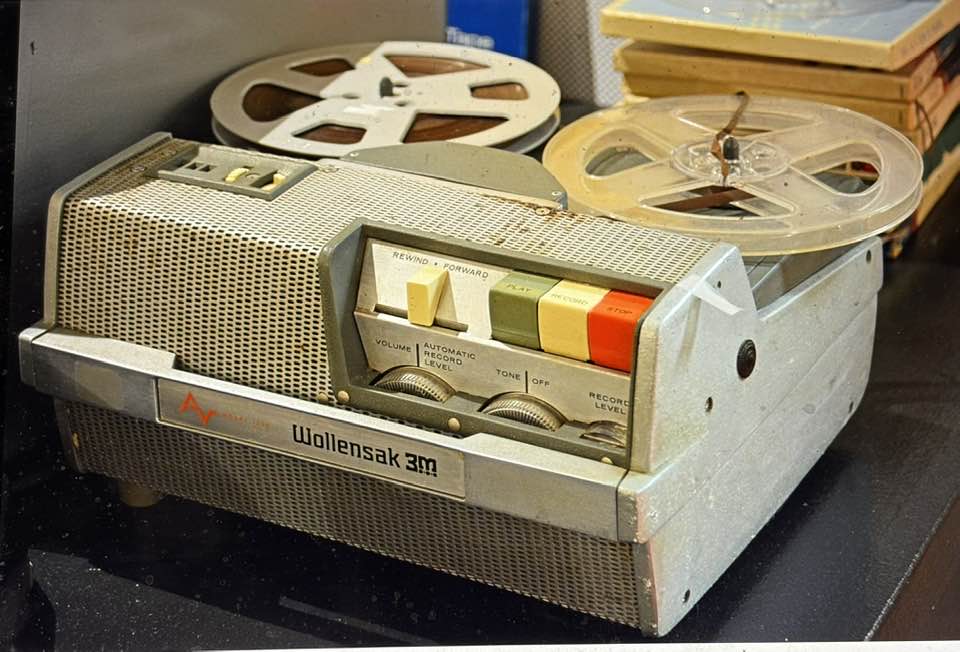
- “On a regular basis (at least twice weekly), I want you to record your playing—then listen and critique it. The best teacher in the world is a recording of yourself.”
My sister Kristina is the one who clued me in on the third point. She imparted this wisdom to me years ago. Unfortunately, I was too chicken to follow it, and when I finally got around to hearing myself, I recoiled with disappointment and despair.
But recently, out of practical necessity, my attitude changed, and . . . here’s the best part: thanks to “the best teacher in the world” combined with an appointment with my dermatologist, I experienced the biggest break-through of my musical career (such as it’s been). (Cont.)
Subscribe to this blog and receive notifications of new posts by email.
© 2026 by Eric Nilsson
[1] Decades later, the hotel was razed to make way for an office building that would house my old law firm—along with a new Radisson Hotel on the first seven floors.
[2] Nicolò Amati (1596 – 1684) was a Cremonese contemporary of Antonio Stradivarius (1644 – 1737). Amati was the recognized master during the early career of Stradivarius. Today Amati violins command auction prices between $300,000 to $600,000.
[3] When I was a young kid, I didn’t know any better, but as an older student, I realized that Gilombardo was a master at dropping notes in dazzling runs—a skill that he’d developed no doubt, as a symphony player, not to mention as a member of the “Golden Strings.”
[4] So to speak.
