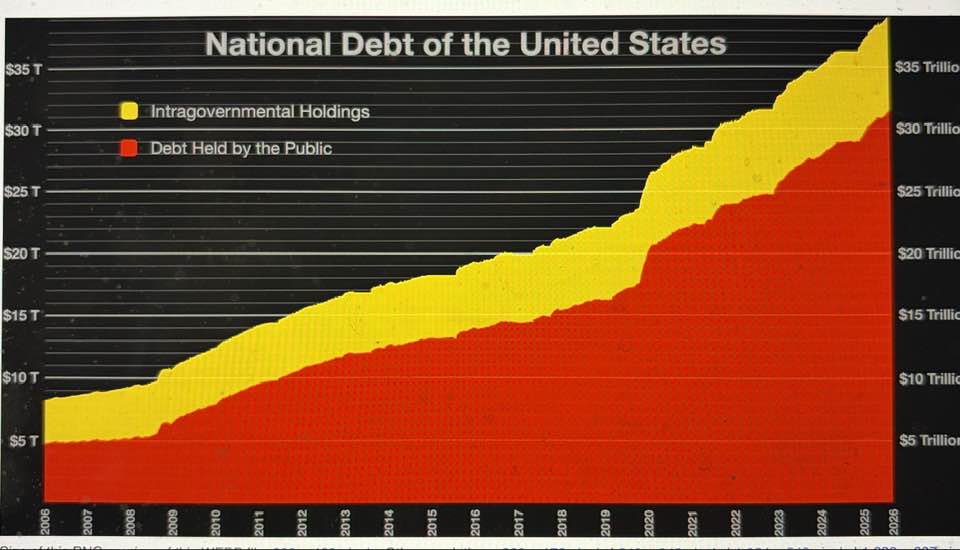
APRIL 8, 2026 – Despite bombs bursting over Beirut, now that the fuse to yesterday’s White House insanity has been cut below the shower of sparks, we the people of short attention spans can turn to other challenges; problems with slightly longer fuses and less prominent dazzle—at least by the measure of “clicks” in our Age of Pavlovian Canines.
First on my list would be anthropogenic climate change. At the close of this post, I’ll return to that exigency. Second in priority is the ongoing political crisis in the U.S. That matter is so loud and clear, our equilibrium demands a brief respite to allow regeneration of faith and fortitude, at least by us who fervently believe that the crisis resides inside the White House and Republican Congressional conference, not within the opposition. Third—and the main subject of this post—is the public debt and its portent if we ignore this storm cloud . . . or mishandle it via the catastrophic method deployed by Elon Musk and his chainsaw.
The basics:
- Currently, the total debt of the United States—that is, money we owe to the holders of U.S. Treasury Bills and Bonds—is $39 trillion. Absent reference points, this is a meaningless figure. It’s like saying there are 30 to 37 trillion cells in the human body—also a fact, but how does that help us understand anatomy or physiology . . . or illness and disease? What gives the $39 trillion some context are the following figures:
- $114,000, which is the per capita (i.e. every single American, infants to centenarians) share of the total debt;
- 15%, which is the rate of increase of our total debt over the past 15 years (vs. an increase in population of only about half that rate—due in large part, by the way, to net immigration (until January 2025));
- $600 billion, which is the projected deficit for the current fiscal year. (Increases in the total debt are due to deficit spending—the amount by which federal government outlays exceed tax revenues.);
- $37 trillion, which is the combined GDP of China, Germany, Japan, India and the UK—$2 trillion less than the total U.S. debt;
- 3.365% ($623 billion) annually – the current average annual rate of interest on the total debt. This rate is a bargain to be sure, next to most consumer and commercial loan rates, but “good things” don’t last forever;
- 60%, which, of total government spending, is the portion allocated to military spending, Social Security and Medicare benefits and interest on the total national debt. Over the next decade, almost 90% of projected increases in federal spending will be among the aforesaid categories. That means everything else, from DHS to whatever’s left of the DOGE-gutted agencies that actually benefit Americans, will receive the crumbs of future spending increases.
But what does all this mean? How does it affect us? Without dragging the reader too far down into the weeds, here goes . . .
When things were bumping along in their usual fashion pre-2025, our financial profligacy, as conservatives characterized it, was like a 40-year-old basketball player’s knee—it still worked but the future didn’t bode well, given the increased odds of arthritis and other age-related deterioration. But when the 40-year-old knee would become a 50-year-old, then 60-year-old knee, the years of neglect and abuse and weight gain would take their toll. If drastic intervention weren’t pursued, options would include a cane, a walker, a wheelchair, or, as in the case of a brother-in-law, above-the-knee amputation. Not good.
Given the current state of our country, in many ways, our national debt and deficit have reached the stage of that basketball player’s 50-year-old to 60-year-old knee. The past year has brought additional injuries to the knee—exacerbating the condition caused by years of high-octane, hard-playing (“spending”?) on the high school, college and . . . YMCA (men’s league) courts. And now, a host of bone-headed moves, from injecting ICE with steroids to shooting missiles at Iran (with the Pentagon’s attendant “ask” for $1.5 trillion next year), have brought further pressures down on that bum knee.
I used to have too many things to worry about in the short and immediate terms to lose much sleep over the challenges that awaited the day after the morrow. The prospect of future inflation based on growing national debt and expanding deficits was among those problems better left for a later day. But so much has happened over the past year, what was once a distant worry has now shifted much closer—and become far more dangerous. It’s no longer a “bum knee.” It’s morphed into a reenactment of Ethan Frome’s fateful trip on a sled.
If America continues its decline, the sledding could become much more dangerous as our Fleetwood Flyer accelerates. Without a course correction, which becomes more difficult to achieve as our descent accelerates, we’re bound to hit the big cottonwood at the bottom of what’s best called, the slippery slope of the “Trump Hump.”
One day the Age of Trump will likely be viewed as a harbinger as much as the cause of the fateful slide down that slippery slope. Consider the following:
- Neglected physical infrastructure. Sure, we’ve built lots of new and shiny things, most notably, Silicon Valley—figuratively representing itself but also tech corridors around the country, but we’ve allowed huge swaths of the country to deteriorate in almost every category of modern minimal physical infrastructural maintenance, repair and replacement. A robust economy depends on solid, modern foundational physical infrastructure. Our infrastructure is replete with gaps and cracks and worse. In some now well-publicized areas (e.g. Flint, MI and Jackson, MS) something as basic as potable tap water has failed.
- Intangible infrastructure. The two big items here are primary and secondary public education and access to affordable quality healthcare Falling student performance in math and science, reading and writing, and general knowledge threaten future economic productivity. The growing crisis in the cost of and access to quality healthcare, also translates to a large drag on economy. In both education and healthcare, the long-term costs of neglect and dysfunction include the expense of remediation as well as long-term loss of economic productivity. None of which works in favor of paying down our debt or decreasing our deficits; in fact, our dire infrastructural needs point to ever increasing outlays—or, in the case of deferral, ever higher direct and indirect costs in the future;
- Declining immigration. Before Trump’s ICE rampage, undocumented immigrants were paying close to $100 billion a year in state, local and federal income taxes and over $32 billion in FICA (Social Security and Medicare) taxes (for benefits undocumented immigrants don’t receive). [1] Their consumer spending was at an annual rate of $300 billion,[2] and according to the Congressional Budget Office, undocumented immigrants were on a trajectory to add $7 trillion to the economy over the decade from 2024 to 2024. In addition to losing all those economic benefits, America faces an even deeper, darker prospective loss: because of the Administration’s war on research and war on institutions of higher learning and overall policy of xenophobia, how many productive and hard working laborers, scientists, innovators, entrepreneurs, other economic game-changers from other countries will turn elsewhere from the U.S. to pursue their goals and dreams? And how long before Americans themselves begin to migrate to greener pastures?
- A culture of grift, corruption, political dysfunction, and authority by tactics of power instead of the rule of law. Perhaps the most significant and lasting damage wreaked in the Age of Trump is (a) the ascendancy of grift and corruption and corresponding drag on the economy; (b) political dysfunctionality that precludes constructive problem-solving in the arena of our biggest challenges; and (c) contempt for the rule of law in favor of autocratic fiat backed by armed force. These ugly features that dominate the Age of Trump are America’s version of the Age of Orbán in Hungary—the economically stagnant and very lowest performing member of the European Union.
In aggregate the foregoing warning flags do not bode well for American prosperity. If our customary economic prosperity—however uneven across American society—declines, burgeoning debt and growing deficits will weigh that much more heavily on our prospects. At best, we will become the poor aristocrat with large holdings but not enough rent from them to heat the castle, let alone maintain and repair it. At worst, we won’t be able to service the debt that we secured by mortgaging the castle. The holders of that debt will come knocking on the castle door. When it still goes unpaid, they’ll foreclose, and when they foreclose, they’ll get to decide who gets to live in the castle and who must pitch a tent and where; and which of the bankrupt aristocrat’s precious possessions get sold and to whom and for what price.
OR . . . in an equally probable scenario, the exchequer of the realm will declare ordinary straw in the stables to be the new currency of the kingdom. Now the aristocrat’s tenant-farmers robbed of crops by wicked storms and wilting drought alike and thus without cash as well, can pay their rent with worthless stubble delivered by a wheelbarrow. In such case, the whole kingdom implodes as the debt holders discover their once mighty asset—the aristocrat’s liability—is now as worthless as straw.
But in any event, one day someday, long after the dispossessed aristocrat and family have been turned into tent dwellers cooking over campfires or, in the hyper-inflationary scenario, cooking over a fire fueled by straw, the castle ruins will become a tourist attraction, and visitors from China or Canada will alight from shiny tourist drones to spend the day taking holographic selfies with faded glories and fallen façades in the background.
At a minimum, however, the foregoing speculations will play out later than the day after tomorrow and thus, are none of our concern today. In the meantime, we have the accelerating effects of climate change. Those too can wait—until they can’t. The cost of climate change too will weigh heavily on our already ponderous debt and deficit. And as with most things that require money to remedy, the cost to cure will be a crippling multiple of the cost of prevention.
So, now, what to do about all this? Don’t despair. Keep the faith in our latent by true and tried resilience as a species and as a society. Celebrate what is good and condemn what is wrong. Eschew the lies and embrace the facts. And finally, make sure that you and everyone you can influence votes blue in November, remembering that “perfect” should not be the enemy of our national imperative and our best hope for recovery. Then hold our elected officials to the highest standards—of character, judgment, knowledge, deliberation, accountability, and concern for the common good.
Subscribe to this blog and receive notifications of new posts by email.
© 2026 by Eric Nilsson
[1] Institute of Taxation and Economic Policy.
[2] Center for Migration Studies.
