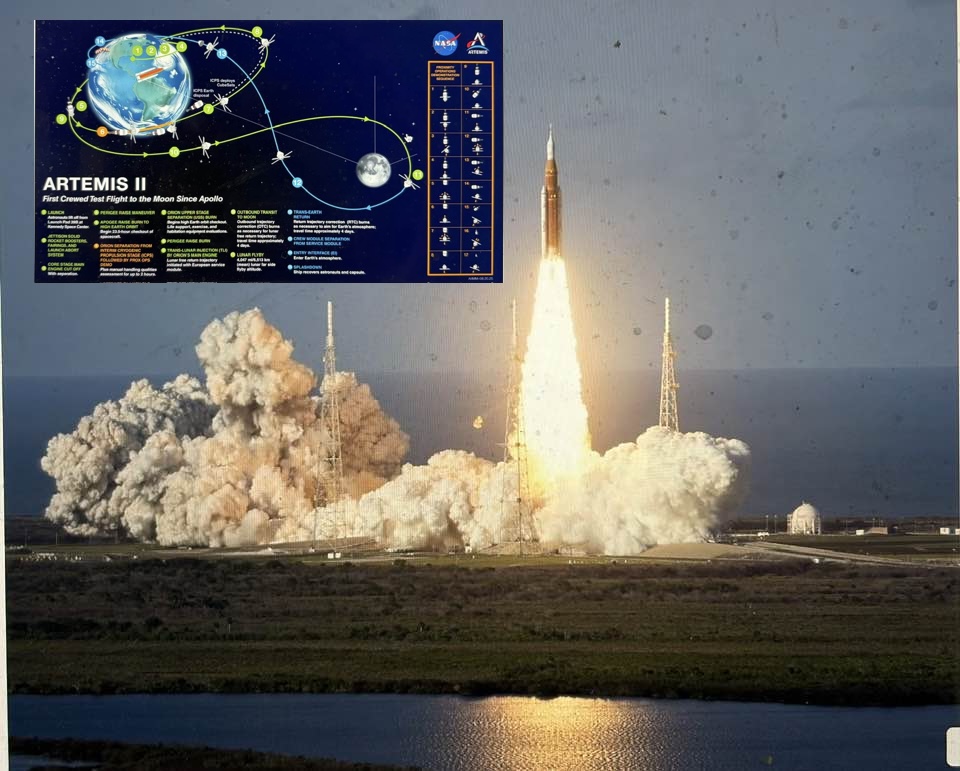
APRIL 2, 2026 – By the giddy chatter of TV reporters covering yesterday’s launch of Artemis II, viewers could’ve been excused for thinking that Neil Armstrong’s “One small step for [a] man . . .”[1] and the five subsequent manned lunar landings were figments of our collective imagination. “Historic,” “Never accomplished before,” and other “firsts” uttered by the reporters were baffling, at first; downright annoying after a time. What in the world . . . er, in space and on the lunar surface . . . are they talking about? I thought. And when their audience was reminded that the Artemis II crew were bound for the moon’s gravitational force, not the lunar surface itself, I laughed out loud. “One small step for [a] man . . .” I thought, “. . . one giant flyby for Artemis II.”
Nevertheless, I cut the reporters some slack. After all, they were expressing pure joy and excitement over an “out of this world” über-science/engineering project; not a Super Bowl halftime show or an All-Star Wrestling match or the final round in the World Championship Mud-Truck Rally at the “Metro-domedomedomedome,” but a truly stellar achievement involving a constellation of engineers and support staff, who, working in concert, placed four astronauts atop 8 million pounds of thrust and sent them into high earth orbit for a four-day-long sling-shot flyby of the moon, then a four-day return to earth for a fiery re-entry (at a record velocity of 25,000 mph) and safe splashdown off the coast of southern California.
Moreover, behind each person filling a mission-critical role were untold legions of educators, mentors, supporters, colleagues, et alia, who by various means and influences, direct and indirect, produced and enabled the “Artemis II Constellation” to reach for the stars—or at least the moon.
The NASA astrophysicist-father of our good friend, the good doctor,[2] Ravi Balasubrahmanyan, was not a fan of humanned spaceflight. He (Ravi’s father) argued that far more scientific progress could be achieved if the enormous sums allocated to humanned spaceflight (estimated at $100 billion, so far, for the Artemis program) were dedicated to unhummanned flights/research. But what evades empirical measure is the political and emotional factor. How many people are inspired to “shoot for the moon and stars” because fellow members of the species have physically travelled into deep space and landed on the moon? It was our fourth-grader, in fact, who’d alerted me to the televised launch. I’d heard about it but hadn’t paid it much head—again, mindful of the Apollo program that had put a dozen humans on the moon between 1969 and 1972. With Illiana at hand, we saw and heard the childlike exuberance of the on-site TV reporters and were looked with open-jaws at the lift-off itself.
And yet, as the SLS (“Space Launch Sytem”) carried the four astronauts inside the Orion spacecraft aloft, three intersection thoughts brought me back to earth:
One pertained to (Sr.) Dr. Balasubrahmanyan’s point, and a second applied to an extension of it: given the analyses provided by Adam Frank in his compact, accessible and entertaining book, The Little Book of Aliens (reviewed in my 3/6/25 post https://writemakesmight.net/the-benefit-of-going-wacko/ ), the laws of physics limit humanned travel beyond an infinitesimal distance on any galactic, let alone cosmic, scale; accordingly, why are we expending such enormous sums and human capital on “shooting for the moon” or even Mars?
My third thought prompted by Artemis II was the sky-high irony of leaving earth to colonize, ultimately, the moon and eventually, Mars. In the pre-launch chatter between the TV reporters and two former astronauts, the latter talked about the most powerful experience of their entire lives—viewing planet earth from space. How sad, in a way, I thought, that we need to leave the planet in order to “see” it; that is, to appreciate fully its majesty. And at a moment in the story of civilization when our home needs more care and attention than ever before, isn’t it odd and neglectful to train our sights on a rocky, lifeless, pockmarked, monochromatic orb for the main purpose of exploiting its minerals?
None of these thoughts was enough to move me to write to my Congresswoman and Senators urging them to defund the Artemis program. I’m too nostalgic about my youth, when I devoured books about the early space programs—Mercury, Gemini and Apollo—and followed each and every launch, flight and splashdown; and how on rainy summer days at the cabin, I’d lie down on the lower bunk in the back bedroom and pretend I was Gordon Cooper on his 34-hour, 22-orbit spaceflight aboard his Mercury capsule named, Faith 7—a mission plagued by serious equipment failures, to which he responded by manually controlling the descent and splashing down just four miles ahead of the recovery ship; and on other occasions at the cabin after the first moon landing, how I’d humor my parents and their guests by climbing down the ladder from the cabin loft, re-enacting Armstrong’s climb down the Eagle and onto the lunar surface. Upon reaching the bottom, I’d put a foot down, then pretend it was bouncing up from the reduced gravity on the moon, and mimic Armstrong’s famous line—without the article “a” before “man,” but imitating a transmission break as I did.
I’m an enthusiastic supporter of scientific research and discovery, and I’ve always been in awe of the stars and moon and mysteries of the universe. I’m just not sure that leaving our magnificent home should take priority over caring for it.
Subscribe to this blog and receive notifications of new posts by email.
© 2026 by Eric Nilsson
[1] As we heard them back on July 20, 1969, Armstrong’s first words from the moon were, “That was one small step for man, one giant leap for mankind.” I remember thinking, “Huh? That’s an odd couple of redundant phrases.” Only after Armstrong returned to earth and heard the recording did he explain that that’s not what he’d said; certainly not what he’d intended. Apparently, a transmission break obscured the indefinite article “a” ahead of “man.” With that explanation, the statement made sense: “That was one small step for a man, one giant leap for mankind.” (Emphasis added)
[2] When Ravi, a family physician, learned of my multiple myeloma diagnosis four years ago, he “went to school” on the disease and its treatment protocols. Every single evening after work (plus weekend calls) for the first four months of my treatment, Ravi called me to see how I was doing. I’m not sure how I would’ve endured those dark days without his remarkable support—and affirmation of the grand care provided by my oncologist, who coincidentally, had hailed originally from India.

1 Comment
Thanks for a thoughtful response to a thoroughly provocative issue. In 1969 I watched the “one small step” landing from a dingy barracks 40 miles north of what was then called Saigon. A few of us gathered around a tiny portable black and white TV the size of a loaf of bread, both amazed and frustrated that we could put a man on the moon but couldn’t get us out a war trying to bomb an enemy back into the stone age. Ditto again. Thanks for raising all the right issues. “When will we ever learn?”
Erik