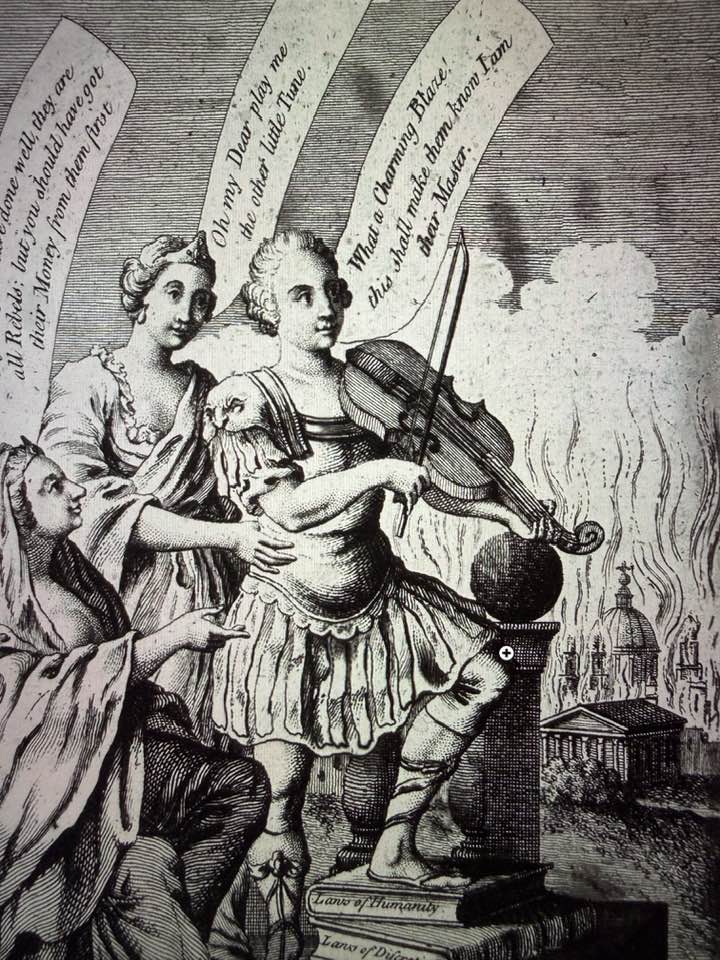
APRIL 1, 2026 – With the title of today’s post, I’ve taken obvious liberties with the famous expression, “Nero fiddled while Rome burned.” I’d intended to add to the unrelenting Democratic outrage and confounding Republican sycophancy over the Emperor’s obsession with Sharpie pens, The Ballroom, and Florsheim shoes while the black smoke from his impulsivity threatens to encircle the globe. The parallels between the Nero of legend and the Trump of today’s reality are unmistakable. I’d intended to use these to play off another parallel: “April Fool’s Day,” and the Fool in Chief of every day since Inauguration Day, 2025.
Moreover, against the backdrop of the latest and potentially most serious disaster of Trump’s reign, I’d wanted to remind myself—as well as my readers—that at the heart of Hormuz is the most serious issue of all: anthropogenic climate change driven by humanity’s insatiable thirst for petroleum-based energy.
But I was diverted; distracted in the usual way by the internet as I investigated—innocently—the origins of the ancient adage describing the ancient parallel to our current crisis: “Nero fiddled while Rome burned.” And “down the rabbit hole” I fell—knowing, at least the source of that in-vogue saying, Lewis Carroll’s mid-19th century classic, Alice’s [Mis-]Adventures in Wonderland.
My quick-and-dirty (so to speak) excavation project settled upon a paper published in Volume 42, No. 4 (January 1947) of The Classical Journal (Johns Hopkins University).[1] The piece is a gem of musical, literary and historiographical scholarship—not to mention being an example of superbly crafted prose. It explains the origins of “fiddle”—both the word and the instrument and describes treatment of Nero’s response to the great fire of Rome in 64 C.E., a full 346 years before the Eternal City was sacked, ironically, by Alaric I and the Visigoths. The Emperor, as we know, was part musician and part persecutor, and the article proceeds to survey the many literary sources that played a role in the development and perpetuation of the saying, “Nero fiddled while Rome burned.” If at the outset of my little dig I was but superficially interested in the provenance of that famous expression, by the conclusion of the spectacular article, I was wholly distracted from my original purpose: publishing a burning polemic castigating (still and again) the Every Day’s Fool and connecting the dots between the biggest immediate threat facing the world—a Trump-initiated recession—and the Horror of Hormuz.
Every bit as intriguing as the article itself, however, was the profile of its author, one Mary Francis [sic] Gyles. She was born in 1918 in Blackville, South Carolina, a town in Barnwell County in the southwest region of the state, established in 1837 as a railroad hub, mainly for shipping cotton. The town was named not after the involuntary labor that picked the cotton but in honor of Alexander Black, a superintendent of the South Carolina Railroad. Nevertheless, today, over 80% of Blackville’s 1,923 residents are . . . Black, as in African American, not (necessarily) descendants of Alexander Black.
Mary Francis Gyles lived to be 87, but I don’t know that 20 years since her death, many people in Blackville remember her. Today the town is best known for its free-flowing medicinal water known as “God’s Acre Healing Spring.” The record owner of the property is in fact, “Almighty God,” pursuant to an honest-to-goodness, bona fide deed (bequest) under the Last Will and Testament of one L.P. “Lute” Boylston probated in 1944. Apparently, testator Lute wanted to ensure that the spring water would be free for all of eternity—or unless and until Almighty God decided otherwise.
What’s remarkable about Ms. Gyles, however, isn’t her place of origin but her level of academic achievement. She obtained a bachelor’s degree in 1939 from the University of North Carolina, with a major in biology and a minor in chemistry. For five years after college she worked in hospital labs and as a chemistry researcher in nutrition as a college research assistant. Unhappy with the work, she returned to the University of North Carolina in 1944 for a master’s degree in . . . Ancient History and Classics. She then won a fellowship at the University of Chicago, but instead pursued a PhD back at the University of North Carolina. I’ve found only two publications to her credit—plus her brilliant exposition on the origins of “Nero fiddled while Rome burned,” but I wouldn’t hold this dearth of publications against her. I’m guessing that back in her day, women faced significant headwinds in academia and academic publishing.
What people do with their lives, their gifts, their curiosity—is a wonder to me. So too a wonder: how yet again, history repeats itself.
Subscribe to this blog and receive notifications of new posts by email.
© 2026 by Eric Nilsson
[1] https://penelope.uchicago.edu/Thayer/E/Journals/CJ/42/4/Nero_Fiddled*.html
