JUNE 23, 2026 – (Cont.) Despite all the time I spent in Boston during my undergraduate days and on my many visits thereafter, I’d never walked the Freedom Trail. It was the brainchild of William Schofield, a columnist for the Boston Herald. He proposed it in a column in March 1951, and just three months later, Mayor John B. Hynes officially dedicated the now famous two-and-a-half-mile red brick trail that winds past 16 historical sites, some of which figured prominently in the run-up to the Revolutionary War. Initially, those stops were marked by painted plywood signs. Today they’re marked by more permanent plaques, not to mention stacks of ubiquitous pamphlets and a fully descriptive online guide. Somewhat ironically, Mayor Hynes was best known for his efforts to modernize Boston by a major spate of “urban renewal.”
The walk took us past the gold-domed State House, Park Street Church, Granary Burying Ground, King’s Chapel, King’s Chapel Burying Grounds, Boston Latin School (bonus: statue of Benjamin Franklin (wearing an orange cone hat (see yesterday’s post))), Old Corner Bookstore, Old South Meeting House, Old State House, Site of the “Boston Massacre,” Faneuil Hall (and Quincy Market), Paul Revere’s House, Old North Church, Copp’s Burying Ground, the U.S.S. Constitution (at the wharf on the other side of the Charles), and the Bunker Hill Monument (viewed from a distance).
Collectively, these sites prompted many thoughts about our history, but the three stand-outs were these:
FIRST: The American Revolution wasn’t pre-ordained. It was a sketchy operation, gaining momentum only by fits and starts, given that communication between Great Britain and its 14 American colonies ran only as fast as sailing ships could transit the North Atlantic, and messaging among the colonies themselves at rates that couldn’t exceed the speed of billowing sails or oat-fueled horse hooves. Moreover, revolution came not from the smoke and fire of a single explosion but from the cumulative effect of missteps and mishaps churned by special interests that paved the way to outright yet disjointed rebellion.
From a propaganda perspective, one of the biggest mishaps and missteps was the incident that Samuel Adams and Paul Revere portrayed as a “massacre.” It occurred five years before the “Shot that was heard around the world” and over half a dozen years before the Declaration of Independence.
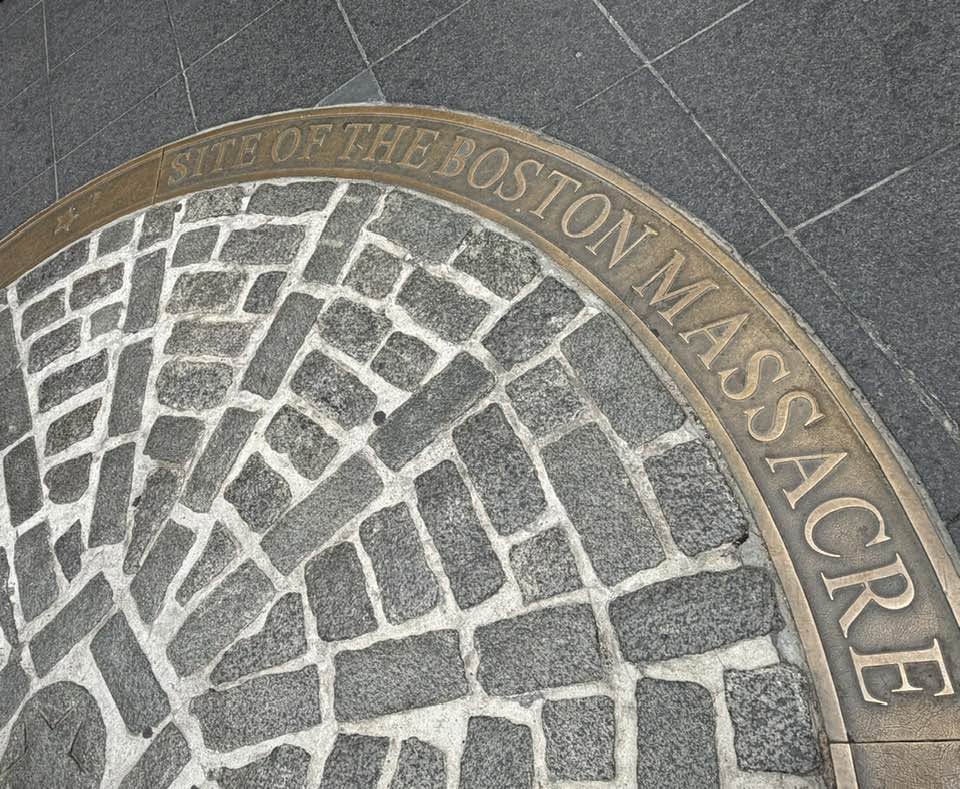
The historical facts are messier than the “Patriot Portrayal” version of the so-called Boston Massacre of March 5, 1770. It all began when a mob surrounded a British sentry and began hurling angry words and insults. When a patrol of seven other British soldiers appeared under the command of one Captain Preston, the mob added snowballs and other objects at the Redcoats. One soldier panicked and fired into the crowd. Without an order by their captain, the other seven soldiers followed suit. Three in the mob died on the site. Of the eight others who were wounded, two later died of the injuries.
Eight soldiers were charged with murder, but in the criminal jury case that followed, six of the defendants were found not guilty. Two were convicted of manslaughter. Their defense counsel was none other than John Adams, future signer of the Declaration of Independence and second President of the United States.
Less than a clear-cut basis for wholesale violent political revolution and independence, the unfortunate clash was manipulated most prominently by Paul Revere’s famous engraving of the purported scene in front of the Old State House.[1] Today the vortex of the incident is marked by a stone circle bearing the date of the historic event. As I stood there in brief contemplation, I felt the ambiguity of history.
SECOND, when Boston lawyer and Revolution influencer James Otis coined the phrase, “taxation without representation is tyranny,” he didn’t foresee the irony of his words. By 1778—three years into the Revolutionary War, the Colonials’ abhorrence of taxation even with representation nearly led to the unraveling of the armed rebellion. Despite General Washington’s desperate pleas for weapons, ammunition, and supplies, the Continental Congress long refused to raise taxes to fund those necessities. Furthermore, not all Colonials were anti-British, and a good many in the South who were anti-British were so over the issue of slavery—especially when slaves were promised manumission if they joined the British cause.
THIRD, until we walked the Freedom Trail past the Park Street Chapel, where abolitionist William Garrison made his first major public statement opposing slavery and Harriet Beecher Stowe’s brother, Edward Beecher, was preacher, did I appreciate the further irony of Boston’s role in our nation’s history: Not only did the city provide an impressive roster of “Patriots” in the rebellion against the British Government, but Boston also became a center of the ante bellum Abolition movement—a cause that would lead to the Second American Revolution, this time, over America’s “Original Sin.” Lest we get too carried away in self-congratulation, the First Revolution kicked the proverbial can into subsequent times—right up to the present.
As the day wore on, we discovered beer being served from bottomless kegs outside historic Faneuil Hall and vendors of fresh seafood and other offerings inside nearby Quincy Market. The latter, however, was a veritable human sardine packed with World Cup soccer fans. We eventually got our fill of beer, pasta and a mound of shrimp—enough to fuel our walk into the North End for two boxloads of cannoli.
We slogged on—with infant and a not-yet-three-year-old in tow, but a cheerful 10-year-old keeping pace with the roll-rate of the strollers. Our parade stopped briefly outside Old North Church. There I tried to imagine the role of the ubiquitous silversmith, Paul Revere, and his compatriots, William Dawes and Samuel Prescott, and in fact a whole network of bell-ringers and Minutemen in their first organized resistances against the “Regulars” who were on the march to Lexington and Concord to arrest Samuel Adams and John Hancock and confiscate stores of arms and munitions.
We stopped again at the Charles River, within sight of Bunker Hill, where the Colonists “lost the battle but (as it turned out) won the war.” At the park filled with families attending baseball games and enjoying the riverside green space, we recharged long enough to hoof it back to our T connection for the ride back to our Airbnb. Our total steps for the day logged in at 17,504. But we didn’t need a health app to tell us we’d ended the day “on empty.” My cold needed a rest . . . or more precisely, I needed a rest from my cold. Yet, the day was filled with warm memories of a wonderful family expedition through a great American city as vibrant today as it was “back in the day.” (Cont.)
Subscribe to this blog and received notifications of new posts by email.
© 2026 by Eric Nilsson


2 Comments
Wonderful Eric many thanks. I walked the FT twice over the years but it’s been at least 25 years since the last time. Great to relive it with you. Please come to Williamsburg soon and see the southern side – the slightly offensive slogan for the 250th here is: “America: Made in Virginia” ! I think you’d find it revelatory with ghosts of Jefferson and Washington and Madison and Henry and Lafayette all present. Your rooms await!
Thanks much, Bill! Yes, I’m realizing exactly that–that we must next “go South,” specifically, to VA and Williamsburg to understand better our colonial past and national formation. We must work on this!!
— Eric