JUNE 24, 2026 – (Cont.) The historical capstone to our Beantown expedition was an all too short morning-long visit to the John F. Kennedy Presidential Library and Museum on the UMass campus along the Charles River. Since the library and museum opened the year after I graduated from college, I excused myself for never having visited this must-see site until now. Yet . . . when examining history, an extra 50 years of perspective is always beneficial. Plus, in the company of one’s grandchildren—particularly a granddaughter who’s attained the age of 10—one’s objectives expand from learner to leader. In this regard, my objective, anyway, was fully accomplished. Illiana now knows infinitely more about our 35th president than she knew before our trek—starting with her later instant recall that JFK was, in fact, our 35th commander in chief.
But I must give expedition leader Byron proper acknowledgment: it was he, not I, who’d placed this important site on our itinerary.
Over the decades, I’ve read in depth about President Kennedy—everything from the admirable to the not-so-admirable; from the inspirational to the “don’t-emulate-this” category of his record. Apart from any partisan bias (harrumph, harrumph), my impression of the library/museum was altogether positive. The numerous photographic displays, the documentary films, the many mock-ups and mementoes were presented in eminently fresh and accessible fashion. Most critically, all the information, general and specific, was designed to capture and hold the attention of a wide range of visitors, young and old, knowledgeable and hardly so, domestic and foreign.
A visitor of my vintage cannot spend more than a few minutes inside the museum without ruminating about America’s passage through the 20th century, let alone confronting the contrasts—and similarities—between past and present.
Though there’s no open reference to Prohibition, the images of Kennedy family wealth and political influence were reminders of the boot-legging fortune generated by the grand patriarch of the clan. Yet, ascension to the highest social-economic elevation of an officially egalitarian but unofficially stratified country, could never compensate Joseph P. Kennedy, Sr. for the tragic loss of his greatest wealth—three of his four sons: oldest son Joe, Jr., in World War II; Joe, Jr.’s substitute, Jack, nearly in World War II, but later, of course, by assassination; and Jack’s substitute, Bobby, by assassination. One can cast whatever aspersions one prefers on Kennedy wealth and advantage, given the illicit origins of such, but when courageous sacrifice is added to the scale, any comparison to the weight of grift and corruption attributable to the current first family winds up as the starkest of contrasts.
Say what you will that’s negative about JFK himself and his record as president, but two incomparable traits set him quite apart from other national politicians of his generation and those who followed: class and courage. By “class,” I mean the elegance of inspirational public expression and demeanor; intellectual edification by education; and empathy for people through meaningful interaction. By “courage,” I mean bravery of the sort exhibited by Lieutenant (j.g.) JFK swimming from island to island after his PT boat had been rammed by a Japanese vessel—while towing a wounded comrade by a life vest strap (held between Kennedy’s clenched teeth). What other Senator before or since JFK has written a book such as Kennedy’s Profiles in Courage—about U.S. Senators who put country ahead of party?
If Kennedy had the vision to form the Peace Corps, the inspiration to land humans on the moon, the will to confront segregation in the South, the nerve not to blink before Khrushchev, and the courage to take on the Mob, it’s a shame he saw fit to order the coup in South Vietnam, to sanction the Bay of Pigs operation, and to marginalize the supreme legislative skills of LBJ.
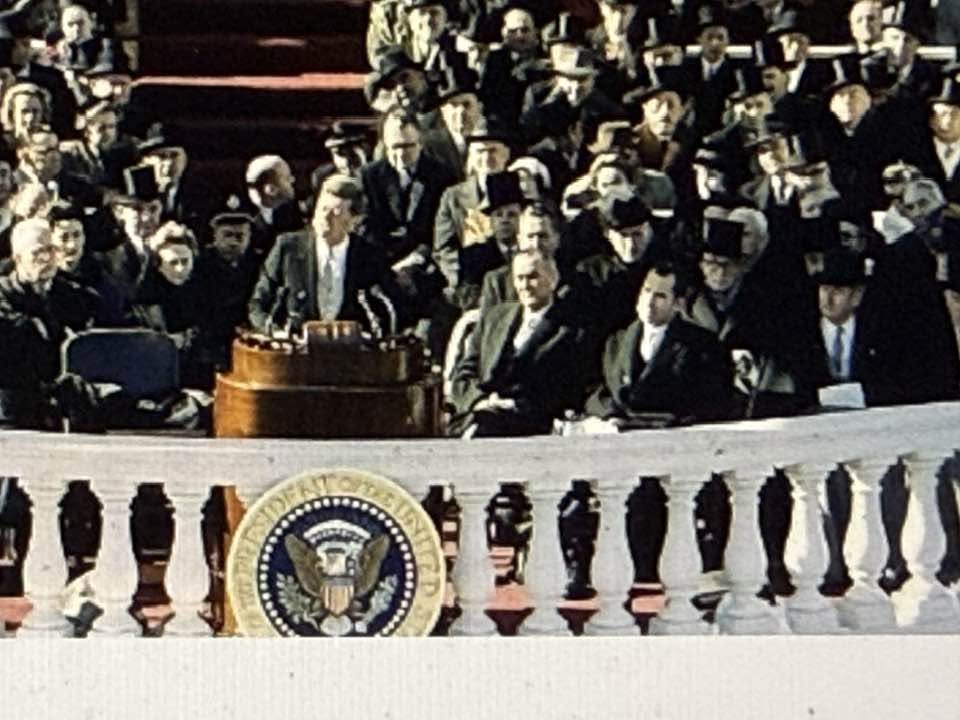
I thought of this third shortcoming as I watched a video of Kennedy’s inaugural speech. Seated to the right of the podium was Vice President Johnson, barely joining the frequent applause of President Kennedy’s soaring rhetoric. LBJ’s pain was palpable. Ever since the man was a kid in the Hill Country of Texas, he’d wanted to be president. When his chance finally arrived to take what was his—the mantle of Democratic Nominee in 1960—he choked inexplicably. He came to his senses too late, and the Kennedy machine rolled over him. LBJ was put on the ticket to keep the South in line.
Until the assassination, LBJ had to stomach Bobby Kennedy’s status as an insider and his own as an outsider—so much so that he was often excluded from critical confabs. For the “Master of the Senate,” to be treated so by a person LBJ considered to be an undeserving neophyte who enjoyed unfair advantages of pedigree, was too much.
The impossible question confronting every visitor who experiences the JFK museum is, “What would the world be like today if President Kennedy had not been killed?” The not impossible but terribly disturbing question that I pondered after our visit was, “Did the assassination of President Kennedy mark the beginning of America’s long unraveling?” (Cont.)
Subscribe to this blog and received notice of new posts by email.
© 2026 by Eric Nilsson
