JUNE 2, 2026 – (Cont.) In anticipation of the 50th reunion, I’d said to a non-Bowdoin friend, “I don’t want to engage in a lot of ‘remember the time our freshman year when [we engaged in some puerile prank that we thought was so clever—guffaw, guffaw]?’ I’d much rather stick to (high-minded) talk about people’s small and mighty contributions to the betterment of our troubled world—even at the risk of the comparative feeling I’ve squandered my own chance and shirked my own duty to contribute to the common good.”
In the event, apart from a few guffaw-ridden skirmishes with our past, reunion conversations avoided reminiscences about collegiate shenanigans. After all, we were no longer in our twenties or thirties with propinquity to our college years. We had a half century of “other stuff” between the present and the glorious past. To that point, over the weekend we were reminded that when we graduated from Bowdoin, the alumni (all men, by the way[1]) celebrating their 50th reunion were in the class of 1926—which now is a full century ago!
In the case of alumni in their twenties and thirties attending their various reunions concurrently with ours, opening conversations went something like this (I imagine): “[NAME]! So good to see you—it’s been forever! What have you been up to since the last reunion—what, two whole years ago?”
The initial encounters among us 72/73-year-old alumni, on the other hand, went more like this (I can attest): “Uh . . . your name tag got flipped around . . . [whereupon, the tag hanging from the neck got turned right-side out] . . . Oh, [NAME]!” [NAME] struggled to reciprocate but couldn’t because the initiator himself hadn’t noticed that his own name tag had gotten turned over. After a few awkward seconds, identities were established, and [NAME] said, “So, where have you been over the last half century?” –“Well, I’m retired now . . .” With that the prospect of a conversation took shape.
In other words, under such circumstances common to us who are 72 or 73, it took a fair amount of multi-tasking and cognitive lubrication to reach the point of, “Remember the time . . .” And yet . . . given the duration of our reunion, thank goodness, we learned to untangle our name tags and raise our mental RPMs enough to recall the more memorable events during our days at Bowdoin.
One “Remember the time . . .” legendary tale that received proper airing was recounted by my good friend Jeffrey McCallum, one of the reunion leaders. It involved an after-dark battle in the ongoing war between Hyde and Coleman dorms—a medieval affair featuring ingenious catapults, water-balloons, and other assorted projectiles, both hand-tossed and mechanically propelled. Only a deranged individual engages in deranged activities wholly alone. Pull a group of college kids together, however, and otherwise latent proclivities fuse into collective roguery. Such was the case with Jeffrey McCallum and his fellow belligerents à la Monty Python.
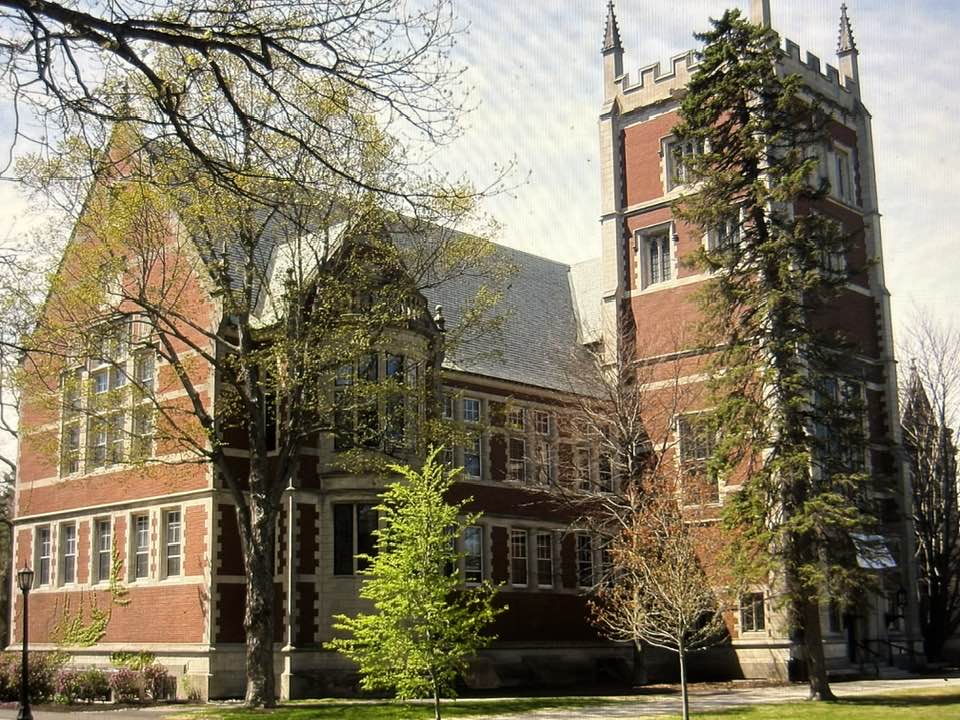
Jeffrey himself cannibalized a dorm rain gutter to serve as a launching guide for a pyro-technical device. The weapon was aimed at enemy quarters and the fuse was lit. Off flew the rocket. What could possibly go wrong? Plenty, as plenty did. The rain gutter slipped, altering the missile’s trajectory from the intended target to wholly neutral territory at the head of the quad, namely, Hubbard Hall, designed by the acclaimed 19th century English-born architect, Henry Vaughan, in the “Collegiate Gothic” style, featuring a blend of 17th-century Gothic designs, crenellated tower, Baroque window pediments, stone gable finials, lone gargoyle poised on the north end, and heavy wooden entryway doors. The stalwart building originally housed the college library but was now home of the Peary-MacMillan Arctic Museum and the Economics, History, and Government/Legal Studies Departments.
To cut straight to the chase, the rocket struck a window of Hubbard Hall, and even more precisely, a window of the Peary-MacMillan Museum inside. The warhead crashed through the glass and in a spectacular display of sparks and flame, landed on the carpet near the taxidermied polar bear, which coincidentally, had established a stylized version of itself as Bowdoin’s mascot.
Thus, what had begun as a sophomoric water-balloon fight now morphed into a potential conflagration engulfing the architectural centerpiece of Bowdoin College.
What to do? What any reasonably self-respecting Bowdoin student should be expected to do: call the authorities, even at the risk of getting himself expelled. In the end, full-on coronaries were avoided. Except for minor damage to the carpet and polar bear—and window—no mushroom cloud rose over campus. All was restored to the status quo ante, as war surrendered to peace in the feuding Kingdoms of Hyde and Coleman. Jeffrey would go on to distinguish himself in a suit of armor on the ice of modern jousting, albeit with a shorter lance. All the veterans (including Jeffrey) of the Hyde-Coleman War would graduate with high honors, pursue noteworthy careers and lead lives of distinguished beneficence . . . no kidding.
And in the wake of their medieval shenanigans, a campus legend was born. (Cont.)
Subscribe to this blog and received notifications of new posts by email.
© 2026 by Eric Nilsson
[1] A distinction of our Class of ’76 is that ours included the first women to have completed four years at Bowdoin.

4 Comments
Hi Eric . Your blog is wonderful and I am really enjoying it.
I’m thrilled, Mark, that you’re enjoying the blog. Stay tuned: you’ll find your name in an upcoming installment.
Eric
All I can say Eric is Yikes! I never thought I’d be a lengthy subject in one of your commentaries.
True story, however.
Jeffrey, I trust that the salient facts are materially accurate.
Eric