JUNE 1, 2026 – (Cont.) I remember the time about a decade after I’d left the venerable St. Paul firm of Briggs & Morgan for greener pastures over in Minneapolis, when I had occasion to attend a business meeting in the same old First National Bank Building where Briggs still occupied five floors of the tower. The meeting was scheduled for 1:00 p.m., and a little ahead of time I arrived at the elevator bank on the second floor skyway level. Soon the car arrived and the doors opened.
Standing against the back were four Briggs lawyers with whom I was quite familiar, though I hadn’t seen any of them in years. I was shocked. All four had aged significantly. “Oh!” I said, before biting my tongue and swallowing the words, “You guys look so old!” and substituting them on the fly with, “Geez, I haven’t seen you guys in ages.” After clearing their phlegmatic throats, they greeted me, and one asked what I was up to. Only as I stepped off the elevator at my stop did I wonder how they might’ve perceived time’s effects on me.
That elevator experience came to mind during my recent 50th class reunion at Bowdoin College. Many classmates had changed beyond recognition. Others had changed much but retained some feature that still allowed for positive identification—a gait; curvature of the mouth (up in some cases; down in others); lines of a scowl; the role of eyes in laughter. A large swath of returning classmates, however, aged in a manner that preserved sufficient overall appearance from 50 years ago to be immediately identifiable. And then there were the people who looked darned near exactly as I’d last seen them in June 1976.
The whole appearance thing produced ample opportunities for sticking one’s foot in one’s mouth, and I observed several instances where the opportunities were seized with what could be characterized as unshackled recklessness or simply the unfiltered candor that accompanies . . . older age.
In the buffet line at one of the scrumptious dinners, the (male) classmate next to me exchanged warm greetings with the (female) classmate on the other side of the line. When the latter asked if the former remembered her, he said, “Oh yes, I do. You were very cute back then.” To the considerable credit of everyone involved—the two classmates in question and the people on either side of them—no food fight or other untoward reaction occurred. Diplomacy reigned supreme, as the offender clawed back his comment, supported by the witnesses, who said something to the effect of “We know you didn’t mean that to sound as it did” and the woman maintained her poise and carried on with enviable grace. A potential disaster was created and averted in less time than it took me to add sauce to the tenderloin tips already on my plate.
In another moment, a classmate greeting me for the first time in a half century shook my hand vigorously while saying, “Wow! You haven’t changed at all!” This was an impossibility. I’d had no beard or eyeglasses back in the day. For our entire four years, I had curly dark blond hair and plenty of it—most notably, on TOP of my now mostly bald pate. Believe me, as an undergraduate there is no way I would’ve recognized my current self. All of which made me wonder, Is this effusive classmate confusing me with someone else altogether? But who might that be?
By the second day, I’d developed the sense that my classmates and I resembled a fleet of “pre-owned” cars. Some were low mileage, some were high, and most people, like cars on the lot, were in between. Nearly all were shined up to reflect well the bright lights that the college had powered up for our class. But as with cars, outward appearances don’t always reveal what’s under the hood.
Having been through some engine problems of my own, I know whereof I speak. Friends who are knowledgeable of the details of my own overhaul often ask how the engine’s running and comment on the ordeal that the overhaul had involved.
Yet, everything’s relative. I was reminded of this in speaking with one particular classmate. During our four years at Bowdoin, I think he knew who I was; I certainly knew that he was one of the leading athletes on campus. It turns out that after college he pursued a career in education and graduated to considerable distinction as an educator. I ran into him outside the Fort Andross building—a former shoe factory perched along the shore of the Androscoggin River in Brunswick—now home to lots of art studios occupied by Bowdoin alumni, including our own classmate and distinguished artist, Annie Ireland (See “Reunion (Part I)”). While the rest of my immediate party, Beth, Jeff and Val, toured and savored the studios, I engaged the former athlete champion-turned-educator champion in conversation.
Though he’d shed his thick undergraduate hair, he still looked fit and trim. But appearances can deceive. It didn’t take much small talk to get to the heart of the matter, which wasn’t his heart or mine. But did involve health—his and mine. My situation paled next to his, however, and under no circumstances would I have traded places with him. In fact, his story was yet another reminder of the old story about people being invited to pack their woes into a backpack or briefcase and join a crowd of other people for an open trading session, wherein everyone can trade their troubles for someone else’s. In the event, however, everyone leaves with what they brought: by comparison, everyone feels better off with their own tribulations.
Then came the shocker: despite this classmate’s health issues, he still plays his sport in an “over-70s” league. With a hearty laugh he recited their tag line: “We’re old, but we’re slow.” His humor and his insistence on staying in the best shape he can despite his serious malady were the essence of a resilient human being, and as a species, what are we, I thought, if not resilient? Had I not encountered him there outside the art studios and had he not shared his story, I wouldn’t have suspected in the least the burden he carries. We ran into each other several times after that, but our encounters were limited. I felt privileged to have had the conversation we’d managed to have Friday afternoon.
I learned of the woes of other classmates too, and again—no trading. And tragedies, too—some godawful. No trades. None of these would be known or even suspected based on outward appearances: dark shadows in the trunks of a shiny car here and a handsome model over there.
Yet, again, we’re a resilient species. My good friend and classmate Jeffrey McCallum, one of the inner group of reunion organizers, was well-suited for the role. Born with an indefatigable spirit, he loves people and has an ear for their stories. Some weeks ago he told me about another classmate and mutual friend of ours, who’d lost his spouse two years ago. It was a terrible blow, but then occurred another example of resilience. Said friend now has a fiancé, who would be attending the reunion.
Upon meeting her I felt pure joy for our friend—as well as his fiancé, given the extraordinary gifts and character of our Bowdoin classmate. Their shared new lease on life reminded of my good friend Linda, whose late husband was a long-time friend of mine. Less than a year after Jack died, Linda married Peter (himself a widower), one of Jack’s best friends and comrades—in the rowing shell at Georgetown and in the canoe in their annual trips to the Boundary Waters, until Jack was taken ill. When I met Peter, I knew instantly that Jack “would approve” of the decision. For both Linda and Peter, the match-up brought enduring delight to what could well have been dismal lives had each wallowed in sorrow.
Before leaving the topic of “appearances,” I must note some aspects of campus appearances. In the first place, the Bowdoin campus of 2026 was largely unrecognizable to me, who hadn’t set foot there since 1986. In our day, the basic layout of the campus hadn’t changed in decades. Many of the buildings dated back to the 19th century, albeit with substantial interior upgrades. Winthrop Hall, for example, my freshman dorm, had been the Bowdoin home of Henry Wadsworth Longfellow and Nathaniel Hawthorne, members of the class of 1825 (along with the future president, Franklin Pierce, who graduated a year earlier). But since 1976, ambitious capital improvements have now surrounded the original campus with enormous facilities of all forms and purposes to advance the mission of the college.
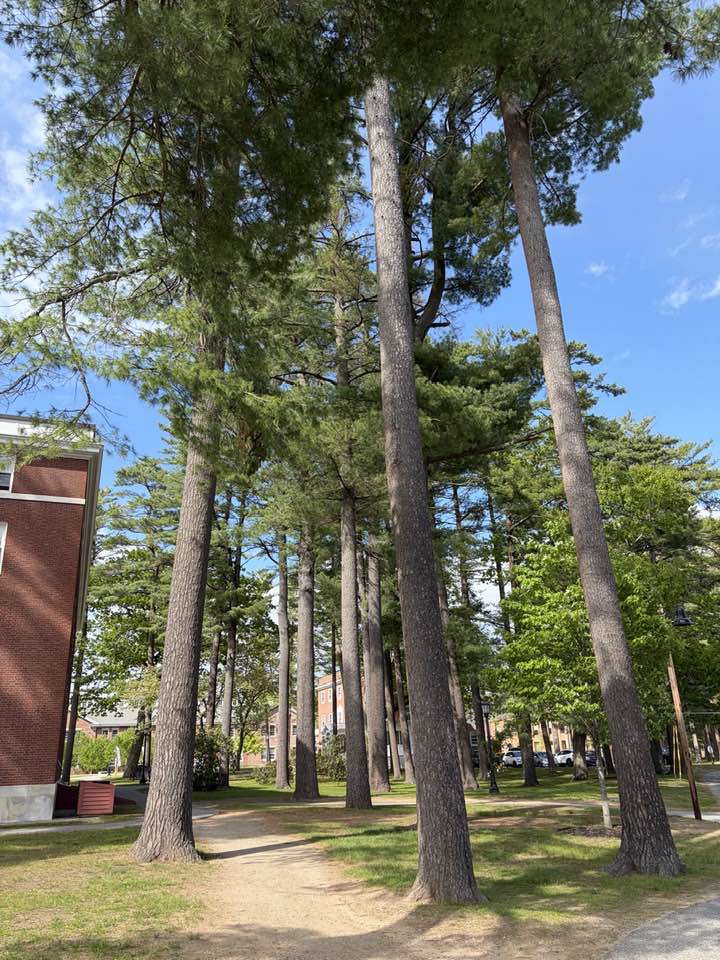
My wife found this off-putting and understandably, but I appreciated the intentional preservation of the many groves of the magnificent pinus strobus—white pine—which has become my tree of choice and the one I’ve spent hundreds of hours cultivating back in the wilds of our family’s property in northwest Wisconsin.
While walking among Bowdoin’s white pines—which now define the college’s appearance—I marveled at this arbor’s meaning in my life. Bowdoin’s famous slogan, for crying out loud, in the language I studied at the feet of one of Bowdoin’s most beloved professors, the Latinist Nate Dane II, is Pinos loquentes semper habemus—“We always have our whispering pines.” The slogan, as it turns out, originated with Bowdoin’s Peucinian [a Greek word meaning, “pine-covered” no less!] Society, a debate and literary club founded in 1805.
Since the 50th class reunion is always the biggest of the annual reunion celebrations, we were given special attention by the college—with superb financial results, including an overall contribution rate of 76% and a staggering amount of dollars to add to one of the largest small college endowments in the country.[1] This VIP treatment included a fleet of student-driven golf carts at our beck and call and cheerful, helpful student “Ambassadors” at every activity venue.
By the end of the weekend, I much appreciated these students. They were quick to engage, and their poise and smarts, good cheer and guidance were exceptional. For us predominantly white members of the Class of 1976, the other striking “appearance” of the students we saw and with whom we interacted were people of color and very representative of Bowdoin’s current student population. I found this refreshing and promising, and in some poetically just way, the answer to the skeletons in the closet of Bowdoin’s history—a history probably not that much different from other institutions in 19th century America and all too far into the 20th.
My good friend John Cross—and former hockey teammate of Jeffrey McCallum—is the on-site, resident Bowdoin historian with an encyclopedic knowledge of the college’s more notable and praiseworthy alumni, as well as the most notorious. If you get John started on the subject, you will soon wonder if he has Bowdoin history confused with a college of the Confederacy. And yet—and yet—Bowdoin’s biggest contributor to the Union cause was none other than Brigadier General Joshua Chamberlain, Class of 1852, best known for his brave leadership at Gettysburg, and later Governor of Maine and president of the Bowdoin (and about whom, of course, John Cross is an expert).
By all appearances, Bowdoin is thriving and firmly committed to serving the common good. Likewise—by appearances—members of the Class of ’76 have led interesting, fulfilling lives and contributed much to the life of their families, communities and country. Inspiration breeds inspiration, and I found that well beyond appearances, the members of our class are an inspired lot. (Cont.)
Subscribe to this blog and received notifications of new posts by email.
© 2026 by Eric Nilsson
[1] The financial strength of the college allows it to approach admissions without restriction based on applicant financial needs.

2 Comments
Hi Eric,
I am loving your blog, your beautiful writing. I think I must have had the same TSA agents as you did at Logan. Never have experience that before at any airport. Did you really get the call from the Massachusetts police? Can I get your personal email from Nancy? Have copies of some things to send you including the Roger Howell Fake Birthday Party that was cohosted by you, me, Margaret Mullin, Dave Larsson and Jeff Zimman, and Roger Howell’s thank you note. I also have a top secret idea to share!
Hugs,
Liza
Liza, you are a first rate “sketch”! I love it. And yes, I really did get a call from the
Massachusetts State Police. Check with Nancy re: my address. — Eric