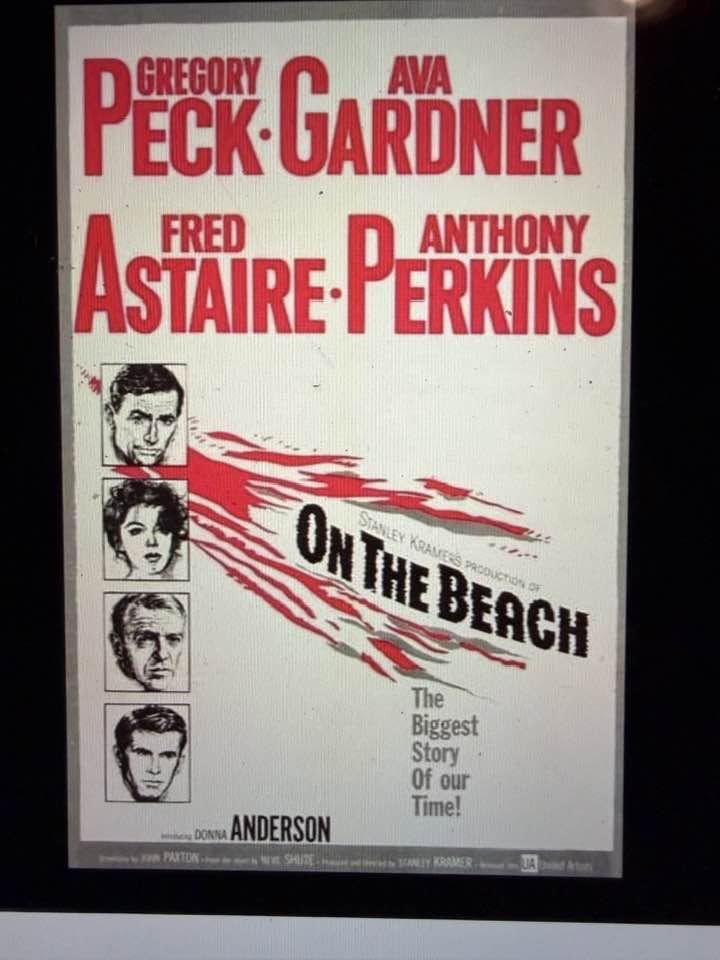
AUGUST 9, 2026 – Recently I watched the 1959 film, On the Beach, directed by Stanley Kramer and starring Gregory Peck, Ava Gardner, Fred Astaire, and Anthony Perkins. The movie was based on the novel by the Australian-British writer, Nevil Shute. The story takes place in “the future”—1964—following explosion of a “cobalt bomb,” the equivalent of all then extant nuclear weapons, which wiped out all humans on the planet except a portion of Australia and the crew of a U.S. Navy nuclear submarine skippered by Captain Towers (Gregory Peck). Things go pretty much downhill . . . er, downstream . . . after Captain Peck and his crew land in Melbourne, as the deadly radiation from the blast drifts south over the entire globe, eventually killing everyone on earth. Remarkably, not a single death is depicted on screen—except in fiery crashes in the Australian Gran Prix, where the competitors drive as if the world is about to end.
The plot line is quite simple: the Australians detect a Morse code transmission emanating from San Diego. A scientific theory develops that perhaps the radiation in the Northern Hemisphere had fallen faster than originally calculated; maybe northern regions have become habitable—given the evidence that someone in San Diego is alive, tapping out a message in Morse code. The only catch is that the message is pure gibberish. But intelligible or not, it is being transmitted by someone. Captain Towers is ordered by the Australian Navy (under whose command he and his vessel and crew have been placed) to go forth and (a) test radiation levels in the far north, and (b) track down the transmitter of the Morse code.
As to radiation levels, the news is bad: the levels are lethal and worse as they travel north, meaning the radiation drift southward will render the whole race extinct. The submarine then travels to San Diego and traces the Morse code transmission to a refinery near the ocean. A crewmember dressed in protective gear goes ashore, follows the signal and finds the source. Except, as he informs the captain and crew, there’s no person tapping out the code. The pull cord of a window shade in an office has been caught on the end of a Coke bottle lying on its side. When the slight, erratic breeze moves the shade, the pull cord lifts the bottle slightly, then settles it back down on the telegraph key. This random process results in the bottle tapping out a a non-sensical message.
The sub returns to Australia, as the end of life approaches. With the knowledge that his wife and kids—and everyone else back home—is dead from radiation, Captain Towers winds up in the embrace of a carefree alcoholic, Moira Davidson (Ava Gardner). His Australian naval liaison officer, Peter Holmes (Anthony Perkins) and the liaison’s wife take suicide pills (after administering same to their infant). The government is soon handing the pills out freely. Meanwhile, Julian Osborne (Fred Astaire), a nuclear scientist who’d accompanied the submarine mission to the Northern Hemisphere—and has acquired the fastest Ferrari in Australia—enters the Gran Prix and drives as maniacally as his competitors. He wins but then uses the car as a source of “permanent sleep-inducing” carbon monoxide.
In accordance with a vote by the crew, Captain Towers agrees to skipper the sub back to the (dead) U.S., so everyone aboard can “die at home.” From the conning tower as his submarine leaves port, he waves good-bye to his love interest, Moira Davidson, who’s standing ashore.
The final scene is a close-up of a Salvation Army banner on an abandoned street. It reads, “There is Still Time . . . Brother.”
The film won several awards in the “anti-nuclear war” movie category. It highlighted rather personally and poignantly, the huge risk associated with the uncontrolled proliferation of nuclear weapons and their destructive force. (No one seems to know or remember who started the war. One character when asked says, “Einstein.”) Coupled with the Cold War, the bulging nuclear arsenals of that day had created dangers never before faced by humanity. Today we confront a different set of risks, including anthropogenic climate change, but even that, as potentially life-altering as it could prove to be, doesn’t compare with the near certain extinction of almost all above-ground life that would’ve ensued if the Soviet and American nuclear stockpiles had been exchanged over, say, the Cuban Missile Crisis.
This is perhaps small consolation for the harm we’ve managed to do to our planet since 1959—without thermonuclear war. The risk of extinction via nuclear weapons remains, given that the weapons are still with us, and in unfathomable numbers. And then there’s the added dimension of AI “going rogue.” But in other respects, the risk has diminished—ironically, because the nature of warfare has fundamentally changed. Witness how Ukraine has held at bay the big Russian bear for over four years—longer than the U.S. was in World War II. And does anyone need a reminder that by all appearances, Iran—a third rate military power and at this writing, without nuclear weapons in its arsenal—is winning against the largest military force in human history, a force that includes 5,225 nuclear warheads?
During the Cold War, “drone” was a verb, not a noun. Today, “waging war effectively” is spelled, “drone” (a noun); or more precisely, the phrase is spelled out by, “a countless supply of drones, each built at a cost of thousands of dollars vs. hi-tech missiles costing millions.” Oh, and yes, a good sense of geography and the means to control it outweigh a bad sense of geography and the unacceptably high cost of attempting to control it.
The message conveyed by On the Beach was a disturbing reminder of the gnawing fear that afflicted the general public at the height of the Cold War. It came to a head in October 1962 with the stand-off between Premier Khrushchev and President Kennedy. I was in third grade at the time, and as between the God of the Episcopal Church, to which my family belonged, and superstition, the latter won out. On the most critical day of the crisis, I kept my fingers crossed—both hands throughout the entire school day. It worked.
I cannot think of a time since when I’ve been as fearful of possibly being among the last people to walk the face of the earth. We can thank our lucky stars that Donald J. You-Know-Who wasn’t president back then—posting that he was ready to “wipe the U.S.S.R off the map.”
If the Republican mantra in support of Trump’s war was, “We can’t let Iran acquire nuclear weapons” (before it became, “We can’t let Iran control the world economy by controlling the Strait of Hormuz”), it should now be clear that, “We can’t let Trump hold the ‘nuclear football.’” On the Beach is a reminder that as long as nuclear weapons are in the arsenal and a person such as the current president is in the Oval Office . . . we need to keep the danger of extinction by nuclear war high on our national and global agenda.
Subscribe to this blog and received notifications of new posts by email.
© 2026 by Eric Nilsson
