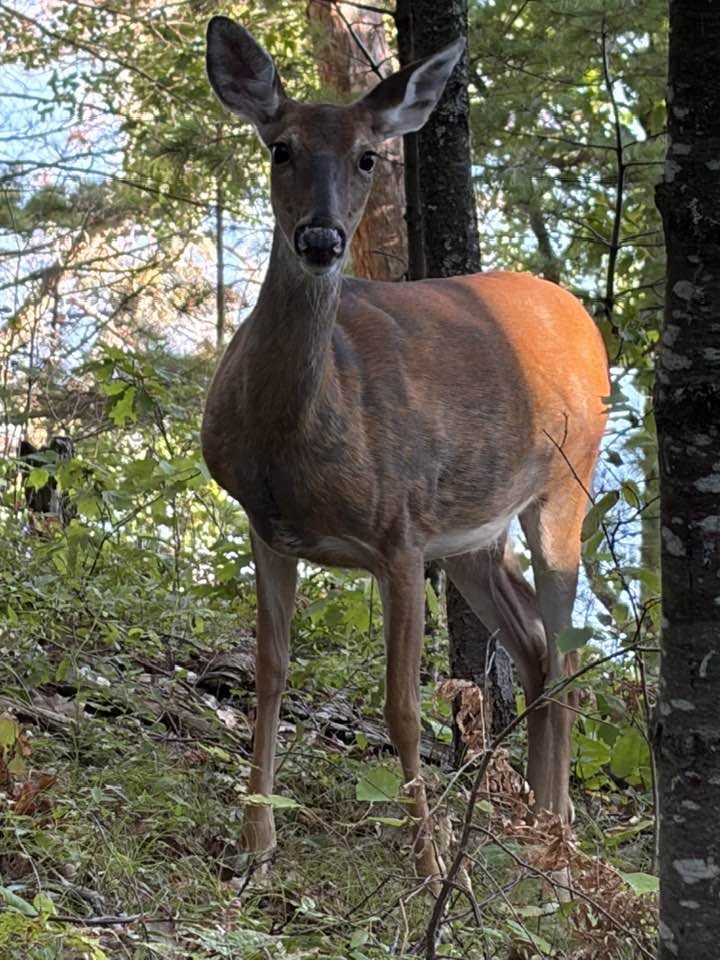
SEPTEMBER 6, 2026 – (Cont.) Among the top 10 maintenance challenges of a lake cabin owner, I must now include “preventing damage to young white pine from rutting deer.” For days now, I’ve been searching online for advice, insights, information on how to deter deer from rutting white pine saplings: what techniques work and which don’t; what materials are effective and which aren’t. My quest for an easy solution was no more successful than Ponce de Leon’s search for the Fountain of Youth. That’s because no easy remedy exists. But through stubborn force of will, I believe I’ve found a solution.
When on Thursday I procured a 100-foot coiled “boa constrictor”—4-inch perforated corrugated plastic drain pipe at L&M Fleet Supply store in Hayward—I thought I’d died and landed in heaven. But today, after many hours of prep time, I installed my first tree protector made from said drain pipe. In the process, I experienced a crisis.
Before I describe my confrontation with what initially appeared as an irreversible setback, I must cover the background that preceded my distress. First, I ventured into the “tree garden” to identify the most desirable—and vulnerable—candidates for trunk protection against the deer. I started with 13 trees (out of hundreds), and in each case, I carefully determined how many whirls could be pruned—and trimmed them with one of the two saws I carried. Next, I measured the height of each trimmed trunk, from ground to first remaining tier of branches. Third, I returned to the cabin yard where the “boa constrictor” lay, still twisted and partially coiled. I then measured and cut 13 lengths, each corresponding to the pruned height of each trunk among the 13 trees I’d selected. To the end of each of the now 13 “corrugated plastic tubes,” I attached a bright orange tag on which I wrote the length in inches.
Now came the ridiculously difficult task of cutting each corrugated tube lengthwise. The first tube took 20 minutes—using a hand-wielded bow saw, which made a terrible racket: HEE-Haw, HEE-Haw, HEE-Haw. If the tube was an inanimate object, it certainly didn’t behave like one. The plastic was so obstreperous, my saw grew ornery, then uncooperative. I switched to hand-held clippers, then a sharp knife, then rugged pruning sheers before surrendering and going back to the hand-held clippers. They were an improvement over the saw, but not by much. I went back online to see what advice I could find.
The prescribed solution: an oscillating saw, which I have, buried somewhere in the cabin junk room, but to operate it safely would require designing and building some kind of jig to hold the tube securely in place. Instead, I experimented with various angles of attack with the clippers. The corrugated plastic is not easy to cut and required a double grip on the clippers. Progress at right angles to the corrugation was slow and laborious, but eventually I figured out a reasonable technique that allowed progress without killing my hands. By two this afternoon, I had 10 tubes cut laterally and tagged. I was ready to carry them into the tree garden and install them on my first set of pruned white pine.
At the first tree, I fell to my knees and pulled the plastic tube up to the trunk. It was at this very moment when I felt like the student pilot about to touch down on the runway and realizing the retractable landing gear hasn’t been lowered. The drain pipe was so inflexible and the edges along the lateral cut, so sharp and ragged, that as I tried to draw the tube over the trunk of the poor tree, the edges lacerated the thin bark mercilessly. To my absolute horror, in my fumbled effort to protect this tree from the destructive scraping of deer antlers, I had gouged the bark myself! And the harder I tried to pull the tube over the trunk, the deeper and longer the lacerations! “STOP!” I told myself.
By now I was in a full sweat, having donned sufficient clothing to protect my own “cambium” from scrapes and pokes by twigs and plant stems in my anticipated work areas. What I feared was the failure of my entire plan. I couldn’t proceed if my method was going to do more harm than good. What was the point of worrying about the rutting deer, I realized, if I’m going to wreck the trees on my own? This is when I felt myself losing my mind. The $50 I’d spent on the drain pipe was . . . down the drain, so to speak . . . but what weighed on me far more was the elusiveness of an acceptable alternative. As I mentioned, I’d spent hours exploring all the options, and if the drain pipe method wasn’t going to work, what now?!
Soon I was questioning my entire premise: that to salvage my venture into silviculture, I needed to prune my white pine saplings; that to prune without protecting the trunks was to invite widespread destruction by the rutting deer; that to fulfill my vision, I had to do all I could to prevent such destruction. The moment was not only filled with doubt about tactics, but with shattered confidence in my overall strategy.
To quell what felt like a crisis, I applied a protective tube to a second pine, but by starting at the bottom instead of the top. The result was no better. The third tree was a repeat of failure.
Now what?! I asked myself. As I staggered back to the cabin yard and my project staging area, I weighed two considerations:
1. I could let nature run its course, knowing that some trees might well be attacked by rutting bucks, but just as likely was that despite some damage, the targeted trees would survive, and in any event, only a very few trees would be attacked.
2. For every problem there’s a solution. The solution simply needs to be found—or invented. So it must be with fitting the drain pipe over young, thin-skinned white pine saplings. Back at my staging area, I picked up one of the tagged plastic tubes and tugged one end of it a bit. Before long I discovered that the solution I sought was right in my hands. In fact, it was my hands. Though the plastic seemed to be irresistibly rigid, if I worked hard enough at it, I could widen significantly the gap between the edges along the length of the cut I’d made. Maybe with a bit of elbow grease, I could bet back in the game. Though it might be unrealistic to think I could apply more than 100-feet worth of protection against the deer, I could potentially ensure the safety of 20 to 25 trees.
I collected all the remaining eight plastic tubes that I’d cut and tagged. Using a rugged pair of leather gloves, I worked over the tubes until they were far easier to apply—and without harm to the trees. I was now on a roll and back on track.
What motivates me at this stage is my mental picture of these trees 10, 20, 30 years from now and beyond—glades of gorgeous white pine striving to join their royal elders that guard the shore. I can “see it”; I can envision what those trees will be. In this one corner of the globe, anyway, people of the future can visit the tree garden to admire nature’s work and find therein, inspiration in the beauty of the white pine. And may they say of us, “They cared.”
Subscribe to this blog and received notifications of new posts by email.
© 2026 by Eric Nilsson

2 Comments
Eric, white pines are, like oaks, sacred trees in my universe. Thank you for doing so much work to save so many. When we had a cabin, I spent many fall afternoons stapling note cards to the growth tips, and mostly they seemed to work. But I didn’t do a thousand trees, either. I think Paul Steffenson still works at that project.
Speaking of oaks, Ginny, I’m particularly fond of white oaks (and burr oaks, but they’re non-existent in our neck of the woods (Björnholm). The white oaks are almost as slow-growing as the burr oaks, and whenever I encounter a really old-timer, I call a time-out and hug the tree. Whenever I encounter a seedling or sapling, I do all I can to facilitate its chances. No doubt it laughs at me as it asks facetiously: “Are you planning to be around for the NEXT 100 years?”