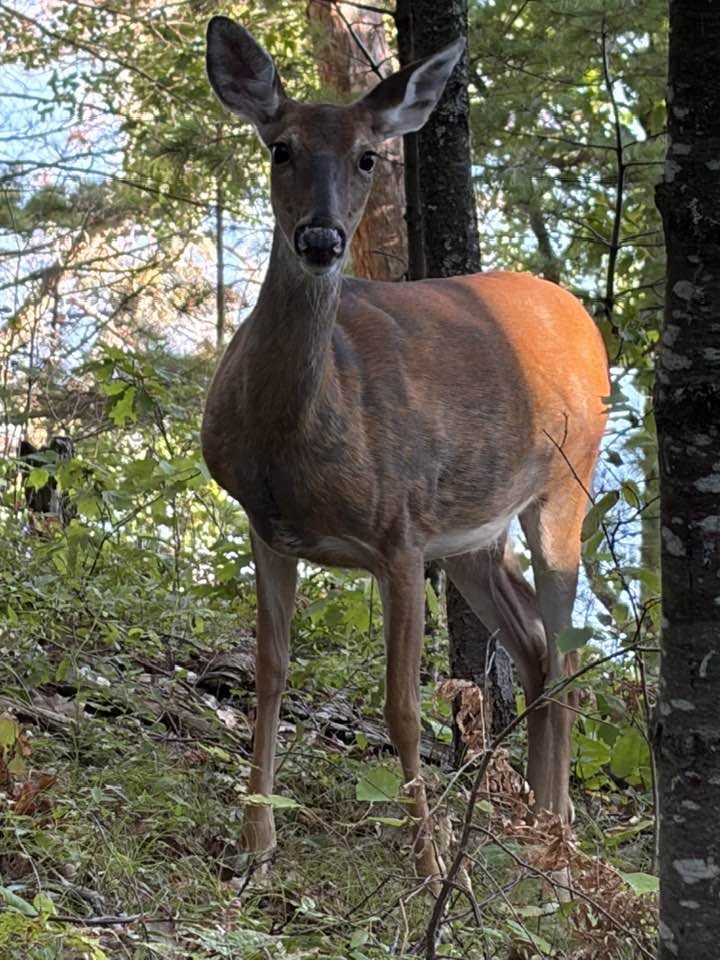
SEPTEMBER 5, 2026 – The doggone deer in these parts have transformed me into a character. No, not the sort with a bow or rifle out to shoot the deer, but as a self-styled arborist and protector of pinus strobus, the white pine that are the signature tree on our land on the shore of Lake Grindstone. Ever since I was a young kid, I’ve been an admirer of this grand species of the northern forest. The only person I’ve known who was a bigger champion of the white pine was my dad. He spent decades admiring, observing and cultivating these dominant indigenous trees—not for their favored use as masts of sailing ships of the 18th and 19th centuries or beams, posts, and frames of buildings erected in the cities of the American Northeast and Midwest at the end of the 19th century and the start of the 20th century, but for their wild beauty as sentinels of our woods. Dad’s main interest in going for a boat ride was to achieve a better vantage point for surveying the big white pine along our shoreline.
It was impossible to spend time with Dad at Björnholm without hearing him praise these rugged trees and comment on their characteristics. By reviewing studies of the tree and relying on his own direct observations, he knew much about white pine—their growth characteristics, their susceptibility to certain diseases and infestations, and above all, their aesthetic attributes.
Ten years ago, which was half a dozen years after Dad died, we retained a local logger to oversee the harvest of mature hardwoods on roughly 40 acres of our land. It was something Dad refused to do because he hadn’t wanted to disrupt the woods—though the land had been nearly clear-cut around 1900. He probably wouldn’t have condoned the harvest, but I think he would’ve understood had he known that we needed to raise funds to pay the holding costs—taxes and insurance—on the property.
Notwithstanding the necessity of converting a big chunk of our woods into cash—ironically, to preserve them—when I saw the devastation of the undulating woodlands that Dad and I had explored so thoroughly over the years and gotten to know so well, I decided some form of penance was required. At a minimum, I told myself, I’d need to order hundreds of two- and three-year-old white pine seedlings from the state DNR and manually plant them over the land scarred by the industrial-gauge logging operation. I chose white pine to replace the harvested oak and maple, because before Paul Bunyan had appeared in these parts around 1890, this part of the world was dominated by this majestic species.
Hand planting the seedlings with Dad’s old (but good) planting bar was one of the most arduous “cabin projects” I’ve ever undertaken. For several weekends in the spring of 2017, I planted the seedlings one-by-one.
Young white pine, however, are “deer-candy,” and late that fall, I had to bud-cap the planted trees to protect them against browsing deer over the winter. This operation involved cutting hundreds of bud caps—4” x 6” rectangles of scrap paper— then folding them around the terminal leader of each white pine and stapling each folded cap three times. Only by experimenting, that is, leaving a few trees unprotected could I confirm that bud-capping was necessary and effective. Sure enough: the trees that I hadn’t bud-capped fell prey to the deer; not in a way that killed any trees but that stunted their growth.[1] Every autumn since, I’ve bud-capped between 500 and 1,000 white pine. Though many of the trees that I planted are now beyond reach of the browsing deer, thousands of “volunteer” seedlings—now saplings—have joined the DNR seedlings I’d planted. Last year, most of the 600 bud-caps I stapled were on these younger volunteers.
Last fall I pruned a few of the trees I’d planted—just one or at most two whirls of branches. To my dismay, however, this light pruning had exposed several smooth young trunks to rutting by local whitetail bucks. They had taken two trees to the cleaners. I was beside myself. Though a tree can survive as long as some portion of the cambium is intact (for upward transfer of nutrients), serious damage to the trunk can expose the tree to disease and otherwise weaken its defenses. The devastation was distressing, and I realized that my plan for pruning the trees—to encourage upward growth, as opposed to lateral “expansion”—would have to wait until I solved the problem of protecting the young trunks. (Cont.)
Subscribe to this blog and received notifications of new posts by email.
© 2026 by Eric Nilsson
[1] Under ideal conditions, white pine seedlings and saplings can put on amazing growth. Some in our woods have grown taller by four feet in a single growing season; many have added two to three feet of height. If a browsing deer bites off the top of the tree, a member of the “whirl” below the current year’s growth will assume the leader’s role, but often an entire year’s worth of vertical growth—two to three feet; sometimes four—is lost.
