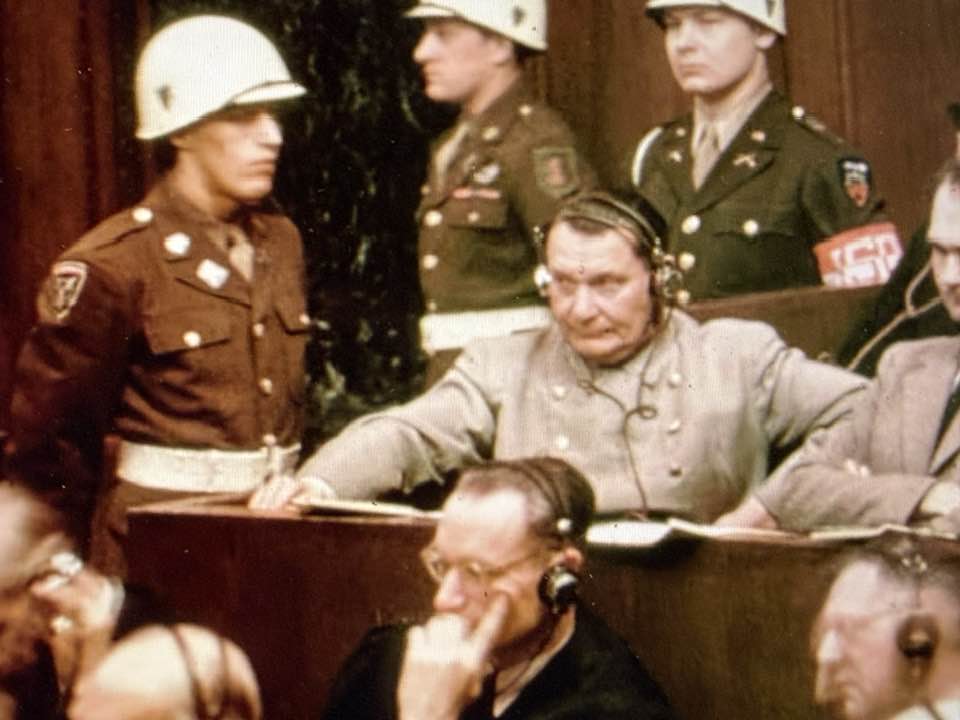
MAY 14, 2026 – The other night I stayed up way past my usual bedtime to watch to completion the Netflix movie, Nuremberg, based on Jack El-Hai’s book, The Nazi and the Psychiatrist: Hermann Görning, Dr. Douglas M. Kelley, and a Fatal Meeting of Minds at the End of WW II. The movie stars Russell Crowe as Göring, Rami Malek as Kelley, and Michael Shannon as Supreme Court Justice Robert H. Jackson (chief prosecutor in the first and most famous (“Trial of the Major War Criminals” – 22 highest-ranking Nazis who survived the war) of the 13 trials before the IMT (the “International Military Tribunal”) at Nuremberg). For the acting, directing and script—plus, of course, the story itself—I give Nuremberg a thumbs up.
This film joins previous movies about the Nuremberg trials—the most famous being Judgment at Nuremberg (see 1/18/26), post), which focused not on the top echelon of Nazi war leaders but on the prosecution of German jurists, whose decisions gave legal sanction to Nazi criminality. The Netflix movie approaches the prosecution of accused Nazi war criminals through a psychiatric and psychological prism. The central villain portrayed in the film is the biggest of the wigs (in power and physical girth) Reichsmarschall des Grossdeutschen Reiches (Reich Marshal of the Greater German Reich) Hermann Göring, but others in the Nazi line-up are also given unflattering “facetime.” They include Rudolf Hess (Deputy Führer who flew himself to Great Britain to try to negotiate a peace deal—but no dice), Julius Streicher (editor-in-chief of Der Sturmer, the virulent anti-Semitic newspaper), Karl Dönitz (head of the German Navy and in the final days of the Reich, Hitler’s successor), Robert Ley (captain of the German Labor Front), and Albert Speer (minister of munitions and architecture). None of these characters was an idiot in the I.Q. department, and Göring, actually, scored a 138 on a test administered after his capture. He was considered by his captors to be smart, smooth-talking, and strategic-minded.
My previous exposure to the trials—primarily through the book East West, by Philippe Sand— had been mostly from a legal perspective. And from that angle, the premise for the Nuremberg Trials was extraordinary. Before World War II, losers in wars had often been executed by the victors, but never before had the losing team been charged as war criminals and put on trial before a tribunal run by the winners—before being executed. Moreover, never had the term “genocide” existed before it was developed by a Polish-Jewish-American lawyer who played a critical role in developing the theoretical framework for the prosecution of Nazi war criminals.
But back to the Netflix movie . . . which provides the viewer with a glimpse into the moral, psychological, and psychiatric aspects of the overseers of the Holocaust; of the barbarity bereft of any moral, ethical, or logical counterweight whatsoever. Göring, being the top dog in the dock and the most flamboyant of the bunch, occupied center stage. The once mighty Reichsmarschall was a clever and conniving sort but was hard pressed to put one over on his assigned shrink, the U.S. Army doc, Douglas Kelley.
While Justice Jackson was preparing his legal case against Göring, Kelley was studying the Nazi’s psychiatric and psychological profile. At first arrogantly defiant, Göring eventually succumbed to Kelly’s disarming approach and wound up treating Kelley not only as a confidante but a friend. Kelley wound up serving as Göring’s messenger, spiriting out of prison, letters the Nazi wrote to his wife and daughter and surreptitiously returning reciprocal letters back to Göring. Kelley gained enough insight into Göring to predict that the Nazi would get the better of the prosecution.
If Göring could turn on the charm, Kelley nailed him as a narcissist. Though reticent about breaking his professional oath to keep doctor-subject communications confident, Kelley wound up yielding to pressure from Jackson and giving him the keys, if you will, to Göring’s weakness—the very narcissism that had turned the corpulent German into a monster. After documentary evidence of the death camps was introduced at trial, Kelley tore into Göring (back in the latter’s cell) without restraint. In the end, Göring convicted himself by affirming unrepentantly his allegiance to Hitler—even in the face of all the damning evidence of evil.
But the Nazi chieftain cheated the hangman by biting into a cyanide capsule just before he was to be led to the gallows. If Göring was justly condemned, we cannot ignore his retort to Kelly’s blistering charge of moral responsibility: What about Hiroshima and Nagasaki? Or the bombing of civilians in Hamburg, Dresden and elsewhere in Germany, and the fire-bombing of Tokyo? Kelley attempts to distinguish the slaughter of millions in the German death camps from the death of civilians as “collateral damage” in the Allies’ targeting of military targets.
Before the trials were concluded, Kelley was dismissed and discharged from the army. He wrote a book about his experience in Nuremberg and warned that what he found in Göring’s warped mind was not unique to the former Reichsmarschall or to Germans. “It can happen anywhere,” Kelley warned.
And indeed it has. What Kelly learned, not only about the Nazis but about humanity led him to alcohol and depression. He died a suicide. His story is a fascinating reflection of the horrific evil not so much of one political system or another but of extreme personality disorders and conditions. The social and political order assumes the responsibility to divert from power, extreme narcissists, sociopaths and psychopaths. By the close of the though-provoking Netflix movie, I couldn’t help but worry that Dr. Kelley’s warning has gone unheeded of late in the very country that took the lead at the Nuremberg Trials.
Subscribe to this blog and received notifications of new post by email.
© 2026 by Eric Nilsson
