MAY 13, 2026 – Yesterday evening my wife and I joined a third of the population of the Twin Cities, it seemed, inside a middle school gymnasium for . . . an orchestra concert. The performers were fourth-through-sixth grade string players from each of the district’s half-dozen elementary schools. Included among the fourth-grade violinists was our granddaughter. Originally, the event had been slated for the high school a mile away, but a major volleyball competition, which surely drew the other two-thirds of the population on the Twin Cities (given the preeminence of sports in our culture), won first dibs on space. The head of the consolidated elementary school orchestra apologized to the audience for the cramped bleacher-seating in the second-choice venue.
I was fine. As we are advised throughout life, depending on the context, you need to “go with the flow.” From our perch eight rows up in what became a veritable sloping sardine can, I surveyed the gathering of violinists (mostly), a dozen or so violists, full ranks of cellists and . . . drum roll, drum roll (I’d say tremolo, tremolo, but way in the back was a bass drum operated by one of the multi-tasking teachers) . . . a lone bass-viol player. I’d never seen so many string players gathered in one place. I was so struck by this sight, I was unable to stifle an outburst that resembled a laugh—something between a “Ha!” and a “Oh!”—which was fully absorbed by the chatter around us.
Without yet hearing a note, I was impressed by the visual spectacle: 272 kids (we would be told by the instructor in charge), each wearing a black T-shirt with the unifying words, “Roseville Band and Orchestra,” seated in 10 rows arranged in huge semi-circles covering nearly the entire floor space of the gymnasium. And most kids were glued to their chairs a full 15 minutes before showtime.
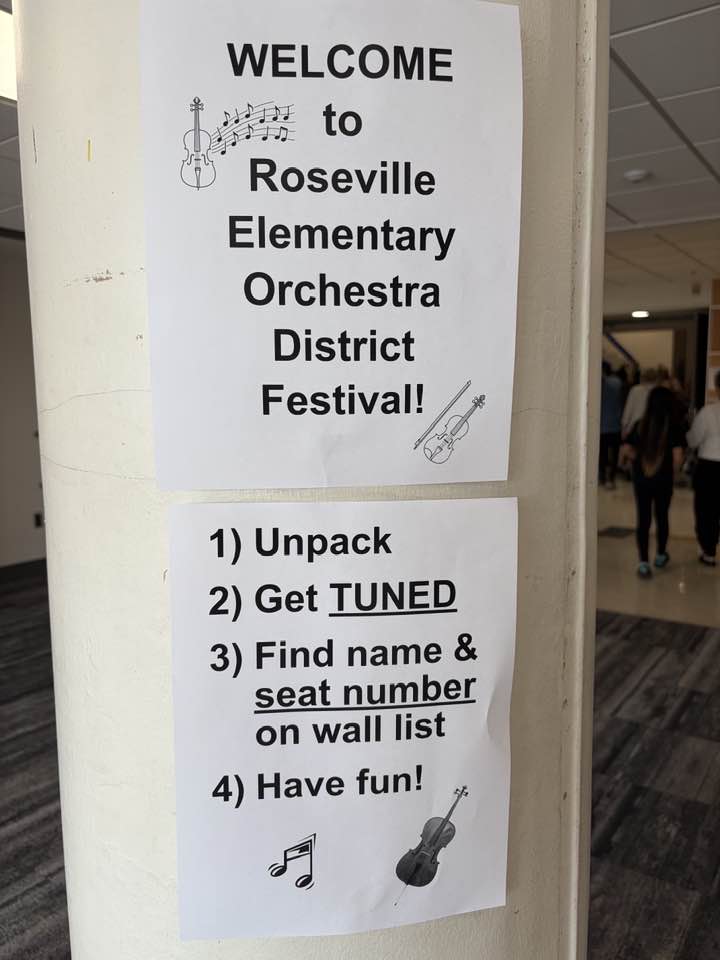
To cut through the din of crowd chatter, one of the orchestra teachers took to the mic to remind the students to check their instruments and if need be, have them tuned.
“If you haven’t tuned your instrument in a few days,” she said, “you might want one of us to tune it for you.” How can you not love these teachers? Whatever they’re paid, it’s not enough.
Of course, our eyes were on Illiana, whom we haven’t heard play the violin. The closest we’ve gotten to do so was to witness a demonstration of her bow-hold. But that was 100% visual, since on that occasion, the violin didn’t even make its way out of the case. Because of a communication snafu she’d missed the single group rehearsal last week, so she was one of the few kids who took a while to find her assigned seat. The process she followed, however, was instructive. A classmate kindly led her to the board in the corner of the gym where the assignments were posted. Illiana then worked her way between rows and found her seat—though additional commotion followed as she sought to fetch a stand from the “stand lot” in another corner of the “concert hall.”
We breathed with relief when she seemed to be settled in. I could see, though, a degree of nervousness on her part. Normally calm, cool and collected, she was busy looking around, then making sure her music was secure on the stand and in the process, nearly causing the sheets to slip away . . . then, once the music was behaving itself, Illiana continued looking around. I imagine she felt just bit overwhelmed by it all—or more accurately, I felt a bit overwhelmed imagining her surveying the crowd. Then, apparently recalling the word about tuning, she stood up and found her way back to the stands where a teacher with ear bent to another kid’s violin was plucking the strings to check for perfect fifths—settling no doubt, for “close enough.”
Eventually, right on time, nervous anticipation yielded to the leader’s formal welcome, introductions and announcements, for which she won hearty applause. She then turned to her cast of 272 musicians and raised her baton. To the chins rose a good 230 violins and violas, give or take a dozen, as the cellists pushed the necks of their instruments away from their shoulders. The moment of truth was about to be heard. Not since our own sons had had their day in the sun—as string players (both Cory and Byron), trombone (Cory? – For a summer), and baritone (Byron, for high school, though I don’t think the instrument ever showed up at home)—had we been treated to a school orchestra “concert.”
Something resembling an organized sound was ushered forth by the teacher’s baton and 272 bows across 272 strings (of 1,088) stretched “close enough” down the length of a corresponding number of fingerboards. If one could understandably relate the piece to birthing sounds emanating from a large zoo, I chose to focus on the supreme accomplishment that was in fact unfolding before the friendly hometown crowd. Here was a crowd of kids—all conceivable ethnicities represented—working in concert (so to speak) at a supremely daunting enterprise: making intelligible music with wooden instruments that in basic design and construction haven’t changed in centuries. Although no one gripped their instruments in the way a baseball player grabs a bat, most of the kids reminded me that few endeavors feel as awkward and unnatural at first as playing a string instrument (other than guitar). (This explains why nearly all proficient string players started when they were very young and had proper instruction for holding bow and box before bad, irredeemable habits set in.) Yet, in any case, however much they might or might not (probably) practice or be inspired to become exceptionally proficient, on this occasion, at least, those kids had pulled together sufficient effort and concentration to be “playing off the same page.” In these times, amidst all the distractions and nonsense in the world, these young people were focused (many to the point of scowling) and wholly “with the program.” For that, everyone involved—the kids, their teachers, their parents (and definitely grandparents, many of whom, clearly, were present)—deserved special mention.
With each of the next three “tunes,” as they were called, the ensemble improved its performance. In each case, the strains could be identified: the “Olympic Theme Song,” a tune with “Paris” in the title, and my personal favorite, “Ode to Joy,” because all in all, the whole Norman Rockwellian production was exactly that.
We didn’t join the scattering of folks who gave the performance a standing ovation. Though this is the land of the standing ovation, certain standards need to be maintained. People shouldn’t get the idea that what they heard was any closer to a Minnesota Orchestra or Saint Paul Chamber Orchestra concert than an elementary school basketball scrimmage is to an NBA playoff game.
As the crowd left the gym—kids with their cases in tow—I contemplated the experience we’d just shared. On one level it was an unremarkable event; one of a sort that transpires thousands of times across this land of ours. Yet, in another respect, it was a reason for hope; a counterweight to so many trends and influences of our day. Beth and I celebrated this modest but critical accomplishment by treating our violinist and her parents at a nearby DQ.
On some days life can be especially sweet.
Subscribe to this blog and received notifications of new post by email.
© 2026 by Eric Nilsson
