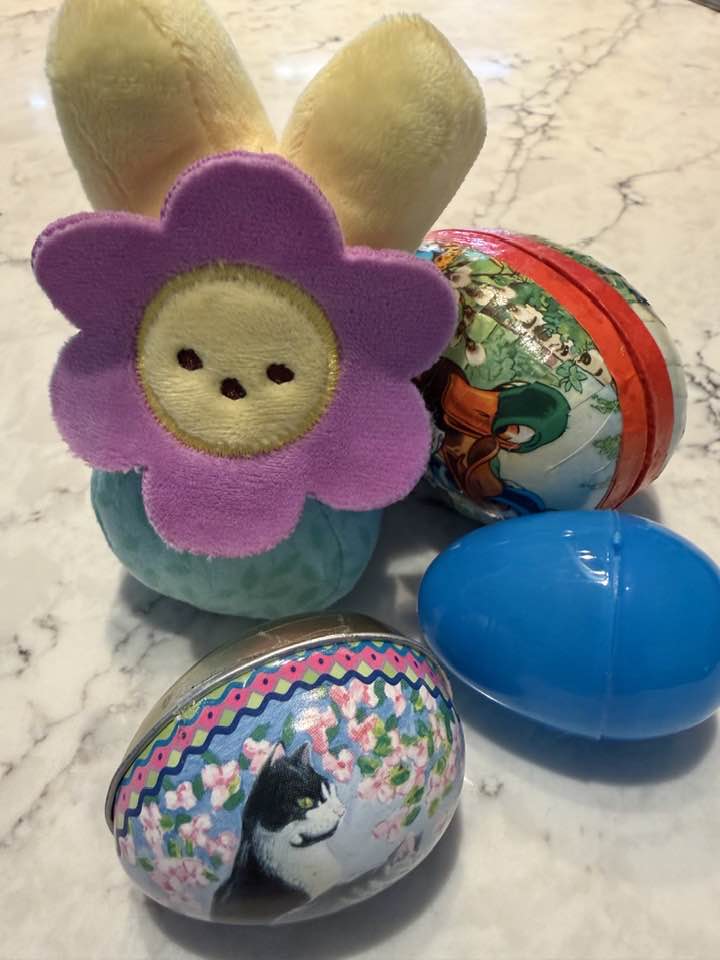
APRIL 5, 2026 – For the first time after days of meteorological dread, we in this part of the world awoke to bright sunshine with all its redemptive promise. By force of culture, tradition and upbringing, I thought of Easter—at least until I looked out the window of our reading room and saw a neighbor out walking her dog and clad in outerwear appropriate for a January cold snap.
A further reminder of Easter was a FT session with Beth, our younger son Byron and his two young kids—Mylène was absent with leave to attend her weekly Pilates class. The main attraction of the commotion in Connecticut (where the sky was defiantly overcast), was the haul of Easter eggs left by the Easter Bunny. The main point of humor was Byron’s persistent effort to introduce young Diogo to the magic of M&Ms inside a plastic Easter egg. “Mâcher! Mâcher, Diogo! C’est du chocolat!” As could be predicted, once the little Skeezix finally bit into a green-coated M&M, then a red one, followed by a yellow one, I watched in laughter as Byron switched to emphatic English and said, “Okay, Diogo. That’s enough! Diogo?! Enough!”
After the usual “Happy Easter-s!” “head hugs” and “au voir-s,” the session ended, and I returned to the quietude of an empty house alit by sunrays with easy access. Outside, the leafless trees swayed cold and stiff in the wind.
Later in the day, our older son Cory and his daughter Illiana will drop by—but conveniently, after they’ve had a proper Easter meal at the restaurant where Illiana’s mother works. This saves me the trouble of baking a ham with candied pineapple, a casserole dish of pomme de terre au gratin, with peas representing the vegetable stratum of the food pyramid—let alone dinner rolls and une planche de charcuteries. What I can and will offer, however, are fresh raspberries from the store and over-sized muffins filled with chocolate chips—fresh from the local bakery.
Meanwhile, in a nod to culture, tradition and upbringing, I called up a recording of Bach’s St. Matthew Passion performed by the Nederlandse Bachverenigning (Netherlands Bach Society). Just yesterday in a phone conversation with my oldest sister, still very much an Anglican (Episcopalian) churchy person in keeping with our upbringing, she told me that on Good Friday she’d performed in church (yet again) the violin accompaniment to Erbarme dich, an alto aria from St. Matthew Passion. Erbarma dich is such a hauntingly beautiful piece of music, it’s almost enough to make me a churchy person again.
As I now close in on the end of the first hour of Bach’s nearly two-and-three-quarter-hour Groẞe Werk (with another 23 minutes to reach Erbarme dich), I’m compelled to reflect on my “culture, tradition and upbringing” as it all relates to Easter of the Christian religion. Having exited the church, I can’t “delete” aspects of it that are permanently etched on my internal hard drive. One feature is the day when my mother once remarked off-handedly that Easter was “far more important” than Christmas. I suppose from the perspective of Christian doctrine and theology, she was correct, though as a kid I could never equate Christmas presents with Easter eggs or ham and candied pineapple with turkey and stuffing.
Now, as my figurative spacecraft travels even farther (“further,” symbolically) from my upbringing, the “Easter story” becomes ever more as fantastical as the Easter Bunny, but when approached from its historical context, the conceptual essence of the “Crucifixion and Resurrection” provides a powerful insight into the human condition. It’s a harsh combination of basic truths about the inherently flawed and “fallen” status of humanity and the long-range hope regarding the power of redemption in the form of our resilience.
A key element of that redemption, I believe, transcends theology and exegesis. It boils down to kindness toward . . . our own kind, broadly defined.
The other day before we’d left the school parking lot, out of the blue Illiana asked me what the difference was between “sympathy” and “empathy.” To complicate matters, she added, “And Grandpa, there’s a third word I need to understand. It sorta goes with sympathy and empathy, but I can’t remember exactly what it is.”
“Hmmm. I can’t think of the word.”
“Maybe when we get to your house we could Google ‘sympathy and empathy’ and see what comes up.”
“Excellent idea,” I said. “But meanwhile, back to the difference between those two words . . .” I proceeded to define them and give examples of one vs. the other.
Seemingly satisfied with my answers, Illiana then said, “Oh, now I remember something about the third word. It has ‘pathy’ in it . . . I know! It’s apathy.”
“Ah ha! Apathy.”
“What does it mean?”
I started with “pathos,” the common Greek root to all three words. I then explained the “a.”
“Whenever you encounter the prefix ‘a’ to a word that comes from the Greek, you know that the word with the ‘a’ means the opposite of the root. So, in the case of ‘apathy,’ ‘pathy’ means pathos—feeling . . . or more specifically, feeling sad—so apathos or apathy means non-feeling. If you’re apathetic about something or someone, you don’t care; you don’t have any feeling. But in interacting with other people, you want to have sympathy or empathy, as circumstances dictate, not apathy. In short, Illiana, you want to be kind and caring, even toward people who themselves aren’t always kind and caring.”
We continued through the cold, wet dreary weather to our house. I groused about the gloom, then caught myself. I didn’t want to be the grouchy grandpa. “But you know, Illiana,” I said, attempting to redeem myself, “up there somewhere, the sun is shining. Even on the darkest, rainiest days, the sun is shining high above the earth and therefore, above us. We should always keep that in mind.”
My effort to eclipse my displeasure with the tiresome weather prompted a recollection. “Illiana, what I just told you reminds me of my frequent grouchiness when I was a kid. Every Sunday morning my mom would swing open my bedroom door and say, ‘Rise and shine!’ It was all part of a Sunday morning routine that I hated—having to get out of bed so that I could eat breakfast and put on dress clothes in time to go to church and Sunday school. I never got out of bed on the first call. My mom had to shout ‘Rise and shine!’ three, four times before I grudgingly complied.”
“Did your mom get mad?”
“You know, Illiana, my mom was one of the most patient people I ever knew. That didn’t mean she didn’t make me do stuff. She was always making me do stuff I didn’t want to do—like get up early on Sunday mornings so I could go to church or practice my violin every day or do my chores or go to the corner store a few blocks away to get something she needed. But she was patient and forgiving. She could disapprove, but she never ever lost her temper with me or anyone else.
“And what was I in return? Sassy, grouchy and often disrespectful, and that’s something I really regret.”
Illiana was silent, but I stole a look at her in the rearview mirror and could see she’d been listening, taking it all in.
“Something else about my mom, was that she was always helping other people. She loved being around people, and if anyone ever needed help, she was there for them.” As I said this, I realized full well that the book of my regrets was a closed tome. What was within my power, however, was to project an awareness of redemption on the young heart and mind of Illiana.
And that’s my take on Easter this time around.
Subscribe to this blog and receive notifications of new posts by email.
© 2026 by Eric Nilsson
