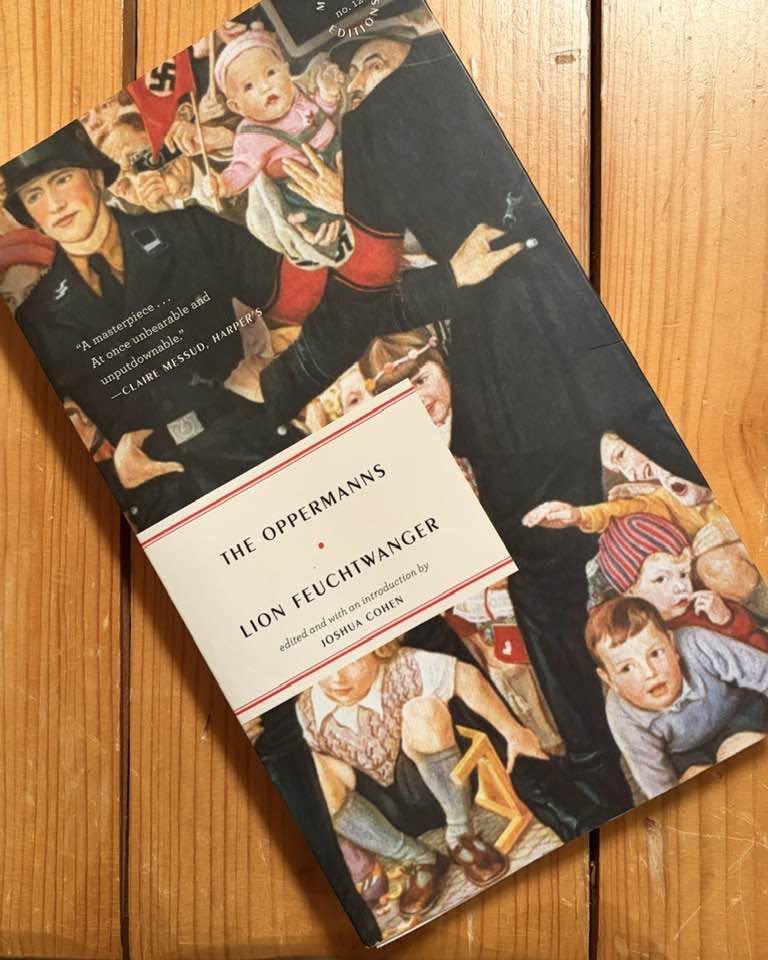
JULY 20, 2026 – Earlier this month I wrote a review of The Oppermans. I’m now reading the book a second time. The redundancy is proving beneficial, both from the standpoint of grasping better the importance of certain details and from the perspective of meaning—that is, why a book such as this should be read in the first place.
Recently I found myself telling a neighbor about the book. She seemed genuinely interested in hearing about it, but rather than provide a synopsis, I simply described a central point of tension and the lesson I drew from it. In the process, I realized how reading good literature can help fortify our principles.
To the extent a person assigns importance to moral, ethical and social principles of some kind (pick your religion, philosophy), it follows that the person strives to uphold those standards in daily life. In ordinary circumstances, most people are good and conduct themselves well within generally accepted community standards. We don’t go around killing each other over a passing argument or stealing stuff out of the neighbor’s garage. And we don’t tell giant fibs or torture cats. Behaving in accordance with accepted moral and ethical rules is largely habitual for most of us. As a result, society hangs on and hangs together—for the benefit of its members, individually and collectively.
We’re put to the test, however, when a price is to be paid for following our principles. In some cases, the price might be relatively low—not getting invited to a neighbor’s barbecue, for instance, because of our uncompromising political views, when we don’t particularly want to go to the barbecue in the first place. In other contexts, however, the price for adherence to principles could be quite high: losing out on a promotion at work, for example, or having the house fire-bombed at 2 a.m. Or being rounded up for “questioning” because of opinions posted—and winding up in a detention center from which there is no foreseeable exit. If enough people under threat decide that the price of principles is too high, then the whole of society is doomed.
ICE tactics—still being deployed across this “land of liberty”—are a reminder that even amidst our purported freedom and Constitutional guarantees, we are just one signature away from a grotesque edict unleashing forces that endanger our liberty, freedom and Constitutional protections. What these developments teach is how fast things can turn; how quickly the critical framework of an accepted social structure can fracture and eventually collapse.
To weather the storm, as it were, including what further encroachments on our freedoms and liberty might well ensue, it’s critical to stay in good shape morally and ethically; to “practice” the skills that are to be relied upon in upholding principles when the “chips are down.” The Oppermanns is a perfect example of great literature that forces the reader to wrestle with the cost of principles. This vicarious experience—I call it “ethical and moral training”—can make a difference if and when in real life our own backs are to the wall over principles.
The specific aspect of the novel that addresses most vividly the “price of principle” and the moral dilemma always present in such circumstances, concerns Berthold Oppermann, the 17-year-old student. This feature of the novel is what fueled my response to the neighbor’s question, “So, what’s it about?”
“Berthold,” I started, “is the son of one of the four Oppermann siblings, who are the primary characters of the novel set in Germany from November 1932 to September of the following year—coinciding with the Nazi seizure of power. He is an excellent student at a prestigious school, and he aspires to a career in academia. His favorite subjects are German history and literature. The headmaster of his school and his teacher are champions of high German culture, manifested in the German enlightenment. They are also devotees of Voltaire and Western liberalism. Berthold’s elders are likewise highly educated, cultivated, and champions of “positive values” within the canon of liberal Western intellectual traditions.
“The advent of the new nationalist-socialist regime, however, sweeps in a master (teacher) from the ministry of education; a German scholar who’s imbibed fully the new Kool-Aid. For his honors paper and presentation, Berthold had selected the topic of German humanism in the 20th century. The new teacher compels Berthold to drop that subject and write about the heroic foundations of Germanic (Aryan) culture, as laid down by Hermann of the Cherusci, who’d united Germanic tribes to fight the Romans.
“Through his research, though,” I said to the neighbor, “Berthold concludes that Hermann was no hero. In fact, he was a big fat loser—or so Berthold says, in so many words. This thesis—and the evidence Berthold presents to support it—is anathema to the fascist teacher. The latter demands not only a retraction but an apology. If Berthold refuses, the teacher threatens Berthold’s expulsion from the school, which will preclude admission to any other school in Germany and thus, will defeat the offender’s ability to advance inside Germany. Out of principle, Berthold doesn’t want to surrender, but the ultimatum imposes a price on the principle.
“The ultimatum is felt by all the Oppermanns, as well as by the headmaster, who, though very principled, also has much at stake if Berthold’s apology isn’t forthcoming. Berthold consults with the whole circle of his elders, all of whom are highly principled. But a price is attached to principle.
“But here’s the inevitable tragic conclusion that Berthold reaches: all the enlightened values that were instilled in him by family, school and a deep study of German classics and philosophers require him to withhold an apology. Yet all the people around him who subscribe to those values were counseling caution. In this Berthold saw a huge contradiction. What’s the point of all that learning if when the most critical principles—integrity, recognition of truth, individual freedom and justice—are put to the test, they must be ignored—because the price of observing them is too high?
“Berthold sees no way out except by his own suicide.”
Our neighbor paid close attention. When she repeated the title several times and added the statement that she wanted to read the book, I knew there was a better than even chance that she will read it—just not my copy yet.
Fast forward another two days to a conversation with my good friend and college classmate, John Cross. A scholar of anthropology and archeology, John is also a lifelong serious student of history. His knowledge of Bowdoin and Maine history is encyclopedic. When I told him about the lesson I drew from The Oppermanns, he mentioned by analogy, the Abolitionist movement in Maine before the Civil War. Today, it’s easy for any of us to say, “Of course I would’ve been an abolitionist, and a highly vocal one too!” But as John observed, there was a price to be paid for standing up against slavery. Right there in Maine, abolitionists were targeted by bigots; their houses burned; bricks hurled through their windows; mistreatment of their children and so on. Together, John and I pondered the question, if our families and property had been physically threatened over our abolitionist sympathies, would we have curtailed our speech, our opinions—and defended our principles against the violent rabble?
Whether the setting had been the abolitionist movement or German fascism, without having been there ourselves, we don’t know, we can’t say with certainty how we would’ve behaved. And though I’m quite sure I know how I would’ve reacted if ICE agents had ambushed a pizza delivery person at our door last January, again, I’m not 100% certain. What I can say with absolute certainty, however, is that before we reach the stage where my principles are tested by the price that attaches to them, reading The Oppermanns and similar books is the equivalent of moral and ethical calisthenics and a few laps around the circuit. The regular exercise won’t guarantee a gold medal in either the 110m hurdles or the marathon, but spending time studying well-written literature with strong characters and realistic scenarios enhances the likelihood that I will finish both the 110m hurdles and the marathon in a manner consistent with my principles.
Subscribe to this blog and received notifications of new posts by email.
© 2026 by Eric Nilsson
