JULY 11, 2026 – Today I experienced little bits o’ heaven. It all started with church. Not church church, but at the Mennonite Church on County Road K a half mile or so south of the south shore of Grindstone Lake. The occasion was the joint annual meetings of the Grindstone Lake Association and the Grindstone Lake Foundation. For the past several years, the Mennonites have rented out their modest church building to accommodate us 150 or so attendees.
Three things can be said about the leadership of these organizations: Dedication, dedication, and dedication. Oops! I missed a fourth trait: Results. Through an aggressive multi-pronged strategy, generous donations, and above all, untold hours of volunteer help, aquatic invasive species (“AIS”) have been held at bay—despite curly leaf pondweed and Eurasian milfoil infiltrations in just about every lake that surrounds us. Thanks to a parallel effort to influence DNR and county policies regarding downstream waterflow control, the lake level has been allowed to recover from disturbing lows over the past several years. Work on other fronts—increasing membership and improvements in communication—continues apace. I, for one, was hugely grateful for the time and effort the leadership and so many volunteers have devoted to the environmental health of the lake—a little bit o’ heaven amidst so much environmental degradation elsewhere.
But I left the meeting abundantly aware of the organization’s greatest weakness: the lack of succession planning. It’s a problem common among many civic organizations. You look around, and many, if not most, board members, officers, leading volunteers supporting non-profits, appear . . . shall we say . . . as though they’re well past their 50th high school reunions. In this specific case, it’s time to start recruiting the next generation of leadership and volunteers.
Yet, soon I was back on the northside of the lake, visiting with our neighbor down the way, Steve B., who’d joined me at the meeting. We sat on his and Nancy J.B.’s[1] shaded floating patio, which is what I call a docked pontoon, enjoying deliciously warm weather and a light breeze to blow any bugs away. Another bit o’ heaven. As is usual for us, we talked trees and nature, birds and nature, then back to trees and nature, before acknowledging our shared amazement over how little we know about our surroundings after all these decades up here. And of course, we veered off into politics—as we always do—but managed to stamp out the embers before a forest fire broke out.
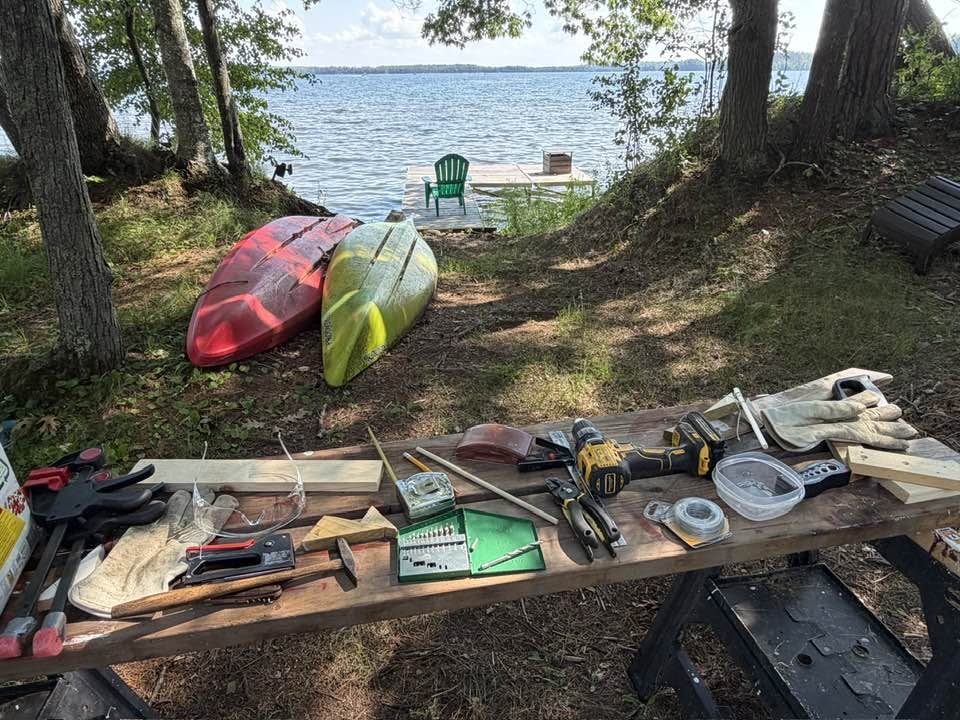
At 1:00 p.m. I returned to our place to begin work on my “sailboat project,” which I described in yesterday’s post. (Beth stayed back, since Illiana starts Korean Culture Camp next week.) It was a typical summer day in heaven “up at the lake.” Only half a dozen boats were out on the lake, and it took some effort to round up that count from the end of our dock. With the place to myself, I set up shop, as it were, in the shade a few yards back from the break in the tree-guarded shoreline berm. Across two sawhorses, I arranged two long wide cedar planks and spread out my tools, pre-cut wooden “sails,” wood stock for the hulls, a package of doweling rods for the masts and miscellaneous parts, fittings and fasteners.
My usual practice for a project of this sort is to prepare (and adjust) numerous scale drawings before doing anything. But to achieve what I have in mind for the wooden sailboats, I realized I’d have to take a different tack. I needed to experiment—not with a pencil and graph paper but with the real stuff—the wooden sails, doweling rods, and various accessories. I could “see” the finished product, but I was entirely unsure of the “engineering” necessary to achieve what was to this point little more than a fiction of imagination. In short, I had to build a proto-type, experimenting as I proceeded.
This proved to be a very slow approach, but hardly tedious. That’s how I define the “zen,” the “nirvana” of a cabin project: glacially slow and lacking all tedium because “glacially slow” creates the illusion of a moratorium on time . . . and all worries and concerns other than identifying challenges and devising, then implementing, solutions. I suppose there’s a third element—a catalyst—to the “zen” and “nirvana” of a cabin project: pure whimsy. Today’s work—figuring out how to “step” the mast and “rig” the sails—was very much like a puzzle-maker’s effort to design, fabricate and assemble say, a wooden puzzle in the shape and details of . . . a sailboat.
My breakthrough came when I switched gears from “approximations” to “actualizations.” By that, I mean, instead of a jerry-rigged (so to speak) approach to attaching the sails to the mast and the mast to the hull, I adopted a wholly realistic design but in miniature; that is, I relied on how a sailboat with a main and a jib works in real life. Over the decades, I’ve owned several sailboats and sailed aboard others. I’ve rigged sailboats a gazillion times. I’m wholly familiar with how a mast is held up (a cable forestay; two cable side stays); I know how the main is hoisted (by a halyard), how it’s held in place (by a cleat), and how it’s controlled (via a “sheet” (line) attached to a “traveler”); ditto the jib (except it’s attached to the forestay, not the mast)—in other words, I know how a sailboat is rigged. Once I recognized my actual Catalina 14.2 sailboat as the “proto-type” for my model proto-type, I felt as though blinders had been pulled. “Problems” vanished, and replacement solutions appeared as if by magic. I experimented, and Voila! I was in business.
The work itself, however, required uncountable micro-steps—but again, they were still very much in the zen zone. Tomorrow I’ll map out the sequence of preparation and assembly of all the parts of my new design. My goal is to build eight model sailboats over the next eight rotations of the earth.
At 7:00 I told myself to close for the day. So I did, though . . . Shhhhh! Don’t tell! . . . When I wasn’t noticing, I tested a few more ideas before locking myself out of the figurative shop. At a quarter past seven, I went for a 20-minute hike down and back the Björnholm shoreline path. The sun slid closer to the horizon, creating an artist’s haven along the way, as golden rays played a near-stationary game of “not-it” with the trees. It was another bit o’ heaven here in this place on planet earth[2].
Subscribe to this blog and received notifications of new posts by email.
© 2026 by Eric Nilsson
[1] Nancy and Steve and Nancy’s daughter, both serious wildlife photographers, are currently in Mongolia on an expedition to capture photos of the rare manul (the Mongolian word for “wild cat”).

