DECEMBER 10, 2025 – Hug your loved ones—hug them tight and tell them you love them. Cherish your friends, and be generous with empathy. Embrace everything in life, even when it’s difficult.
Over the past 36 hours, I’ve learned that L.I.F.E. is (among other things) an acronym for “Love,” “Irony,” “Friends,” and “Empathy.” I’ve also learned a paradox about life: in the smallest things are the biggest.
Two and a half days ago, I had one set of well-defined pressing priorities. Yesterday, at precisely 3:59 p.m. CST they were rudely reordered by a new priority—one that blew down from the dark cavernous attic above our garage. For 11 months of the year, this attic harbors bins and boxes far from mind and light; Santa figurines, nutcrackers, ornaments, and other paraphernalia of Christmas cheer, locked up in darkness.[1] The blast from the 3 x 4 opening allowing ingress and egress for that space produced the scariest moments of my life: first hearing the ear-shattering sound of a tall aluminum ladder crashing against the concrete floor, then seeing my wife’s crumpled body lying still beside the ladder, her feet entangled around a step, her eyes shut and her ears closed to my panicked cry, “Beth, Beth, . . . Beth!” as I dropped to my knees beside her.
Our granddaughter stood beside me. Just 45 minutes before, I’d picked up the fourth-grader from school and rendezvoused with Beth (who’d been running errands) at the Christmas tree lot just three minutes from our house. We’d planned to instill a bit of seasonal cheer into our dear granddaughter’s life, so fraught recently by conditions beyond her control, before her dad arrived after work to take her home. Before we’d even unloaded the tree from Beth’s car, Beth was already in the garage putting a ladder in place to retrieve the tree stand from the attic. In those critical moments, I was helping Illiana remove her school pack and violin case from my car, parked in the driveway. Her grandmother, now still as a fallen statue, has played a pivotally loving and positive role in Illiana’s young life. The two are very close. “I love you to the moon,” says Grandma at every parting. “I love you to infinity,” Illiana cries out in reply.
With one hand-in-mitten cushioning the back of Beth’s head, I shook my other mitten off, reached for my phone and called 9-1-1. When I later checked, I saw that the call had gone through at exactly 4:00 p.m. The blizzard that had been forecast was in full gear—at top of rush hour—and the wail of sirens seemed to take forever to pierce the early onset of winter dusk and the horror that was building around my thoughts. In shock herself, no doubt, Illiana knelt next to me and patted her grandma softly on the forehead. To me it looked like one angel giving succor to another.
As she promised, the dispatcher stayed with me, asking questions, giving me instructions, until the legion of firemen and EMTs appeared on two fronts—around the street side of the house and along the alley at the end of our driveway. The interminable wait turned out to be only 11 minutes—the duration of the 9-1-1 call—as my phone data later revealed.
“Do you want us to go to Regions or United?” asked one of the EMTs, after they’d transferred Beth to a snow-covered gurney already standing behind her car in the driveway.
“Regions,” I said. I watched as they pushed the gurney like a sled toward the ambulance. By this time, Beth had regained consciousness but was in a state of confusion. With slurred words she asked what happened, where she was, where they were taking her. Despite my answering several times, she responded with a half-alert, puzzled look, as if waking confused after a deep slumber. When asked by an EMT, she had no idea what day or month it was. Relieved that she was alive, I nonetheless felt my heart sink again as I peered into the unknown ahead.
“You might want to wait a while before you head down,” said one of the fire rescue team. The roads are a mess right now, and it’s going to get worse. Be careful.”
“I know,” I said. “We’d just arrived home when all this happened . . .”
Moments later I watched the ambulance push down the alley like a snowplow without its blade. As it disappeared into the blizzard, the whole mystery we call Life, like some cosmic electric impulse, charged through my consciousness.
“Regions” is “Regions Hospital” near the capitol, a 15-minute drive from our house. Having made the trip umpteen gazillion times during my multiple myeloma journey, I know it well. My latest visit? Ironically, it had been less than 24 hours before, when I myself had been admitted to the same Emergency Room to which Beth was now headed.
That evening (Monday), I’d experienced trouble breathing—and when serendipitously I’d mentioned this in an email exchange with my good [F]riend Mike Fischbein, a semi-retired physician in Falmouth, Massachusetts, he wrote in so many words, “You should go the doctor now.” I immediately toggled from my email to the website of our closest urgent care clinic a five-minute drive away. For another 35 minutes, according to their home page, they were accepting walk-in patients.
Despite my breathing difficulty, I jumped to, though in the simple course of grabbing coat, hat, gloves, and car fob, I was winded. I took Beth’s car—better suited for the deteriorating snow conditions (ahead of the blizzard that would hit on the morrow). When I reached the doors of the clinic, I was greeted by a sign that read, “Due to High Demand, We are no Longer Accepting Additional Patients. For Emergency Care, Call 9-1-1.” I rushed past it—albeit winded anew from my short walk from car to clinic entrance. Oddly, the waiting area was unoccupied. A lone staff person was at one of the reception windows.
“We’re closed,” she said.
“I’ve got to see someone,” I said.
“What’s your concern?”
“I can’t breathe!”
“Have a seat. I’ll find someone.”
What ensued was immediate attention by a well-trained and caring staff of assistants, nurses, and physician. I don’t know where they came from. I saw no one else on hand, and for a moment I felt as if I were in some kind of dream, in which I was in desperate circumstances, but as if by some miracle, people appeared from nowhere to bring me back from a precipice. Routine tests were administered—including an EKG, which didn’t set off any alarms. The doctor listened to my lungs and didn’t think I had pneumonia.
After the EKG, a nurse’s assistant entered the exam room to explain she wanted to check my heart and respiratory responses to modest activity. “If it’s okay,
she said, “I’d like to take you on a short walk. Is that okay?”
“As long as I don’t have to walk the plank,” I said. The kind assistant chuckled with me.
The upshot of my visit was that my problem was beyond the testing capacity of the clinic but that the condition could be serious; I should head for ER immediately, the doctor told me sternly. But how—by ambulance? Have my spouse pick me up? “Except,” I said, “I drove her car to get here. Mine’s buried under the snow. I think I can get myself home. It’s only five minutes away.”
The good doctor who’d assumed charge of my case and whose serious demeanor and apparent age suggested decades of experience, called ER to make sure they’d be ready for me. She informed me that only a dozen people were in the waiting area. “Unless there’s a plane crash before you get down there,” she said, “you should be seen right away.”
It was 9:30 when Beth dropped me off at the entrance to Region’s ER before she parked. I huffed and puffed my way in, where one of the dual security detail at the front desk asked if I had any weapons. After that preliminary question, spoken and answered as if it were a code to distinguish a “friendly” from an infiltrator in the field of battle for good health.
After a full examination and battery of tests (and breathing aid in the form of “rescue” albuterol) administered by multiple doctors, nurses, and assistants at ER, every single one of them a visitor from some heavenly zone of this world, I was released on good behavior with follow-up instructions. It was now 4:00 a.m. Beth had left at 2:00—in extreme discomfort from having sat so long in a poorly designed chair in room B4. Coincidentally, because I myself had been sitting/lying in one position on the ER bed, angled from the waist, for so long, my left side sciatic nerve had turned me into a veritable cripple. With a great squeeze of the jaws—but air now in my lungs—I managed to find my way out to the ER waiting area.
I pulled up my Lyft app, but since I hadn’t used it in eons, I needed to add my current credit card for payment. This, of course, required me to pull out my wallet. Our health insurance, unfortunately, would not compensate me for the time and hassle of having to cancel the card and order a replacement and apply for a new REAL driver’s license and passport card, bar membership card, and photos of our grandchildren tucked away in front of a folded mug shot of Andrew Jackson. I would learn of the lost wallet six hours later while disrobing inside the Neuroscience Center before my previously scheduled MRI in anticipation of next week’s biopsy.[2] As I hobbled up the snow-covered walk to the house, then up the stairs to collapse from fatigue into bed, I had no inkling of what the new day soon to break would bring.
In concert with the shock 12 hours later, however, would appear more Friends, starting with Amy and Lynn next door. They’d seen the lights, heard the sirens. No one else could be better at being neighbors. Without the slightest hesitation, Amy swept the snow off Beth’s car so I could drive immediately to the hospital after Cory picked up Illiana. This morning I woke to the sweet Minnesota sound of a snowblower clearing our driveway, our sidewalks, our front steps—thanks to those snow angels next door, Amy and Lynn.
Next came an exchange of supporting texts from our dear friend Linda, who’s been through more tough stuff in life than 10 people should be expected to bear, yet who in each case has rebounded with grace, strength and humor; who, because of her own travails but also on account of her personal power and character, knows how to convey [E]mpathy and support of the highest order. When Linda checks in, you know a higher power is at the helm of your life.
Throughout our recent crises, Beth and I have seen [E]mpathy in action; not only from family and friends but from all the health care providers who’ve ministered aid and comfort to us. They are evidence—nay, proof—that despite all the darkness in our world, bright light shines with irrepressible intensity.
At 10:00 last night, I helped Beth out of the car and into the house. It was rough going. Despite the administration of various pain inhibitors, she, a stoic with a very high threshold, was in a state of pain-charged debilitation. My immediate mission was to get her safely situated for the night.[3] A crisis compresses thoughts and actions into tight linear thinking and short steps of urgency.
But as I’ve learned from various challenges, the smallest things are also the biggest things in life.
Yesterday while waiting for Cory to appear so I could chase down to the hospital[4], I prepared some “Instant Pho” for Illiana and a bowl of packaged ramen for myself (not having had a chance to eat since supper just before chasing down to urgent care/ER the evening before). We sat side by side at the kitchen counter with her great aunt Jenny on the speaker phone.
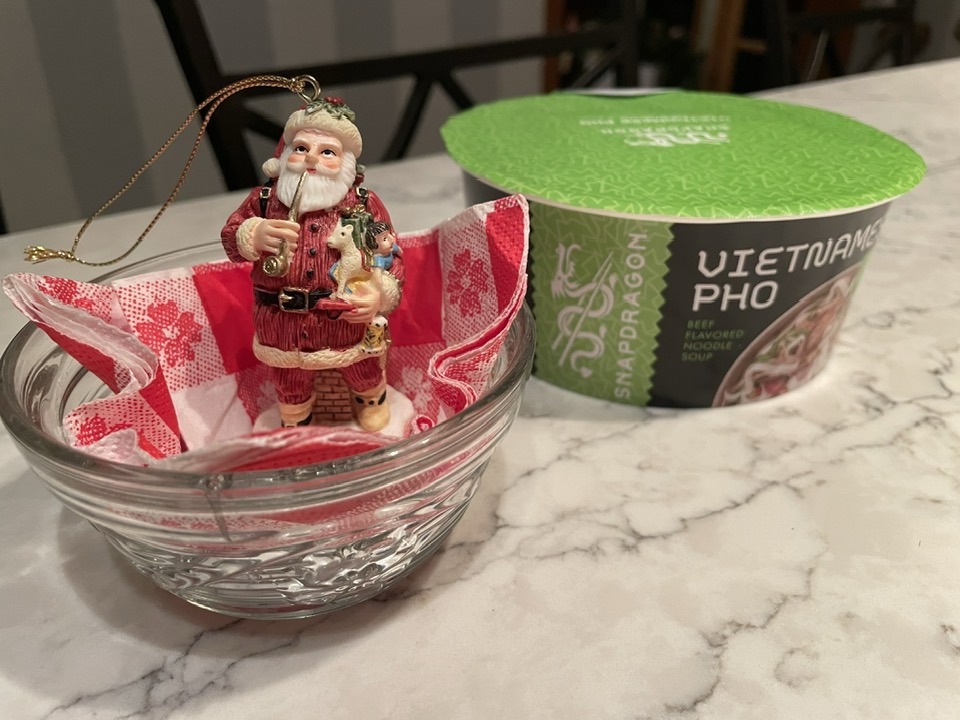
As I described to my sister what had just transpired, Illiana pushed her empty pho bowl aside and retrieved a small glass cup from the cupboard. From a linen drawer, she pulled a small red and white checkered napkin bearing a pattern of stylized flower blossoms. She arranged the napkin into the cup, much as Beth places a tea towel in a serving basket for fresh rolls. Illiana then found a small package of chow mien noodles that had been tossed into the bag of Chinese takeout that Beth and I had ordered over the weekend. Illiana emptied the noodles into the cup and began munching on them, one at a time. My focus remained on the phone call, but when I glanced at what she was now doing with the noodles, I saw her arranging them into the shapes of eyes, faces, human figures.
I regret that I didn’t have the presence of mind to photograph them—to include in her amazing and ever growing “portfolio” of extraordinary artwork. By the time Cory appeared at the back door and I signed off with Jenny, the noodles had disappeared. A “little thing,” perhaps, in the grand arc of my life, but something I will long cherish after the pain, urgency and anxiety of the immediate crises have long been banished from our thoughts. (To be cont.)
Subscribe to this blog and receive notifications of new posts by email.
© 2025 by Eric Nilsson
[1] The subject of my 11/25/25 post, “Finally: What Comes Down from the Attic Stays Down from the Attic.”
[2] A minor convenience in the scheme of things. I was well compensated by my conversation with the Somali driver, a young guy working his butt off to take care of his family, whose reaction to the latest reprehensible ICE attacks against the local Somali community was downright inspirational: “When Trump calls us ‘garbage,’ he said with a laugh, it motivates us to try that much harder. To make contrast with those few fraud people [the people of Somali origin who were involved in the well-publicized theft of huge public funds], the rest of us must now be 100% good, 100% honest, 100% doing good things—not any lower percentage; 100%.” (Just plain “Wow!” I told him, offering my full moral support.) As a footnote to the footnote, I’d checked very carefully, the back seat and floor of the car before exiting, making sure I hadn’t left anything—hat, glove . . . wallet—behind.
[3] Reserved for tomorrow’s post will be a nail-biting sequel to this post. The focus will be on . . . the attic, the ladder, Beth’s phone . . . and a Christmas tree stand, the necessity of which is what triggered the episode featured here in this Neflix-like series called, L.I.F.E.
[4] Room B5, as it turned out this time, identical to room B4 the night before.

2 Comments
Dear Eric,
As (DF) distant friend, I found myself like Pavlov’s dog suppurating at the bowl, empty for two days, waiting for the sustenance of your daily posts. Then came the cacophony of life coming apart, falling ladders, human frailty, swirling snow scenes en route to emergency care and care again. All narrated from right inside the damn paper-weight snow globe itself, the swirl of written expression! All the while knowing that I first wish to a. Keep vigil; then b. Send signs of L.I.F.E.; followed by c. Extend my own paltry words of comfort and care; before d. Biving over to the anticipation of the promise of a “to be continued, next installment.” I can do nothing but stand back (or beside) in awe of the indomitable human spirit. Thanks so much for sharing your insight.
Erik Hansen
Erik, my good friend (“GF”), you are an inspiration!