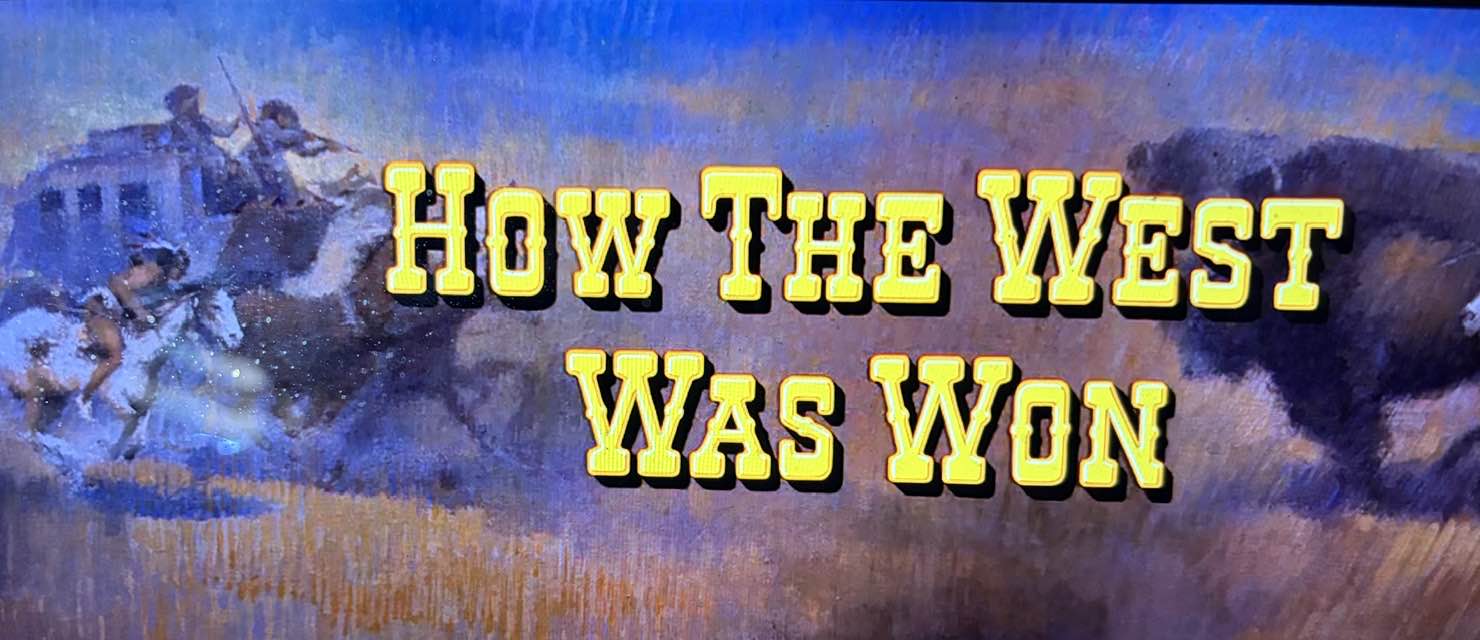
APRIL 14, 2026 – (Cont.) In many ways, the movie is a celluloid wonder. It had three directors, featured a real live buffalo stampede filmed in Custer State Park, South Dakota and attracted a long roster of the day’s stars: Jimmy Stuart, Peter Fonda, Debbie Reynolds, Gregory Peck, Karl Malden, Richard Widmar, George Peppard, Thelma Ritter, Spencer Tracy (as narrator), and of course, John Wayne. In some regards the work captured the essence of a sweeping historical episode that fueled countless scholarly books and numberless more romanticized, superficial and crackpot movies, TV shows, and trade books. In other words, How the West was Won conveys the basic traits of “Manifest Destiny”: irrepressible geographic expansion of an adolescent nation propelled and accompanied by grit, lust, avarice, good and evil, some justice and lots of injustice. But much of the injustice, of course, is nowhere to be seen. Above all, the movie is a work of propaganda in the vast canon of American mythology, dominated by “good and good-and-white . . . men.” Completely ignored, because it would’ve ruined the film’s prospects from the outset, was the prelude to the plot: White conquest of the Indigenous East.
The film opens at a departure point along the Erie Canal, as Zebulon Prescott, an Eastern farmer fed up with “raising crops of rocks,” leads his family to the Promised Land somewhere west of Pittsburgh (most likely Ohio). It ends with a cringeworthy collage of scenes featuring the (glorified) rape and pillage of natural resources—open pit mining, lumber mills and the like—culminating with a twisting aerial view of L.A. expressways, all symbolic of the great “Win,” all accompanied by the strains of “Patriot-Hollywood” music. Just plain, “Wow!”
As I reflected on the film this time around, I gained insight into the biases instilled in me—not to mention the numerous blinders attached to my vision—when I was a young kid, and the prejudices that I carried forward through much of my life, sailing right through the best formal education that money (of course) could buy, and well into my informal, self-directed education thereafter until all too recently. Now much more aware of my ignorance, I no longer wonder about its fathomless depth.
My reaction to the movie was hardly the first session of self-flagellation over my nation’s history. I’ve been in this “come to Jesus, then torture thyself” frame of mind for a good 20 years or more. But it isn’t a static condition. Each chapter of every book read nets me more information for me to grasp “how things were” so as to grapple with “why things are.” If I can’t change the past, at least I can apply my revised perspective on it to build a more reasonable assessment of the present.
Why does all this matter? What should I do about it? Perhaps for geezer-like-me, one very white individual Boomer American, the most constructive action turns on a three-step plan: 1. Encourage others to pierce the veil of national mythologies; 2. Put aside self-flagellation and pick up mindfulness as to who—close by and around the globe—subsidizes and who benefits from my consumption; and 3. Set an observable example for our heirs to this world so that by incremental steps the arc of our history might “bend toward justice.”
Subscribe to this blog and receive notifications of new posts by email.
© 2026 by Eric Nilsson
