AUGUST 29, 2026 – (Cont.) The pinnacle of my fishing career, as it were, occurred during my Grand Odyssey around the globe in 1981—a journey on which I was fishing for an answer to the ultimate question in life: What should I be when I grow up?
One of my side trips took me to the far north of Norway and voyages aboard a series of small commercial vessels out among the gloriously scenic Lofoten Islands that arc their way out over the Norwegian Sea from Ofotfjord (which leads from Narvik). Starting with hiking adventures on the first and main island, Svolvær, I eventually wound up on the islet of Røst near the end of the chain. On Røst I stayed at the most remote youth hostel of any over the course of my entire odyssey. The hostel—as tidy as it was sturdy—sat on a small promontory at one end of the otherwise flat-as-a-pancake island.
Four other travelers, including a Brit, a Norwegian and two Germans were among my co-guests for the three nights of my sojourn. We got on well from the start, and together we decided that an appropriate feature of our stay would be to spend a day at sea on a local fishing boat. On the suggestion of the hostel manager, we hiked down to a nearby wharf to make inquiries. At the first try we found a willing captain. Fair weather was upon us, and he said it would be a good day to experience the nearby fishing grounds by the small, ruggedly sculpted uninhabited islands a few miles beyond Røst.
I remember well the feeling of remoteness as we chugged out into the open sea—the unfamiliar angle of the sun, the bracing air, the isolated islands ahead of us, appearing like geologic clocks amidst timeless waters. If iPhones had existed back then, I would’ve taken at least 60 photos per minute before realizing the scenery wasn’t to be captured and saved but to be experienced and stored in my memory. Thankfully, I came to this realization early, since all I had at my disposal was a cheap knock-off version of a Kodak instamatic.
Once we reached the fishing grounds, the captain and his deckhands helped us operate the line spools attached to the gunwales. Every couple of feet along each 50-foot line was a hook, and attached to the shaft of each hook was a piece of bright orange plastic. A lead weight was tied to the end of the line. When the side crank on the spool was unlocked and turned counter-clockwise, the weight and gravity pulled the line out to its full length. After a wait of one or two minutes, the line would be wound back in. Miraculously—or at least, according to my frame of reference, quite mysteriously—a two- or three-pound cole fish (member of the cod family) on nearly every hook.
In one big fat hurry, I was cured of any residual aversion to handling fish. In short order, I was standing amidst our collective harvest from the sea, as crew members worked feverishly to transfer our catch to bins.
After our success, the captain headed back to the wharf, where crew members showed us how to clean some of our catch. They generously said we could take as much as we wanted. For the next day and a half, we ate fresh fish, and what we couldn’t consume, we wrapped and stored in the hostel freezer for future guests. On the kitchen counter we left a tri-lingual note that read, “Help yourselves to the fish in the freezer.”
The experience had given us a fresh perspective on the multitude of fish-drying racks that stood near the wharf and outside every cottage on the island.
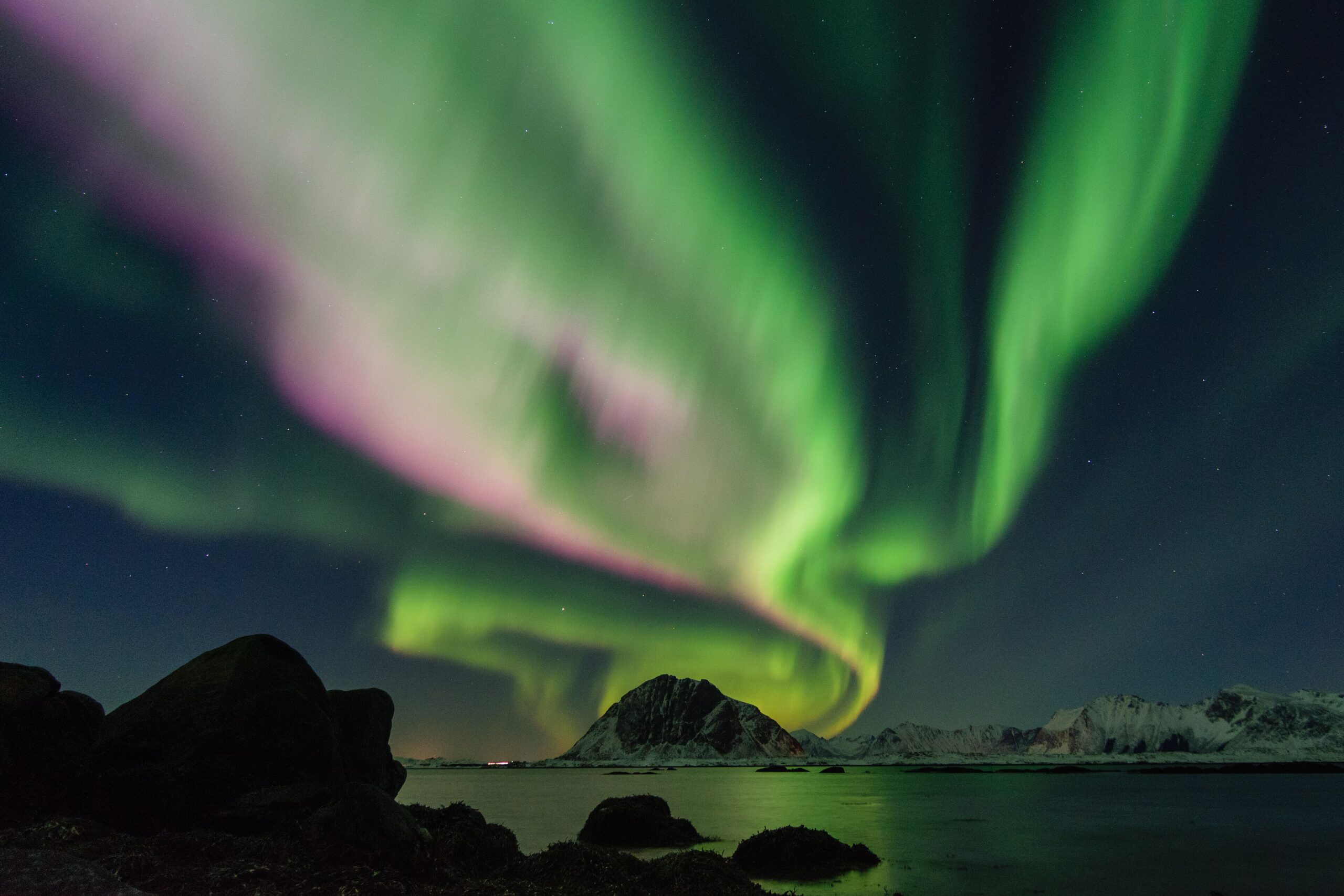
The capstone to that ultimate fishing expedition occurred on the over-night voyage from Røst to Bodø on the mainland (the northernmost Norwegian railhead for trains running south to the arctic circle and beyond). Since August was drawing to a close, the long summer days at the high latitude of the Lofoten Islands were growing shorter, but twilight still lasted long. I stayed above deck to watch the changing light and color of the sky. In an attempt to get some sleep, the Germans whom I’d met at the hostel had gone below deck to find a place out of the wind. Twenty minutes or so after my fellow travelers had retreated down the stairs, the Aurora Borealis filled the now dark blue velvet sky with such pulsating brilliance, I was afraid I was on drugs. After gaping at this display for a minute, I tore down the ship stairs in search of my friends. They were sound asleep—heads, arms and shoulders resting on a table—in the small eating area adjacent to the galley. I had to shake them awake, and as they gained consciousness, they searched hard for their bearings.
“Quick!” I said. “Schnell!” I repeated it in German, thinking it might rouse them more quickly. “You’ve got to come up to the foredeck to see the Aurora!” Reluctantly, they followed me, as I clamored up the staircase. But by the time we reached the open air, the much-vaunted northern lights had vanished entirely. The groggy Germans appeared more confused than displeased, as they stumbled back to the stairs and disappeared back down into their dreamworld below deck. But I will never forget that amazing light show in the heavens above the Norwegian Sea. If the “big one” had eluded the Germans, I’d been at the right place at the right time to catch one of the sharpest and most lasting visual memories of all my travels.
Subscribe to this blog and received notifications of new posts by email.
© 2026 by Eric Nilsson

1 Comment
Great stories and memories. Your travels from decades ago were quite the adventure!