AUGUST 26, 2026 – (Cont.) During the next summer was my second fishing expedition on Round Lake. Coincidentally, the trip didn’t involve the Roeckers but the Ridges, who had been the previous residents of the house where Roeckers now lived. Ridges had moved to St. Cloud, then Minneapolis, but remained friends of our family and stayed in touch.[1] Their grandparents (Will Ridge’s parents) owned a simple cabin called “Seldom Inn” on the south side of Lake George, and we were invited out to the place for a cookout early one evening. After supper, Mr. (Will) Ridge announced that he was taking several of us kids fishing to see if we could catch some sunfish. For the next hour or so, we tried our luck, but nothing was biting. When we returned, old Grandpa Ridge, hands in the pockets of his trousers held up by suspenders strolled down the lawn from the cabin to meet us at the dock. I’ll always remember what he said, because he repeated himself three or four times: “They’re back, but they got no fish . . . They’re back, but they got no fish . . .” Will Ridge seemed a bit miffed by his father’s repetitive pronouncement of our patent failure. By the tone and tempo of the grandpa’s voice, however, I decided he was making a simple observation in a grandfatherly way, not issuing a criticism of our lack of skill or knowledge.
During the summer before fifth grade, my neighborhood buddies and I spent lots of time down along the river’s edge in our immediate neighborhood behind the homes across the street—the Caines house, Bob Ehlen’s place, the Thurstons, and even farther downstream all the way to the somewhat spooky underbelly of the Anoka-Champlin Bridge. We found the most action on the frontage along the Caines’s property and Bob Ehlen’s. There we’d encounter Jeff Caine and his buddies—all much older than us punks—fishing with what appeared to be high-end rods and reels.[2] They caught mostly carp, some of them huge and ugly. Jeff called them “junk fish,” an eminently apt description in my limited view of the fish world; the term “rough fish” was way too charitable—right down there with “bottom feeders.” The grossest versions of carp were the dead, stinking-to-high-heaven ones staring blankly from the shoreline stones where their over-sized carcasses had been deposited by the lazy muddy waters of the Mississippi. Carp made sunnies look like princes and the northerns and muskies I’d seen depicted in resort brochures up in Hayward, high-end storybook royalty.
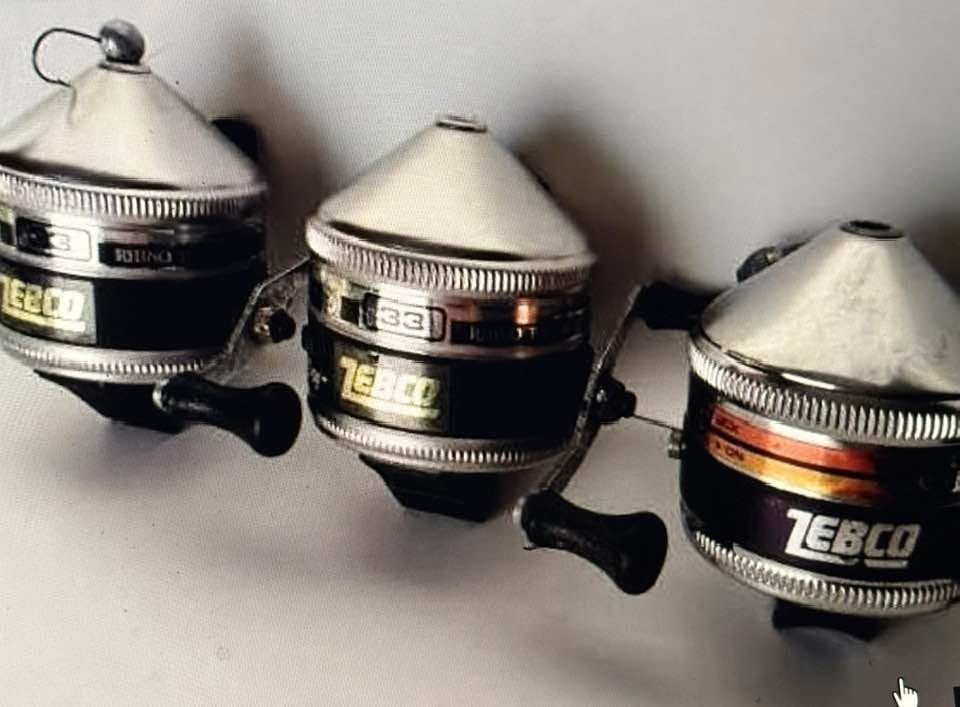
Despite my impression of river “junk fish,” I found myself caught up with the finesse with which Jeff and his buddies wielded their fishing rods. Each of these guys would stand nonchalantly on shore and with a casual twist, bring the rod back, then flick it forward as if throwing a warm-up sidearm pitch or alternatively, an over-the-shoulder fast ball. The moment before the ball left the glove—that is, at the very point where the lure’s momentum carried it almost past the end of the rod—the thumb bar of the Zebco reel was released, and I got to watch lure and bait sail out over the river. I’d then watch each of the big kids reel in his line, slowly, deliberately, and above all, patiently. When a big carp struck, the hit was announced by a “Woo-hoo!” Everyone then got to see Jeff or one of his lucky friends haul in another junk fish, much to the fascination of my buddies and me.
It wasn’t long before I too wanted to stand on the shore, a long grass stem in my mouth, casting a baited lure in a beautiful arc over the muddy Mississippi, then reeling in a really big fish, even though it was likely to be an ugly carp. I’d let my astonished buddies touch the fish or do whatever they needed to release it back into the river. To achieve this dream, however, I’d need a rod and reel, plus tackle, a tackle box, and a good-sized net.
On many a day leading up to my birthday in early August, I’d review my choices—again—in the Sears Roebuck and Montgomery Wards catalogues that were stored on a shelf in the den of our house. I’d perused the individual rods and reels as well as the packaged sets and knew what I wanted. I faced a quandary, however: One the one hand, I couldn’t afford any of the sets I wanted; I’d have to drop a strong hint to Dad that for my birthday present, a fishing set—rod, reel, tackle, and box—would hit the bull’s eye. (I’m not sure when it started, but while my mother pulled together my actual birthday party each year, it was Dad who took care of my birthday present, and he always took very good care of this most critical part of turning a year older.) On the other hand, however, I did NOT want any of the reels that had a single knob on the crank. I had to have a double-knob crank—one that imitated the classic Zebco reel that several of Jeff Caine’s buddies had. (He himself had a Shakespeare spinning reel, which was far too much to wish for. It had a bail instead of a thumb release, and—ironically, a single knob crank.) But how could I convey this to Dad without turning a hint (i.e. a request) into a rude demand?
My solution involved two steps: first was to turn to the fishing gear section of the Sears catalogue and draw an arrow pointing to the set that met my “requirements”; the second step was to mention casually to Dad one evening that I’d been “looking through the Sears catalogue for fishing gear and ‘saw some good stuff.’”
About a week later it appeared that Dad had followed my “clues”: I noticed two boxes on the hat shelf of Dad’s front-hall closet. One was long; the other was much more compact. The closet was Dad’s exclusive domain. It’s where he hung his overcoats, fedoras, hat brushes, dress gloves, and other outerwear accessories, all neatly organized. From time to time, he also stored special things on the hat shelf, and you didn’t have to be a genius to connect the dots of (1) those two boxes, (2) my approaching birthday, and (3) the hint about having seen “good stuff” in the fishing section of the Sears catalogue. Things were looking good—except for one thing: the smaller box was too small, I figured, to accommodate the reel, the tackle box, and all the tackle that had appeared in the illustration of the package next to which I’d drawn the arrow.
What if Dad had ignored the arrow and ordered only a rod and reel? What would I do about buying all the accessories that were included in my preferred package—hooks, lures, weights, fish line, a scaler, and a stringer, not to mention a tackle box to carry it all? But there was another problem: what if Dad, who was thrifty to a fault, had ordered one of the less expensive single-knob reels instead of a double-knob one that resembled a classic Zebco? With each passing day, my worries increased. (Cont.)
Subscribe to this blog and received notifications of new posts by email.
© 2026 by Eric Nilsson
[1] The dad, Will Ridge, was an engineer, and coincidentally, during WW II he’d worked in the same engineering section of the Curtiss-Wright plant in Caldwell, New Jersey as my mother. They’d known each other—along with another Anokan, Bob Donaldson, also an engineer at the Caldwell plant. By sheer coincidence, after the war, all three wound up living on quiet Rice Street in Anoka, Minnesota.
[2]Despite our age difference, Jeff didn’t chase us away and was actually accommodating. He would become a land surveyor and wound up building a house on the vacant river lot adjacent to his childhood home and directly across the street from our house. Decades later, his wife, owner of a antique store in town and estate sale coordinator, would handle my parents’ estate sale. I experienced another indirect coincidental encounter with Jeff some 15 years ago. While trying to schedule a meeting with another lawyer, the attorney had to plan around an annual hunting trip. When I asked about where he hunted, he told about a family tradition—his dad and brothers joining another dad and brothers for a long weekend on the same grounds each year. He mentioned that the other group was “from Anoka.” Naturally, I asked their names, and lo and behold, it was the Caines!
