AUGUST 25, 2026 – (Cont.) My earliest memory of fishing dates back to the Franklin Elementary School annual carnival. I wasn’t yet in school, but my two older sisters were, and they knew their way around the highlights of the carnival—the cake walk, the ring toss, the balloon darts, and . . . the fish pond, where you were handed a fishing pole with a clothes pin attached to the end of the line. With help from the PTA volunteer, you’d get the clothes pin over the top of the curtain. After a moment or two there would be a tug on the line, signaling that you’d caught a “fish.” You’d then pull the line back over to your side of the curtain and the volunteer would unclip the prize—a small party favor of some kind—and follow your sisters to the next classroom that had been transformed into another venue for the carnival.
My first real fishing experience arrived the summer after kindergarten. Two doors down from us lived the Roeckers, who had two kids—John, who was going into second grade, and Suzy, who was in my sister Elsa’s class. John and I were friends, as were Suzy and Elsa, and the parents became good friends of our parents.
Late one Saturday morning in June, John came down to see if Dad and I wanted to go fishing with John and his dad, Lyle, up on Lake George, 14 miles north of town. I remember the occasion well, primarily because for years running afterward, when Dad showed guests his growing inventory of home 8mm movies, his film fest would invariably include a sequence showing John and me walking down the street from Roeckers to the end of our driveway, each of us carrying a stringer loaded with the day’s catch of sunnies. I also remember Dad “staging” the shoot: when we returned, he rushed into the house to retrieve his Bell & Howell movie camera and directed John and me to re-enact our final approach along Rice Street to our house.
What I remember about the fishing trip itself is that we rode in Lyle’s old white Chevrolet panel van. Dad and Lyle rode in the seats up front, while John and I occupied the windowless (except for the small windows on the double doors at the back of the van) and seatless space behind. Not long before, Roeckers had owned a late model Cadillac, but we’d been informed that Lyle, a realtor and real estate investor, had traded it in for an airplane. (He later gave us rides in the airplane. [1])
I don’t remember how we gained access to the lake itself. Roeckers didn’t own a boat or property on the lake. I’m surprised I don’t remember the boat itself, because I was attuned to such things even as a young kid. What I can recall is that John and I sat in the open bow—so it must’ve been a modest rowboat. Once we’d navigated to a fishing spot occupied by other fisher people, Lyle dropped anchor and handed out the fishing gear. He and Dad then helped us hook worms onto the lines of our bamboo poles.
What I remember best about this first authentic fishing “expedition” was the near total absence of any sporting aspect to the adventure. We simply dropped our lines into the water, waited a minute or so for the red side of the bobber to flip up when a fish went for the worm and . . . hauled the catch into the boat. It was as easy as the fish pond at the Franklin School carnival.
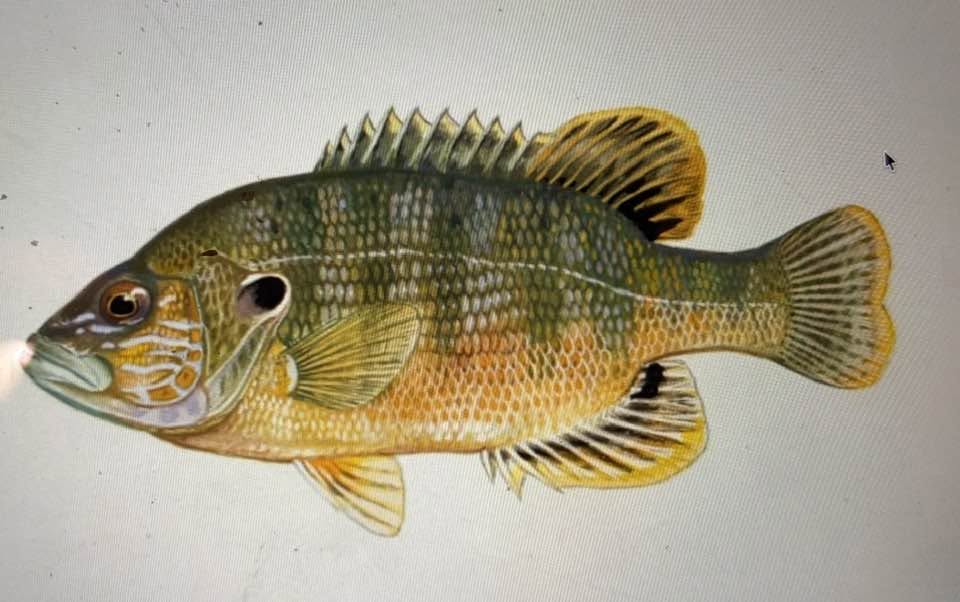
I soon learned that the only fish in Lake George, it seemed, were sunfish, or “sunnies,” as Lyle called them. But I never had to touch any of them, since Dad and Lyle assumed the role of “de-hooking” everything we caught, putting them on stringers tied to the inside of the boat, and slipping the fish-stringers back over the gunwales after each catch. Oddly, though I had an aversion to touching the fish, I had no problem fishing slimy worms out of the bait container and handing them to Dad to impale on the barbed fish hook tied to the end of my line.
By the end of our fishing trip, we had enough “sunnies” to feed the masses, though individually, the fish were quite small. If I was old enough to catch fish, however, I wasn’t old enough to clean them. Dad wound up taking on that scaly business, which told me he had more experience as a fisherman than he’d been letting on. Mother, ever the good sport about things, cooked up what was left after Dad’s cleaning operation. Two bites, and I was done with fishing for the sake of eating.
One aspect of the adventure that stands out to this day was the bright sun in our faces as we walked from Roeckers’s driveway to our house. On our way back from Lake George, we’d encountered a local thunderstorm and hard downpour. It stopped raining by the time we reached Roeckers’s driveway, and as we walked the short distance down Rice Street—due west—to our house, the sun burst through the clouds and straight into our faces. Everything was still dripping wet from the rain, and the sun reflecting off all the water was brighter than the klieg light that Dad used with his movie camera when filming indoors. I remember diverting my eyes downward and noticing that the sun was reflecting just as brilliantly off the sunnies on my stringer. Of course, I thought: they’re called “sunfish,” after all. (Cont.)
Subscribe to this blog and received notifications of new posts by email.
© 2026 by Eric Nilsson
[1] Several years later, the Roeckers moved across town to a house right on the Mississippi. (In our neighborhood, they (and our family) lived across the street from the river. Lyle obtained his float plane certification and acquired a beautiful new float plane, which he parked along the shore of their lot. He specialized in lakefront properties up north and used the plane to fly potential buyers from the Twin Cities. Often we’d see him fly up or down our section of the river. In 1964, he and his wife, Betty, had a close call when trying to land somewhere, they got tangled up in power lines. The plane was wrecked, but both Lyle and his wife survived with relatively minor injuries—Lyle with a broken nose, and Betty, with a broken arm. Their daughter Suzy became a commercial pilot. I lost all track of John.
