NOVEMBER 3, 2026 – This afternoon I was on my way home from business in downtown Minneapolis, when our Connecticut son called on his way home from work.
“Hey, Byron,” I answered.
“Have you voted yet?”
“I voted a week ago. How about you?”
“I’m on my way to the town hall right now. So, what’s your prediction?”
“I’m cautiously optimistic,” I said. We went on to talk about several of the Senate races—Texas, Michigan, Alaska—and agreed that the late-inning party flip by El-Sayed’s primary election opponent and the amateur hour move to put a second “Dan Sullivan” on the ballot in Alaska were, in street vernacular, “nothing-burgers.”
Soon Byron reached his destination. “I’ve reached the town hall, Dad. Gotta go.”
Since Beth (who also voted last week) is still visiting Byron’s family, I came home to an ultra quiet house. None of the polls out East had closed yet, and with over an hour before any key races would be called, I took advantage of the downtime—first to work on another model sailboat, then to do some writing while the glue dried, adhering the splashboard to the boat deck.
Dinner could wait—for the first polls to close. Besides, I’d eaten a late lunch at Merlin’s Rest, an authentic Irish Pub in an interestingly diverse part of town across the river. My good friend Erik Hansen, the finest living writer I know, had just returned from a three-week sojourn among friends in Switzerland and Denmark and as occurs inevitably with travel abroad, he returned with added perspective on America. He shared my cautious optimism regarding the election outcome. The lunch fare was fine, but whenever you break bread with Erik, the conversation the occasion prompts relegates the bread, no matter how high the quality, to secondary status.
“I thought of you on two occasions,” he said. “The first was while we were sailing on Lake Lucerne. As the boat heeled, I thought, ‘Eric would get a charge out of this!’ Plus, the mountains in the background made for wonderful scenery.
“The second time I thought of you,” said Erik, “was while my friends and I were hiking along the west coast of [Jutland], facing the harsh winds and surf of the North Sea.” He then presented me with a gift carefully wrapped in blue tissue and a piece of corrugated cardboard. As I wrestled gently with the tape that bound the covering, I could feel parts of the object inside.
“What makes me think it’s a boat?” I asked. “I can feel what seems to be . . . the hull?”
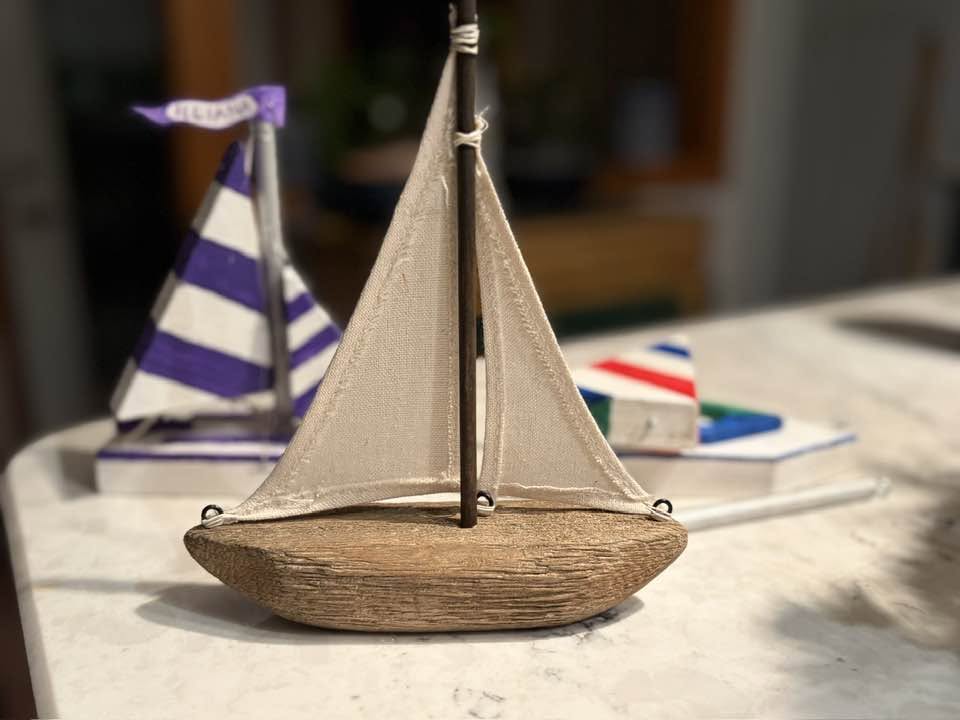
Eventually I released the gift from its protective wrap, and sure enough, it was a model sailboat—of dimensions very close to the one of my growing fleet. This model, though, was made of driftwood, and the sails—a main and a jib—were of cloth (not wood), fastened to a simple mast and tied down to eyelets on the “deck.”
“The driftwood could be from Sweden,” Erik said in a nod to my heritage. On a Google map he then showed me how Baltic currents flow around southern Sweden, then bend down along Jutland, carrying with them natural detritus—fallen trees, etc.—from the coast of Sweden.
With simple elegance the vessel adorned our table as we discussed the state of the world. The sailboat will be assigned a special mooring spot among our home collection of various model boats—symbols of connections beyond our immediate horizons.
Earlier in the day, I’d made another connection closer to home port. On my way home from an errand, I stopped at a local Aldi store. It was a spur of the moment move. My recent purchase of broccoli had gone bad. Surely by now a fresh (or fresher—given that it was Aldi and not upscale Byerly’s) delivery of produce had included a better selection of broccoli. Wrong.
But now that I was in the store, I couldn’t leave empty handed, so I grabbed some additional items. Clutching them awkwardly, I found my way to the checkout line and took a place behind an elderly woman, who was steering a generously loaded cart. When she saw me with my hands full, she offered to let me go ahead of her.
“No, no. I’m fine,” I said. “But thank you.” Just then I noticed the gentleman who’d stepped into line behind me, holding a single box of fresh spinach.
“I would’ve taken her up on that offer,” he said, with a tone that sounded like an affected gripe.
“I’m sorry,” I said, “but I didn’t want to abuse her offer.”
The man’s countenance told me it was all okay. To soften it further, I said, “I guess you could call it a lesson in patience.”
“Patience? I tried a 12-step program in patience,” he said with a smile, “but I didn’t get very far.”
“And then there’s the daily news to test one’s patience,” I said. Given the crimson Harvard cap the gentleman was wearing, I figured he was probably a Democrat, but just in case I’d misjudged, I gave the question a neutral spin. Curiosity, though, is what prompted my question. I wanted to know what he thought about things and why.
He snapped up the bait, as it were, and by the time I was dumping my groceries onto the checkout conveyor belt, our conversation had progressed considerably. It reached the point where in answer to my inquiry, he was listing all the serious periodicals to which he subscribes—and reads. “I highlight what articles I want to read, then take the magazines to the gym and read them on the treadmill.”
If my checkout took all of 15 seconds (Aldi checkout pros win the prize for alacrity), Mr. Harvard’s box of spinach was scanned and paid for in five. But neither one of us was about to let the other off the conversational hook. For a drop-out of his own imaginary “12-step patience program,” Mike, as I soon learned was his name, had a great deal of patience. Retired from a career in government, he now serves as a substitute middle school teacher in the Roseville school district. He runs with humor, including voice impersonations, and knows how to capture and hold the attention of his students. His love for teaching—and learning—was inspirational. Here was a guy whose middle name was “Engagement”; clearly a people person, he was also a scholar, in command of several languages, including Russian (though he’s as Irish as can be), and a veteran of Slavic studies.
His accent revealed East Coast origins—I guessed Gotham itself—and sure enough, he said he was born in Manhattan, grew up in Queens and went to college in the Bronx. As it turned out, his alma mater was Fordham, not Harvard; I didn’t get to ask why the Harvard cap, but I wouldn’t have been surprised if he’d said it was in sympathy for what that institution has had to endure by the fiats of Trump, Musk and DOGE.
I also learned that Irish Mike plays regular gigs at local pubs and breweries—banjo, guitar and vocals—with other established local musicians. Later, after accepting his “friend request” on Facebook, I learned that he’s friends with Larry McDonough, a locally prominent pro bono lawyer and serious jazz pianist, and with Anne Hills, a nationally famous folk singer, who graduated from Interlochen a year ahead of me. Small world connections brought to light by a mix of patience and spinach in the checkout line at Aldi.
At a little past 8:00, I checked the splashboard on my model boat under construction. The glue had dried; the splashboard was secure. Work on the model can now resume while I watch the “Big Beautiful [Blue Wave]” inundate Congress and resuscitate American democracy.
Subscribe to this blog and received notifications of new posts by email.
© 2026 by Eric Nilsson
