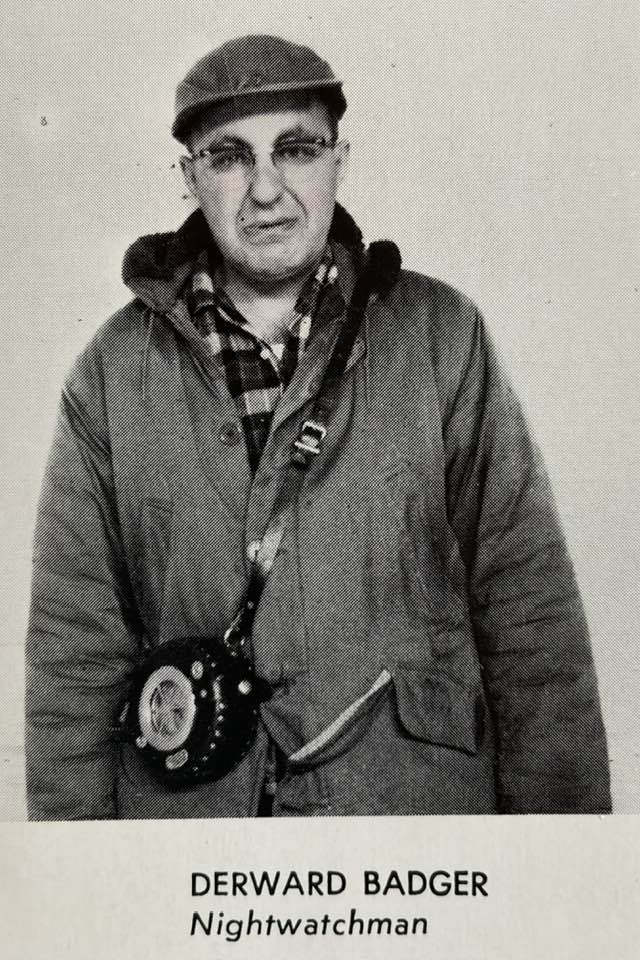
MARCH 22, 2026 – I’m not making up the name—Derward Badger. If I were writing a novel, however, set in the remote reaches of Vermont (admittedly redundant, given that the entire Green Mountain State is relatively isolated) featuring a seemingly odd and inscrutable character, a veritable old Vermonter whose appearances are minor and scattered but nonetheless memorable, I would assign him the name, “Derward Badger.” His first name was very old and very Anglo/Saxon – English, according to Wikipedia, derived from “doorkeeper” or “door-ward” (duru-weard), which, as the reader will soon learn, is wholly apt given the man’s vocation when I was attending Sterling School in Craftsbury Common.
He was the night watchman at Sterling, and the only context in which any of us encountered him was when he was making his nightly rounds, stopping at small, preset metal brackets affixed to obscure nooks inside campus buildings. His job, as far as we could tell, was to “punch in” at these stops using some sort of round awkward device that was strapped securely around his shoulder.
Ed Lennihan, a junior from Philly, who was one of our dorm monitors and invariably spoke with confident authority, once told us that Derward’s nightly rounds satisfied some kind of fire insurance requirement. That explanation was good enough for us freshman and sophomores who lived in Adams Hall. Ed was also the one who informed us of the night watchman’s name—his first name, anyway. Not until the yearbook was published, with a photo of everyone associated with running the school, as well as students and faculty, did I learn that Derward was a . . . “Badger.”
He was a big man with eyeglasses scaled to his large head. He bore what I thought was an oversized misshapen mouth, and for most of the school year, he wore a heavy jacket, drab green, adding to his imposing cameo appearances, yet at the same time befitting . . . no, projecting . . . his non-threatening image. Though laconic, he never failed to reciprocate when we greeted him. “Hi, Derward,” we’d say, and as he stopped and allowed what passed for a smile, he’d release an effortless “Hi.” That was it. That was the extent of anyone’s interaction with the man, but it was enough to tell us that however imposing his hulking shadow, he was a gentle giant.
In addition to being an authority on the exhaustive compendium of school rules—written and unwritten—Ed Lennihan also played soccer and held his own, I noticed, among the more rambunctious students among us, especially the in-your-face lacrosse players. Adding to his impressive stature (to me, anyway), one day Ed disclosed that he was an Episcopalian.
Back in Lutheran Minnesota, despite our quintessentially Scandinavian background on Dad’s side of the equation, Mom dragged us to the Episcopal church. At the time I thought we belonged to some kind of odd-ball denomination. Most of my friends attended Zion Lutheran; a few, with French, Irish or German surnames, went to St. Stephens, the catholic church—the one with the steeple that on a clear day you could see all the way from the top of the Foshay Tower in downtown Minneapolis, 30 miles south of Anoka. Anyway, Episcopalians were in the distinct minority in our part of the world, and somewhere along the way I learned that the reason we belonged to that backwater church in town was that Mother had been an Episcopalian back in New Jersey, as had my grandparents.
When I learned that Ed Lennihan was of that persuasion, I thought it was a fluke; a noteworthy coincidence, ignorant as I was that given the historical influence of English settlers in the Northeast—including my own forebears on Mother’s side—Anglicans (Episcopalians) would be a much larger force than they were in the Upper Midwest. I would soon discover that a fair number of Sterling students besides Ed came from Episcopalian families, which in retrospect is understandable given that most kids were from the Northeast, many answering to English surnames.
At any rate, if Ed was no more outwardly religious than I was, his Episcopal pedigree counted for something and reinforced his credibility and authority, as far as I was concerned. Thus, I took him seriously when with his typical earnestness he revealed a fascinating fact to a few of us one evening just after Derward had punched in at Adams Hall and just before we all had to clear the decks and be in our bunks for “lights out” check.
Ed’s disclosure concerned the laconic and inscrutable but non-threatening night watchman. According to Ed, Derward was a PhD in history.
You don’t hear something like that, ascribed as it was to a man of Derward’s appearance, and drop off to sleep on command when the monitors yell, “Lights out!” No. You lie there staring into the darkness pondering the improbable. The first thing you realize is that there’s a lot about the world, about people, that you simply don’t know—until you do, if you ever do, and what you might learn about things could lie well beyond the limits of your education and experience. But then you consider more deeply the revelation itself; in the case at hand, that Derward was a scholar in disguise, a PhD masquerading as a night watchman punching in on his rounds on some kind of highly routinized scavenger hunt.
As I lay there while my roommate, occupying the lower bunk, kept flipping his pillow, I tried to assemble the pieces of Derward’s puzzle, now that I knew his life was, in fact, a puzzle. I started with his age. He looked older than my dad but younger than either of my grandfathers. That could mean, I thought, that he’d retired from his academic career, and to occupy himself in retirement, he’d taken on his current job. Perhaps its simple routine was an antidote to years of study, taking exams and writing papers, then teaching and grading tests and papers, writing books, even, and whatever else was required of professors.
Or, I thought, maybe Derward had never been a professor, though what else a person would become after getting a PhD was quite beyond my understanding. After mulling it over for a while, I decided that for Derward not to have become a professor was as improbable as a person going to med school or law school and not practicing afterward.
I moved on to other possibilities. Perhaps Derward had suffered a nervous breakdown such as you’d hear about back in those days. I remember on occasion my Mother remarking about so-and-so who’d suffered a “nervous breakdown,” and by the way she, Mother described these disruptions, I imagined the poor person as a baseball player getting smacked by a fast ball—or more likely, a curve ball—at the plate and going down hard, so hard, they had to sit out the rest of the game. (Only decades later when Mother herself suffered a “nervous breakdown,” did I catch on that that term was a euphemism for “psychosis.”) Maybe, I thought, Derward’s “nervous breakdown” had caused him to “leave the game.”
Another scenario was a variation of the “nervous breakdown” theory. Perhaps Derward had suffered some terrible personal loss. Maybe his wife had died in a terrible car accident on their way home from a faculty party at which Derward had had too much to drink. Crushed by guilt, he could no longer function in a position of responsibility. Moreover, he’d had to clear out of Cambridge, New Haven, Hanover or Princeton (given the number of Ivy grads among the tightly-knit Sterling faculty, I assumed the Derward was from the same mold) in search of anonymity in an obscure corner of northern New England.
Before I finally drifted off to sleep, my curiosity was well stirred. I wanted to know more about this character Derward; who he was, what he’d done in his life, what he thought about the world. But it was never to be. The only time he appeared was on his nightly rounds, and he never stood still for more than three seconds—two to punch in with his device at the metal bracket and one second for a “Hi”—assuming our paths happened to cross, which was seldom.
No one else other than Ed seemed to know anything about Derward, and Ed was a frenetic type, always preoccupied, it seemed, with laying down the law or hitting the books or sweating it out on the playing field. I never had or created the chance to quiz him about Derward.
I have no idea why I thought about Derward today, but I did. Maybe it was my recent connection with Erik Hansen (see my 3/12/26 post), who’d joined the Sterling College faculty three-and-a-half decades after my student days, and who has fond memories of the place. Erik’s time would have followed Derward’s by decades too, of course, so the mystery man was unknown to Erik. But maybe Erik’s recent reminiscences about Sterling triggered my own, albeit with a 10-day delay. And possibly, as I dug into the attic of my memory, random synapses led me to a small box labeled, “Derward.”
In any event, when today I recalled those fleeting images of the night watchman 1,200 miles away and seemingly 1,200 lifetimes ago, the old question came back: How did a guy with a PhD in history wind up “punching in” to satisfy insurance requirements for an obscure boarding school in the Northeast Kingdom of Vermont?
I did what any tech-savvy dinosaur would do. I Googled the man. Except, ahead of that, I did what any old fogey would do: I pulled out my 1969 “Commoner”—the Sterling School yearbook—and thumbed through the pages in search of a photo of “Derward,” mainly to see if he had a last name, which he did, which happened to be “Badger.” I laughed out loud, for in his mug shot—wearing the only apparel any of us associated with him, with the “punch-in” devise strapped securely over his shoulder, his curled mouth drawing attention to his face—Derward looked just like a big badger who’d emerged from behind a barn on a Vermont dairy farm.
I typed “Derward Badger” and hit return. Sure enough—several hits, leading with his 2004 obituary. I read it twice to make sure I hadn’t missed anything. I hadn’t. After all these years, Ed Lennihan was wrong. There was no sign of a PhD—in history or any other discipline–in the compact synopsis of Derward’s life. In fact, there was no sign of college. I was disappointed. What I’d thought was a mystery box in the rough, a repository lined with gems and gold filigree and holding rare manuscripts bearing treasures of the mind and imagination turned out to be nothing more than the equivalent of an small empty container that once housed a week’s worth of Vermont Cream Cheese.
Born in 1921—the year before my dad—Derward had graduated 20 years later [sic] from Greensboro High. After working at the United Farmers Creamery “in his earliest years,” according to the obituary, he went on to become a “self-employed custodian, an independent maintenance worker in Hardwick and a custodian for the Hardwick Senior Bemis Building.” He was “involved with” the Hardwick Resource Group for nearly a decade and “was a member of the Hardwick Senior Citizens.”
The obituary offered few other details of the man other than that his survivors were “a sister, niece, a nephew and several cousins.” Apparently, Derward had never married.
But one line lifted my spirits: “He enjoyed visiting with people that came to the [senior] center in Morrisville and taking part in elder care activities.” This affirmed my passing impression of the man. Far more important than a PhD, Derward had unassuming dignity and humanity, which he’d shared generously. I recalled my fleeting exchanges with him—probably no more than half a dozen—and what it was about them that had impressed me. It wasn’t knowledge, sophistication, grand thoughts, or great achievements. It was a guy a tad older than my dad, making his nightly rounds, doing his job—reliably and conscientiously—and taking the time to answer my “Hi” with a spontaneous “Hi” of his own. A good man.
And that, I realized, not some edifice in the sky or monument in the park, let alone a PhD, was the enduring legacy of Derward Badger.
Subscribe to this blog and receive notifications of new posts by email.
© 2026 by Eric Nilsson
