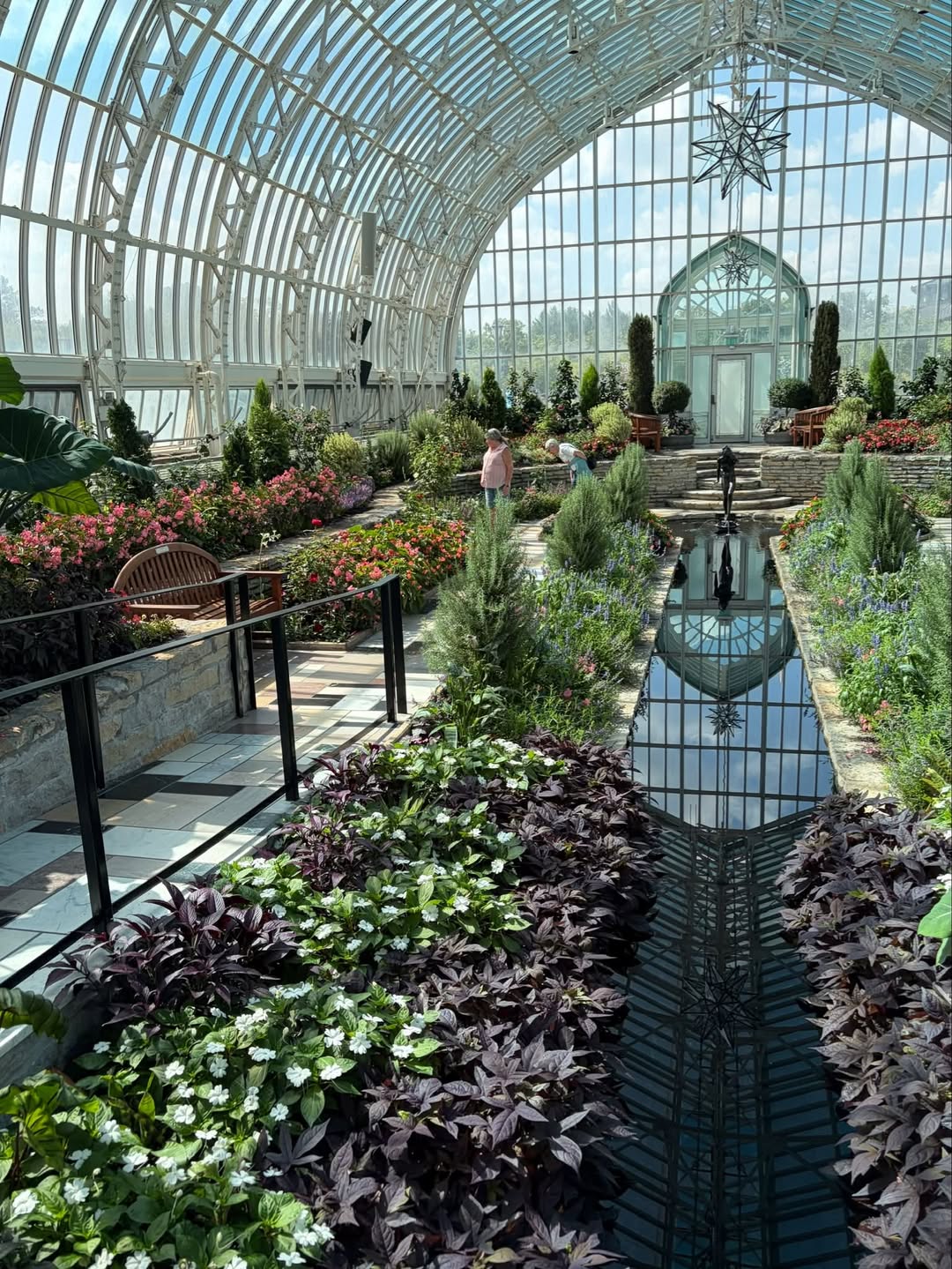
AUGUST 31, 2026 – The other day while our son’s family was visiting from out of town, my son, grandson and I were left to our own devices. I was about to suggest an outing to Como Zoo and Conservatory, but Byron beat me to it. “Dad, how ’bout we go to the zoo?” he said. Given our close proximity to Como Zoo, I knew he meant that facility, not the 500-acre Minnesota Zoo in Apple Valley.
After the women of the house had departed for their day of bargain hunting, we men got ourselves organized and drove the mile-and-a-quarter to Como. Many other parents and grandparents had the same idea, which wasn’t a problem, except most families own a United Van Lines-like vehicle for carting their kids and their kids’ paraphernalia. Our trio traveled light with a conventional stroller for D. and his accessories, which were tucked away neatly behind the seat.
As we proceeded past the famous Cafesjian Carousel adjacent to the zoo, we were treated to an unobstructed view of one of the two large reflecting pools—each filled with gigantic lily pads—that straddle the entrance to the main building of the zoo. The aesthetics of the setting—wonderfully enhanced by the clear blue sky filled with sunshine—reminded me of some idyllic place in the ancient world as depicted in a rare mosaic or painting, with details so vivid one could imagine being there, experiencing royal splendor.
It had been a while since I’d last visited the zoo and adjoining conservatory. I’ve always valued it as a regional public asset, but this time around, I realized just how precious this institution is. In addition to entertaining young people of all ages, the organization engages in serious conservancy efforts having an impact around the world. Its animal species survival program covers over 40 species, with polar bear care being a major focus; the conservatory is a designated Plant Rescue Center for plant species threatened by extinction. Climate change study and education is another realm of the institution.
In the moment, however, I was as impressed by the animals as any three-year-old such as our grandson could be. Little was new, but I soon realized how edifying it was to divert my attention for a few hours from the cares of the world to the magnificent weirdness of such four-footed creatures as Bison bison—and no, that isn’t a typo any more than Bison bison bison is, this “three-in-one” being the plains subspecies of the American bison, which is . . . Bison bison. I’d seen plenty of “buffalo” plenty of times, in and out of captivity, but the close-up view we were afforded at the zoo gave me a rare chance to ponder the size and odd design of this animal. “Why,” we asked ourselves aloud, “are the massive head and shoulders so mismatched with the skinny, short-haired butt?” – “Simple,” said Byron, as he read from his iPhone screen. Evolution had designed the front end of the animal to withstand severe wind chill and blizzards when turned into the weather out on the Great Plains. When summer continental heat covered the plains, the animal’s short-haired rear end, on the other hand, dissipated heat more efficiently than would a head-to-tail . . . thick, long-haired “buffalo robe.”
The zebras, the giraffes, the polar bears, the orangutans, the lemurs, the seals, the cougars (designated a “small cat,” not on account of its size—cougars can be rather large—but by the fact they don’t growl), the snow leopards, the lions and tigers, et cetera—all were quite fascinating in a way I’d never perceived them. But then again, as part of the aging process, I’ve become more patient in my observations and more deliberate in my appreciation for the infinite variety of life on planet earth.
After a long, satisfying stroll past all the animals, we ventured into the conservatory, which opened in 1915. Architecturally, it was inspired by the Palm House at Kew Royal Botanic Gardens in London, and was the brainchild of Frederick Nussbaumer, the German-born landscape designer who in 1890 was appointed superintendent of St. Paul parks. Nussbaumer had trained at Kew Gardens.
If exotic animals stir amazement, lush tropical plants caress the soul. Their perfectly controlled environment, emulating a rain forest and quiet except for the soothing trickle of fountains, was delicious and delightful. Birds flitted about like emissaries from a magical kingdom, often zipping so close to us we had to—or thought we had to—duck.
Eventually we came to a display of a few of the bonsai. Ironically, we became so focused on these—hatching the idea to create a bonsai white or red (Norway) pine and researching the details for such a project—that we forgot entirely about the extraordinary Charlotte Partridge Ordway Japanese Garden, designed by Masami Matsuda, a landscape architect from Nagasaki, St. Paul’s sister city. The garden opened nearly a half century ago, and has undergone major renovations and improvements since, most recently under direction by John Powell, a famous landscape architect specializing in Japanese Garden design and who designed the magnificent and expansive garden of my dear friends, Linda Lovas Hoeschler and her late husband Jack, surrounding their former home in St. Paul.
I’ve since alerted Byron to our oversight—and our mandatory visit to the Japanese Garden when he’s next in town.
For the first time I bothered to wonder about the operational budget of Como Zoo and Conservatory and its funding sources. The current year’s adopted spending budget is $7,749,515. Next year’s proposed budget is $7,977,974, a 2.9% increase—less than the current headline annual rate of inflation (3.4%). Funding sources are as follows: City Parks and Recreation budget: 43%; donations (admission is free): 21%; revenue generating operations (rentals, concessions): 16%; Como Friends (a non-profit partner): 11%; state lottery: 9%.
The rest of Como Regional Park (golf course/ski area; playing fields; swimming pool; Lake Como pavilion and activities) are under separate jurisdiction and budgeting from the zoo and conservatory.
I was glad to see Byron stick a generous amount into the donation box at the entrance to the zoo. If I weren’t totally cashless by habit, I would’ve followed suit. I’ll now start giving to Como Friends (now that I know more about the financing structure). Meanwhile, as a taxpayer . . . oops! I can’t say that, since we don’t live in St. Paul—just over the edge in the “heights,” as noted in yesterday’s post.
In all events, I encourage Twin Cities followers of this blog to visit the zoo and conservatory . . . and Japanese Garden . . . if you haven’t done so recently. The whole complex is a sparkling gem and a credit to many generations of visionaries and contributors to its development, maintenance and regular enhancements.
Subscribe to this blog and received notifications of new posts by email.
© 2026 by Eric Nilsson

2 Comments
We love Como!
Totally agree! Even the crowds at the zoo on Saturday were impressive. Well behaved kids and happy parents! But when we and our Japanese visitors left, the fairgoers had jammed all the nearby streets (and the many homeowners hawking their lots and driveways didn’t help!) Not really complaining here because Minnesota nice was on display, anyway!