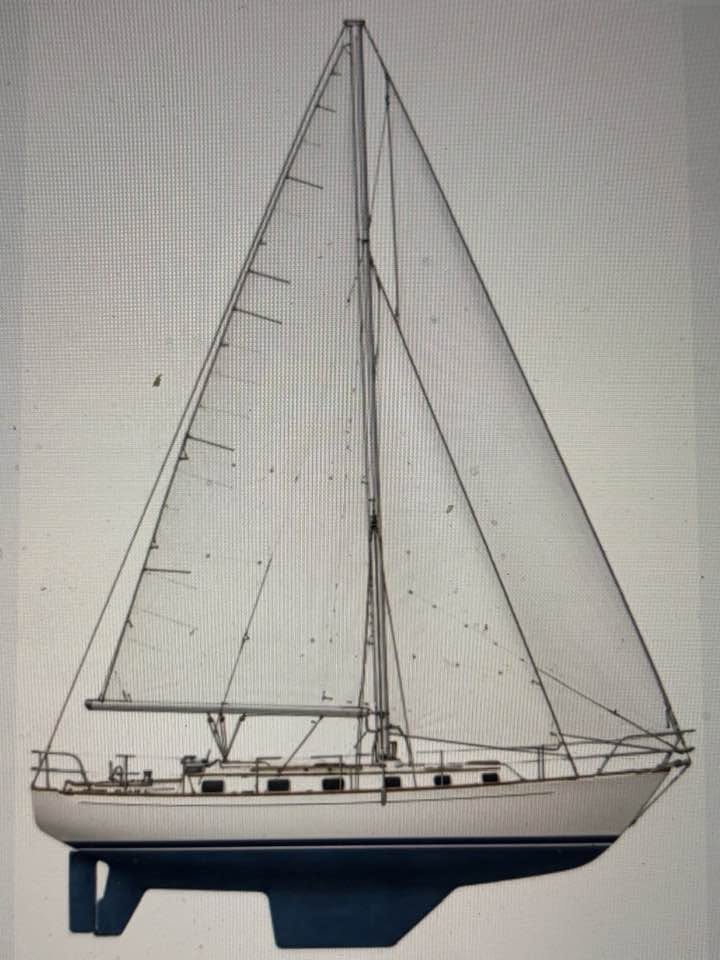
NOVEMBER 12, 2026 – For the past 39 days I’ve been following the daily reports and positions of Phoenix do Mar and her captain, the inimitable Oliver Widger. The good ship is a 40-foot cutter-rigged (a mainsail and double or triple headsails) sailboat on which the captain—no crew—is navigating around the globe, non-stop, without motorized propulsion and without direct onboard human assistance. (In this age of Starlink, he does rely on a shore-bound crew for digitally communicated advice and weather guidance.) Starting from Port Townsend, Washington, boat and helmsman have journeyed nearly 5,000 nautical miles thus far[1], with a position of 9º07’S 114º36’W, which is way, way out in the Pacific an imaginable distance from any terra firma. He has another eight months, give or take, and approximately 23,000 nautical miles to go before a huge crowd of fans, friends, family and other well-wishers cheer his return.
Having cleared the Doldrums last Saturday, he’s now running and reaching (with limited beating or heaving to) his way to Cape Horn, the Roaring Forties, the Furious Fifties, and the Screaming Sixties—and out again to more hospitable (yet still treacherous) seas beyond the Drake Passage.
All of us fans of Captain Widger have gained increasing confidence in his prospects for success. Although he has enjoyed excellent conditions so far, he is proving himself to be of unusually sound mind, with deep reserves of fortitude, resourcefulness and intelligence—though, as an exclusively inland waters sailor, I must acknowledge my limited familiarity with all the vagaries of saltwater, let alone off-shore, sailing.
As every offshore sailor I follow makes clear, life at sea has its divine moments of exquisite scenery, magical encounters with the stars above and marine creatures below, and meditative solitude throughout their passages. But the over-arching theme of long-distance sailing is “repair and replace; retrofit and restore.” As Oliver Widger puts it, “Everything breaks or requires fixing.” The key to success—and survival—is to be in a constant state of inspection and remediation. It’s akin, I think, to being a Gran Prix race car driver without a pit crew or staff of mechanics. Not only “to win” but simply to finish the race, the fine-tuned machine must be in the best possible condition at the start—every bolt, every nut, every gasket, every cylinder, everything must be in impeccable condition. And as the car is pressed to its mechanical limits and beyond, the driver must monitor every hint of over-stress and pull into the pit before the engine flags or tires blow. With speed of purpose equal to speed under way, the driver her/himself must repair and replace parts and pieces before it’s too late.
Even in fair winds and following seas, fittings and fixtures aboard a sailboat wear out or break. Early on in Widger’s passage, he noticed chafing of his sheets (lines). A close-up video showed how one had mercilessly scuffed up an adjacent line. He addressed the friction by adjustments and applying a protective sleeve around the chafed section—noting a potential alternative repair, if necessary, by cutting out and replacing the damaged section altogether. Additional videos have highlighted other conditions, which left unattended, could devolve into significant problems.
On a much reduced level, I can relate to Widger’s most critical imperatives: monitoring and maintenance; repairs and replacements—before addressing such big-picture worries such as waves, swells, currents, weather and navigation.
In the late 1980s, I was out sailing on our lake with one of my bros-in-law. Angry white caps crested all around us, as we hooted and hollered our way on a broad reach, half surfing and half sailing the plucky 12-foot lateen rig I owned at the time. I’d yielded the tiller to my now ex-bro-in-law, since he was quite a bit heavier than I, and I wanted to shift our weight aft as much as possible to prevent the bow from submarining. I managed the sheet, and since the boat was not equipped with cleets, I was gripping the sheet with both hands, as if they were Vise-Grips. Moreover, both of us were hiking out as far as we could to counterbalance the wind against the sail. With both hands and great effort, Chris, the ex-bro-in-law, pulled the tiller toward himself to maintain our course the best he could. His wide-open eyes spoke volumes. We were flying.
Suddenly, with zero warning, he was catapulted backward into the drink. In the same instant, the boat snapped violently, got slammed by a wave and nearly capsized. I let go of the sheet and scrambled to stay on board. When the boat went into irons, Chris swam to it, and I assisted him aboard. Because the wooden tiller had broken where it connected to the rudder post, we were in effect without a steering wheel. We had to drift closer to shore before we could rescue ourselves, walk the boat back to the dock and make repairs.
About 10 years ago, I experienced another “catastrophic equipment failure” but in a particularly bizzare manner. In 1991 I’d bought a brand new day-boat, a 14-foot Catalina sailboat. She had a colorful main and jib—each consisting of geometrically shaped pieces of sailcloth sewn tightly together, each piece a shade of pink, purple or blue. Near the tack of the main was a label bearing the words, “Computerized Design.” At the time, I took that to mean “state of the art,” since we weren’t yet accustomed to using the term, “high-tech” and “AI” would’ve been confused with “Aye-aye [Cap’n].”
The boat was charmed from the very outset. After dark on the day of the vessel’s beautiful and fulfilling inauguration, a thunderstorm swept through our corner of the lake. Beth and I were seated on the porch of our original cabin—no more than 30 feet from the water’s edge and the new sailboat was at rest on its lift. Lightning flashed all around, as the heavens roared and ferocious gusts swept torrents of rain sideways. Suddenly, a super-gust picked the boat right off the lift and slammed the hull down on its side upon the dock. “What?!” I said, but my outburst was drowned out by the commotion outside. In shock my unspoken thoughts continued: I’d owned the boat for less than a day before I’d be filing an insurance claim.
I resisted the impulse to enter the storm to inspect the damage. Lightning ignores all prayers, and I wasn’t about to get anywhere close to what was now a damaged hull attached to a lightning rod—the mast. I would have to wait until the storm had passed.
Not more than five minutes later, however, the rampaging wind switched direction by nearly 180 degrees. Before our eyes, the big blow picked the boat back up and slammed it back down—but upright—onto the lift. An hour later, after the storm had exhausted itself, I ventured out to take full stock of the damage. To my amazement there was barely a scratch on the hull. The boat had proved itself not only to be eminently seaworthy, but to be storm-proof as well.
But then came that day a decade ago when I learned a lesson in metal fatigue or some comparable phenomenon. I had been out sailing in moderate wind and mild waves. By day’s end, as is often the case, the wind decreased to a slight breeze, and the water was nearly relatively calm. I decided to leave the boat at its mooring instead of pulling it onto the lift. The overnight forecast called for calm, and the next day’s weather would also be mild, with only a light breeze.
The next morning, all was well with the boat, moored as she was a few yards out from the end of the dock, sails down, with jib gathered on the deck ahead of the mast and the main collected atop the boom, which, in turn, was resting on the floor of the cockpit. As I sipped a cup of Java, I eyed the boat bobbing gently at its mooring. With the rising sun and warming air, a stir to the air gave promise of another good day of sailing.
Then, to my shock and dismay the starboard stay snapped. The mast fell with a clatter and splashed into the water, dragging boom and main and sheet into the lake as well. I leaped from my chair, jumped into the water and rushed to the scene. After rescuing the mast and rigging from the lake, I inspected the severed ends of the severed stay. The cable looked as though it had been cut clean with large-handled wire cutters.
I remember thinking, Thank goodness the failure occurred when and where it had and not out in the middle of the lake the day before—without a phone, destined to drift until someone around the lake noticed and came to my rescue or my shipwreck washed up on some distant shore.
Two years would pass before sufficient motivation kicked in. In time I ordered and installed a replacement stay. I did so in time for Byron and Mylène’s wedding, when Mylène’s Portuguese relatives would descend on the Red Cabin and wonder why the sailboat was in “dry dock” if it weren’t restored by then. I rendered it sail-worthy just before Mylène’s father, Antonio, her brother, Miguel, and cousin Fernando arrived. As they watched me hoist the sails, they brought out the Super Bock Portuguese beer and an old boom-box and collection of CDs featuring the best of popular Portuguese music.
“Vasco de Gama!” Antonio called me. For the long cruise that followed, my crew raised their bottles of Super Bock and made many toasts to . . . “Vasco de Gama!” I’m sure lakeshore residents wondered what had descended upon the local wilderness, when for the first time ever, Portuguese music reverberated across the waters, as three laughing Portuguese sailors shouted “Vasco de Gama!” until they were hoarse.
So, in a fashion, I can relate to Oliver Widger’s omnipresent need to inspect, repair and replace. Somewhere among his stores of food and drink he should have a bottle or two of Super Bock. After all, he’s of Portuguese descent (Phoenix do Mar is Portuguese for “Phoenix of the Sea.”).
Unlike Mylène’s people from northeastern Portugal, whose ancestry is a mix of ancient pre-Roman Iberian tribes—Gallaeci and Lusitanians—along with Roman, Germanic and even Celtic influences, Oliver’s ancestral background looks more southern, where Moorish roots and ties are stronger. What’s more significant than ethnicity, however, is the tradition of Portuguese nautical exploits. The southwest corner of Portugal marks the western most point of continental Europe and center of Prince Henry the Navigator’s 15th century nautical innovation equivalent of the Silicon Valley. Portugal’s location and orientation on the Atlantic led naturally to sailing the ocean blue.
Though the Portuguese Ferdinand Magellan died in the Philippines, en route to that archipelago, he’d led the first European expedition through the treacherous Strait of Magellan and across the Pacific. His ships and crew would be the first to circumnavigate the earth. I’ve not heard Captain Widger mention Magellan, Henry the Navigator or Vasco de Gama, but perhaps the modern sailor derives some inspiration from the earlier Portuguese sailors.
Many challenges await Oliver, but thus far, he’s acquired invaluable experience managing his boat and navigating his way south. Just this evening he reported that as he soon enters a high pressure system and much lighter winds, he’ll take advantage of the quiet seas to conduct a thorough inspection of everything aboard ship and make necessary repairs and adjustments before entering the Southern Ocean. His thousands of online followers—I being very much among them—will continue at his virtual side, monitoring his daily progress.
Subscribe to this blog and receive notifications of new posts by email.
© 2026 by Eric Nilsson
[1] As of 7:31 a.m. CDT today, 4,988 nm, to be exact.
