NOVEMBER 10, 2026 – With last Saturday’s post I reached the 2,700 mark, a kind of benchmark, I suppose, but not as significant as the 100th post over seven years ago seemed to be—evidence to me, anyway, that a somewhat tepid experiment had become a habit of discipline, or, as the psychologist might suggest, an unmistakable sign of OCD. But in my own defense, I ask—rhetorically—what’s the difference between OCD and hard-core discipline? Or to put it in more practical, everyday terms, “Show me any human endeavor requiring repetitive training and effort, from general surgery to marathon running to compositional writing to sailing a boat to flying a plane to growing heirloom tomatoes to playing a musical instrument beyond rudimentary proficiency to hitting two out of three free throws in pick-up games at the Y to orbiting earth in the ISS, and I’ll show you discipline posing as OCD . . . or the other way around.
In the case at hand, however, after 2,700—now 2,703—essays, from little to long, I’m in danger of repeating myself, just as the long-distance runner staggers yet again up Heartbreak Hill or the veteran concert pianist specializing in the Schumann in a minor, glides through the first movement cadenza. I mean, at some point, in the fashion of the elderly since the beginning of time plus 70 years (give or take), a person runs out of stories or can’t remember which stories haven’t been told, so to be safe, tells again what’ve already been told.
Retelling tales is fine—as long as the audience hasn’t heard them, or, perish the thought, can’t remember. Perhaps the case most likely to roll the auditor’s eyes is when the (elderly) storyteller begins with, “Have I ever told you about the time when [. . .]?” and you say, “Uh, yeah, you did . . . last week, as a matter of fact . . .” and despite your disclosure the storyteller proceeds with great vigor to retell the yarn.
But again in self-defense, just as no two basketball games play out exactly the same and no two performances of Beethoven’s Emperor concerto—by the same artist—are indistinguishable . . . Oops. Bad comparisons. I was never any good at basketball, and I sure never played Beethoven’s third concerto for the piano—even in my technicolor, surround-sound dreams, though I’ve listened to it so many times, a person would think I’ve got OCD. My point here is that the beautiful thing about human accomplishments—versus the prospect of AI perfection—is that no two renditions of anything are precisely the same, and in fact, in many cases, duplicative efforts provide welcome variation.
So it is with the balance of this post, devoted as it is—and as was a previous post some months ago—to the sun . . . of all mundane things in life.
I say that with intentional irony. In the first place, “mundane” derives from the classical Latin, mundus, meaning “the [tangible] world,” later reduced by a definitional shift in the mid-19th century to “dull, commonplace, and down-to-earth,” as opposed to mind-bending manifestations of physics across the cosmos, starting with our very own . . . sun. But we humans are expert at distilling the fantastic down to the familiar. Since the sun shines day in, day out; because it “rises” and “sets” with mathematical precision, and therefore regulates our lives without regard for our needs and desires or even our existence, our star is simply a fixed fact of the cosmic order, utterly ignored except when its obstructed or unobstructed appearance (as the case may be) makes us comfortable or uncomfortable (as the case may be) or . . . in those fleeting moments when in conspiracy with clouds, water, horizons and oblivious birds in flight, the sun’s rise or decline provides a display of light and color pleasing to the artist’s eye and the romantic’s heart.
As landscape artists and photographers well know, six to eight weeks after the equinoctes, sunlight in the middle latitudes casts a spell across the surface of the earth. This magic compensates for the shortening of daylight in autumn and energizes vernal hopes and dreams.
By chance, the siting of our house and placement and dimensions of our windows turns the morning and late afternoon sunlight into amazing theater. Sunbeams unimpeded by blinds or curtains land with flare on walls, floors and furniture. Through louvred blinds, the sun splits into rows of uniform stripes on a carpet or bends with the curvature of dining room chairs. Through windows dressed in translucent curtains, rays are diffused, casting soft, blurry shadows on an opposite wall. Objects placed atop the grand piano, meanwhile, catch more Phoebean radiance, like so many actors on a stage, each standing perfectly still in its own spotlight.
The entire show is deceiving. At any given moment during the hours of infiltration, the work and play of the sun is stationary. Or appears to be. But walk to another corner of the house, fetch a book or a pair of shoes or a drink of water; check a text or send one; peer out the back windows . . . then return to the scene of heat and light generated by nuclear fission eight minutes and 93 million miles from earth, and you’ll see that the sun has moved—or rather, the earth has moved . . .
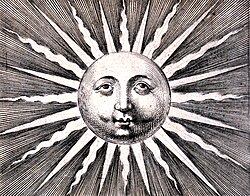
Then something occurs to the mind; something greater than all the woes and worries, hopes and dreams, knowledge and imagination of that mind: While we scurry about our lives here on the surface of the earth, whether we’re passive or aggressive, in motion or at sleep, sailing the open sea or grinding away at work for recompense to sustain our earthly needs and whims . . . the world . . . turns. Gravity spins our precious sphere one way around its axis, while that same universal force pulls our planet in a giant orbit around the sun—a smiling face in art, myth and poetry, but in physical reality, a giant ball of plasma composed of hydrogen (mostly), helium (somewhat) and traces of heavier elements. And here’s the thing: only when perceiving the ostensibly imperceptible movement of sunrays playing on the stage of our walls, floors and furniture, are we reminded of the big, fat, huge reality that transcends the sum total of everything else in life: something as simple and complex as gravity works on two enormous cosmic spheres, except . . . one is much larger than the other[1] and from a single light year (88 trillion miles) away, our sun would be invisible to the unaided human eye, since at that “short” distance, the big bright (from an earthly perspective) sun would appear no larger than a point of light approximately 0.03 arcsecond[2] across (i.e. less than a pin prick). I don’t have to tell you that the earth would appear (to an eagle, perhaps; not a human) 0.0003 (rounded up) arcsecond across.
In short, amidst the hubbub and distraction-packed lives we lead, in the many places we occupy, sunbeams quietly remind us of cosmic forces in scope and size and importance infinitely beyond our busy selves and all that is dear and important to us—and yet . . . and yet, those very forces are at our fingertips, flashing onto the very surfaces where we sit and stand, walk and look, think and wonder—a reminder that even in our loneliest moments, all of us are connected to the same grand source of light and life on planet earth.
Subscribe to this blog and receive notifications of new posts by email.
© 2026 by Eric Nilsson
[1] The diameter of the sun is 109 times that of earth; the sun’s mass is 333,000 times bigger than ours, and the sun’s surface gravity is 28 times stronger than what we experience here (i.e. A 100-pound weight at a gym on earth would weigh on the sun as much as a Toyota Corolla weighs back here).
[2] An arcsecond is a unit of angular measurement equal to 1/60th of an arcminute, or 1/3,600 of a degree; thus, in looking at a star in the sky above earth, the star’s apparent size would be expressed as a fraction of an arcsecond, which is a teeny-weeny portion of a degree, there being 360 degrees, of course, to a full circle (for all practical purposes, 180 degrees from horizon to opposite horizon from the perspective of a human standing aboard a ship on the open ocean or standing in a flat desert stretching beyond the horizons.
