JUNE 27, 2026 – This morning I shot off an order for a couple of new books—The Backsliders: Why Leaders Undermine Their Own Democracies by Susan Stokes, a professor of political science at the University of Chicago and Our Declaration: A Reading of the Declaration of Independence in Defense of Equality by Danielle Allen, a professor of public policy, politics, and ethics at Harvard. To have these in hand before the upcoming fireworks displays in celebration of our continuing trade with China, I put in for immediate delivery—of the books; the fireworks have already arrived within earshot of our back porch.
The first book was recommended to me by a good friend and Bowdoin classmate, David Dickson, a professor (now retired) of international relations at George Washington University. Knowing David as I do, when he recommends a book . . . I put it on my “most favored nation” book list. The Backsliders promises to shed light on the most disturbing question of our era: Politically, how in the world did we wind up where we are now?
The second book is even more immediately topical than the first. A fortnight ago I heard the author interviewed on NPR and found eminently compelling, her discourse about the seminal document of our governmental framework. Her focus on equality as the central thrust of the Declaration dovetails nicely with a recent article I read in The Atlantic by Jesse Wegman, author of The Lost Founder – James Wilson and the Forgotten Fight for a People’s Constitution. The article had been forwarded and recommended by another good friend and Bowdoin classmate, Jeffrey Klenk—like David, a non-stop reader whose recommendations I trust implicitly.
Wilson was one of the only six people who signed both the Declaration and the Constitution. He was a man before his time. Early on in the construct of both foundational documents, James Wilson championed individual equality over states equality. He advocated for direct election of senators and the president, but as we know, it would take more than a century before direct election of senators became the law of the land (via the Seventeenth Amendment – (1913)). Many of us are still envisioning direct election of the president.
After placing the aforesaid book orders, I proceeded to the backyard to engage in some serious weeding along the limestone border of our miniature Amazon rain forest—pun fully intended. As I worked the grass clippers, stem cutters, rake and backhoe . . . I’m kidding about my use of the backhoe but not about the need for it . . . I savored the thought of my new books arriving tomorrow and Monday.
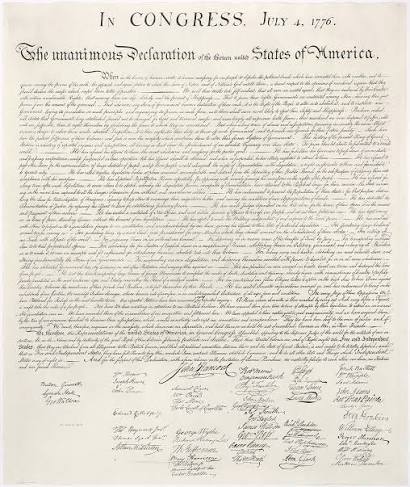
For some reason—perhaps my contentment in weeding on a gorgeous Goldilocks summer day (not too cold; not too hot)—my thoughts settled on the express “inalienable rights” identified in the Declaration of Independence, to-wit: “Life, Liberty, and the pursuit of Happiness.” I zeroed in on the “pursuit of Happiness.” I was eager to learn what Professor Allen would have to say about this clause; how she parses it and draws its intended meaning from her research of the historical record.
As I await her discourse, I’ve embarked on a shallow excavation in pursuit of limited exegesis. From what little I’ve unearthed, the range of divinations runs the gamut from “it’s all about property” to “it’s all about a Happy Meal—with plastic toy.” Apparently, however, “Pursuit of Happiness” was coined by John Locke, the 17th century English philosopher whose writings stoked the American and French Revolutions. In any event, once I’ve educated myself further about the inalienable right to the pursuit of happiness, I’ll so inform my readers. Stay tuned.
During my daily promenade early this evening, however, I ruminated about the “pursuit of happiness” in a generalized sense far beyond any political framework. That is, I considered the notion of happiness (and its opposite) in the larger context of the human condition. And that’s where matters grew interesting—and meaningful. (Cont.)
Subscribe to this blog and received notifications of new posts by email.
© 2026 by Eric Nilsson
