JUNE 15, 2026 – Today, Beth, our 10-year-old-granddaughter and I boarded a train bound for “the City.” Bits of conversation, long views out the window, a medium-length snooze, a Chekhov short story, and an even shorter cab ride . . . took us to our destination. The main elevator to the apartment is being overhauled, so we were granted VIP treatment and given a ride by building staff member-operated service elevator. When the friendly operator opened the sliding gate, then the hinged outer door, our hosts were there to greet us with good cheer.
Following catch-up conversation, five of us descended back down to earth and crossed over to Central Park. There we hiked down from the Reservoir, around the west side of the Great Lawn, then over to the King Jagiełło Monument and on to the Hans Christian Andersen Sculpture and the Alice in Wonderland Sculpture, before settling in for lunch at Le Pain Quotidien overlooking the Conservatory Water. After a delectable repast, we unleashed our granddaughter back onto her favorite attraction in the park—the Alice in Wonderland Sculpture—and enjoyed the perennial entertainment provided by young parents directing their young kids to move “this way” and “that way”; to “hold onto the rabbit’s ears”; to “stand next to Alice’s head,” then in each case, to “smile [for the obligatory photograph].” We then emulated them.
Eventually, we proceeded north to the Met gracing the east side of the park along Museum Mile. Inside the museum we drifted through Impressionism and visited the American Wing, including a stop inside the living room of the Frank Lloyd Wright house transported directly from its origins overlooking Lake Minnetonka back in Minnesota, and re-sited inside the Met. During the summer during college, my dad worked as a painter inside that very room. I’d heard much about it, but not until late this afternoon, just minutes before the museum closed, did I see this unusual exhibit.[1]
At 5:00 our party sauntered back to the apartment, where everyone wound up in the kitchen helping with the production of dinner. As we consumed the same, we heard stories told by our hosts about their very first trips to New York—in 1953 as a boy almost 11 and in 1964 as a girl not yet 6.
In the case of the boy, he got to accompany his father on the road trip to Minnesota, since his older and favored brother had a job at the local Super Valu back home, and their younger brothers were too young. The sisters didn’t stand a chance, since it was a “man’s trip.” It was made in a brand new Pontiac, which the boy’s uncle had purchased for the boy’s cousin, who was in the army and stationed in Germany. The car was destined for an ocean voyage to Europe out of the Port of New York. The boy had obtained Federal Maps highlighting two-lane U.S. highways (the Interstate Highway System was a thing of the future). Along the route, he diligently called out all the landmarks described on the maps. But father and son had a job to do, and stopped for nothing except gas, food and lodging on the two-day trip.
After delivering the car to the wharf, they spent a week and a half in the city where the father had been stationed during WW II. Drafted despite having three kids at that stage, he was assigned to a stateside job—sorting G.I. mail at the main post office in NYC. Less than a decade after the war had ended, the army veteran was now showing his son #2, some of the highlights of the big city.
As the son described it over this evening’s dinner, “I loved it. We went up in the Empire State Building, and it was like being in the National Park of Tall Buildings.” It was “pre A/C,” and one night because of the extreme summer heat, father and son took their Brooklyn hotel room sheets and joined a crowd of other people sleeping on sheets in a nearby park. As would occur today, the two Minnesotans heard New Yorkers speaking many foreign languages. For their meals the adventurers ate at cafes, but they also relied on Horn & Hardart Automats—popular food vending machines in Manhattan during the 1950s.
Having fulfilled their dual mission—sight-seeing and delivery of the Pontiac—the travelers took a bus back to Minnesota. That fall in school, the son reveled in his fame as the only kid in the entire school ever to have been to New York City.
The girl then told of her first adventure to the Big City, where the Big Attraction was the New York World’s Fair. “What I remember,” she said, setting up her story with laughter, “was a kid getting his head stuck between the bars of a containment fence along the entryway to an exhibit; the “It’s a Small, Small World” exhibition; the “TV telephone” at the AT&T pavilion; and the new patent leather shoes that I insisted on wearing, which resulted in a bad blister.
“Mother had warned me against wearing the shoes, and the next morning when I woke up at [our grandparents’ home across the river in New Jersey], I learned that [Mother, UB, and older brother] had gone back for a second day at the fair without me! They probably figured I’d be no good with a blister.”
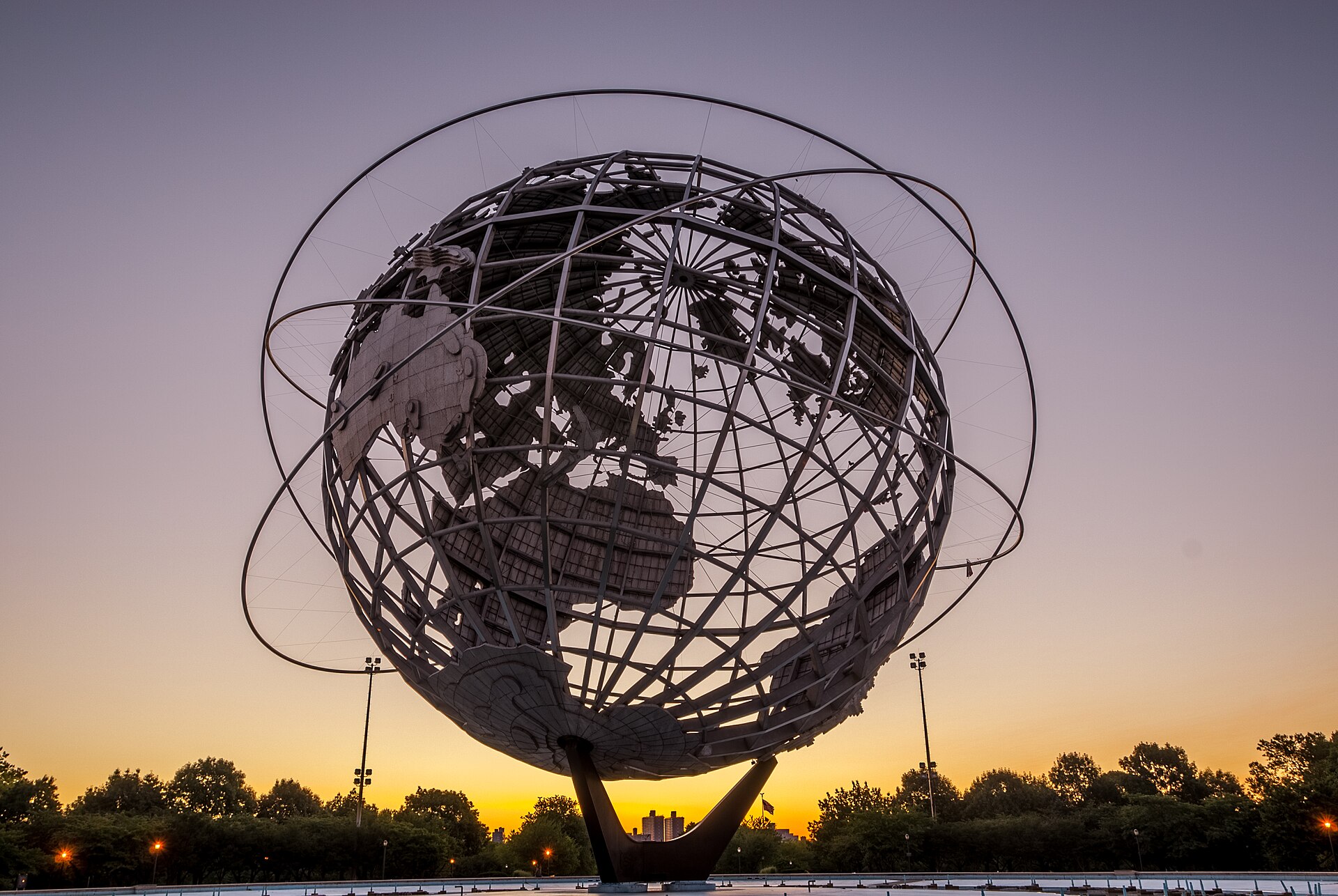
But there was something else the girl remembered: the iconic 140-foot high steel “Unisphere” with the three orbits of John Glenn depicted by three steel bands suspended over the globe. “That fall I started kindergarten. When my teacher, Miss Murphy, told our class that she and the other kindergarten teacher, Miss Squires, were planning to go to the fair the next summer and that they were ‘going to stand on the top of the world,’ I raised my hand frantically. When Miss Murphy called on me, I told her that there was no way that Miss Murphy and Miss Squires could do that. Miss Murphy was disapproving of me telling her so. She thought I was being disrespectful. But Miss Murphy didn’t realize that no one could do what she was thinking of doing. People simply weren’t allowed to climb up on that huge sculpture, least of all two old women with their big pocketbooks and high heels. And if they tried they were going to hurt themselves. That’s what I was all worried about!”
As I listened to these stories, I wondered how our granddaughter will one day describe to her grandchildren, her early trips to the Big City—now becoming a June tradition. I’m guessing that her visits to the Met will fit in somehow. Today she took photos of the many paintings and sculptures that caught her eye. As the guards shepherded us toward the exit at closing time, she hurried along like a butterfly, and with an outburst of enthusiasm, summarized her impressions: “Why do there have to be so many beautiful things?!”
Why, indeed.
Subscribe to this blog and received notifications of new posts by email.
© 2026 by Eric Nilsson
[1] One of the managers who reported to me during my years at Norwest Bank/Wells Fargo was the grandson of the folks who’d commissioned the famous architect to design the house.
