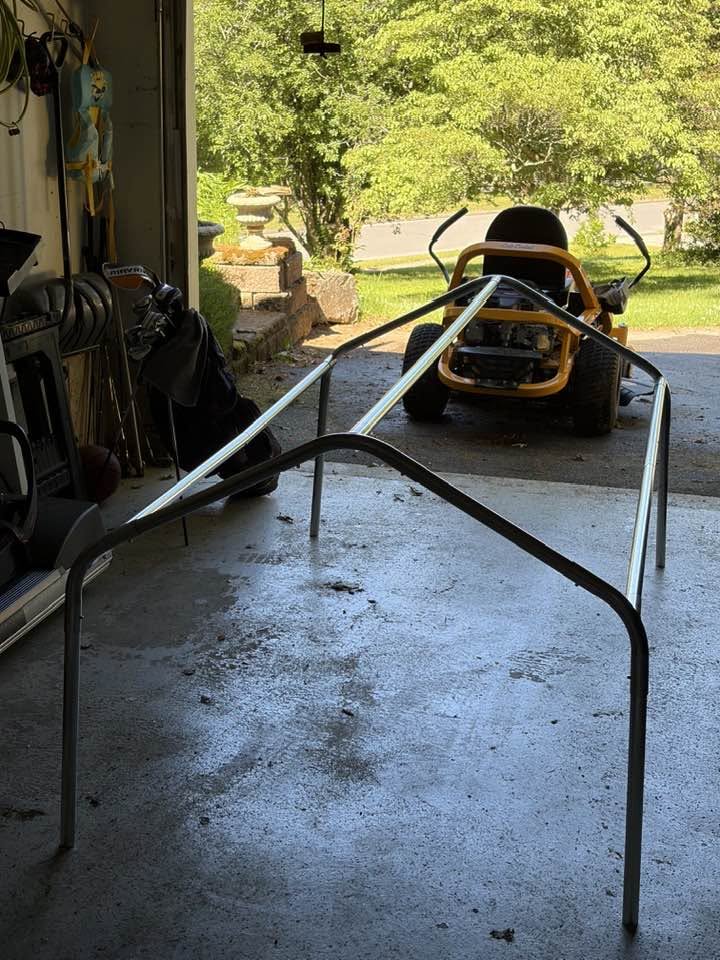
JUNE 14, 2026 – Our “Connecticut son” has a large mower to go with his family’s large yard. He also has a large garage for storing the large mower, but as he has learned about space in the context of home ownership, the homeowner never has enough of it. In other words, he discovered that the full-up garage wasn’t big enough to store the big mower. His plan: acquire a small aluminum-framed storage tent in which he could store the not-so-small mower. He could site the tent within a copse out of sight of the street, the house, and all but the most obscure vantage points of the yard.
It all made perfect sense. Except . . . as our son Byron has further learned, one’s available time for assembling a Home Depot storage tent for the home is inversely proportionate to all the other stuff one acquires for one’s abode, especially when the toys and accessories of two young children are thrown into the mix.
All of which is why I was enlisted yesterday by Byron to “do what [I] could” to assemble the storage tent. I gladly accepted my assignment: good ol’ Dad/Grandpa loves to put things together. “Better yet,” I said, “I like working on my own so I can work as slowly as I darn well please, thus achieving for me, myself and only me, a state of zen.”
“Good,” said Byron. “I’ll back out my car and the mower,” said Byron. “My thought was, you could assemble the frame inside the garage, and I can then help you carry it to where we want it to go.”
I was then left to my own devices—or rather none. I had to search the inventory of garage tools to find one to open the heavily packaged tent. Within a short time I found the perfect tool: grass clippers with the mouth of a barracuda. As I grasped its handles then opened and closed them, the carnivorous blades reminded me of the first rule of thumb when handling any kind of cutting tool: don’t cut off your fingers.
I went straight to work on the packaging, designed first to prevent pilfering on the part of FedEx, and second, to make sure the consumer breaks a sweat trying to gain access to the object of purchase. After what seemed like an hour of effort, an explosion of tape, staples and cardboard littered the garage floor. I spent the next quarter hour cleaning up shrapnel.
But the unwrapping end of the job wasn’t yet finished. In the wake of my messy but victorious fight against the outer packaging, I discovered that Home Depot had sent a Russian matryoshka doll. The struggle continued, this time against layers of bubble wrap, small rubber bands, and plastic bags coated with warnings not to pull the bags over baby heads to stop their fussing.
Eventually, I reached the bottom of things—and the “Assembly Instructions.” I was reassured to see below the title, an image of the tent and not a picture of a sophisticated rocket. (If I’m not an assembly engineer, I’m certainly not a rocket scientist.) In further assurance, the tent dimensions were printed: “6’ x 8’ x 7’.”
Following Byron’s suggestion, I was soon laying out the parts to the upper part of the storage tent. The instructions were delightfully simple and straight forward: plain illustrations and numbers corresponding to the small numbers stickered to each of the parts. Absent was any verbiage in need of translation from English to . . . English. There was likewise no need for the Spanish, the French, the German, the Japanese, or the language that uses curly-cues in its script. I could wallow in the bliss of interpreting cave drawings amidst theoretical illiteracy. Besides, the weather both inside and outside the garage was picture perfect.
Against the backdrop of the noise and commotion of life, close and far, my thoughts and mood were levitating in the rarefied air of a Buddhist lamasery surrounded by the Himalayas in Ladakh and Zanskar. I was adorned in a saffron-colored robe with hands at work on a string of prayer flags. Or so I imainged.
Byron, meanwhile, was hard at work assembling a pressure washer to remove Connecticut dust and dirt from the outside of his fine white car. Our 10-year-old Minnesota granddaughter along on our annual June trip to the land of nutmeg, was watching in anticipation of her own enlistment in the weekend work of the household.
I continued to revel in the satisfaction of my age and place in life—no longer a monk but an engineer, slowly and methodically working on the American ideal of . . . building . . . something, albeit with parts from China. But why would the place of manufacture matter? Has our species not achieved its long-awaited day of one world, one people, one economy? Surely so!
“How’s it coming, Dad?” Byron asked.
“I’m having a blast,” I said. “No worries, no complications, no frustrations. I’m working at the pace I choose—slowly—without inhibition and without any concern for the pressures that others might wish to impose on the project.”
Byron chuckled. He’s patient with all people, especially his old parents and young children. Yet, he and I both were mindful that in about an hour, his and Mylène’s friends Flo and Luke would arrive for a festive dinner of long-smoked ribs, exotic beverages, and . . . as it would turn out . . . even more exotic tropical fruit to supplement Mylène’s planned dessert of home-made lemon merengue tarts.
“I’m glad Luke isn’t here now,” I said.
“Why?”
“Because he’s a real engineer, and he’d knock off the tent assembly by himself in a tenth of the time it’s taking me, thus depriving me of a decent dose of zen.”
“I get it,” said Byron.
He then let me continue on my own.
An hour later, I reached a moment of truth. All the packaging, the printed instructions, and Byron’s express assumptions represented that the tent was eight feet long and six feet wide. But in reality it was barely four feet wide—a 2:1 ratio, length to width vs. the promised 3:4 ratio. This meant that the super-sized mower wouldn’t fit into the tent. I checked, double-checked and triple-checked my work. This process failed to reveal any errors in assembly.
“I think you were sold a bill of goods,” I said to Byron when I next caught up to him. “The tent is supposed to be 6 x 8, but it’s only 4 x 8, which isn’t wide enough for your mower.”
“Huh,” he said in his graceful rush between giving Mylène relief on the kids front and checking on the ribs that had been smoking for four hours. “Are you sure you put it together correctly?”
“I’m sure. I’ll put the problem to Luke when he and Flo arrive, just to confirm.”
“Okay,” Byron said with his usual calm. He’s quite good at knowing what problems are worth major worry and which ones aren’t.
About 90 minutes later, after Luke and Flo had appeared and we’d settled into conversation, I solicited Luke for assistance with the tent. Out in the garage I showed him Exhibit A (the face page of the assembly instructions bearing the explicit dimensions of “6’x 8’ x 7’); Exhibit B (the diagrams that clearly showed a 3:4 ratio of width to length, not 2:1); Exhibit C (the diagrams depicting the steps of assembly that I’d completed so far); Exhibit D (the assembly itself and how it corresponded to the instructions); and Exhibit E (actual dimensions of the frame by use of a tape measure). I explained the problem and asked for his analysis.
Luke examined my work with the scrutiny of a building inspector with a bad case of OCD and determined to reject an application for assembly approval. I nervously awaited his verdict. “You did everything correctly,” he finally said. “But I think there’s a design flaw. The corner parts aren’t angled properly. They should be bent to a wider angle so that the sides flare out more rather than run straight up and down, as they appear to do.”
So far, the frame was resting on four, 2” x 48” aluminum sections that I’d attached to the corner pieces Luke had declared were flawed. I had yet to connect an additional 2” x 60” to each of the four-foot-long sections. I suggested that when the equivalent of 125% of the existing length was added to each of the four corners, the frame on each side of the tent could be pulled out a foot to produce a base width of six feet quite easily.
“Let’s test the theory,” I said, “by adding a 60-inch section to each of the front corners.”
As I rounded up the parts, I became more convinced that all would work out; that there’d be sufficient flex in the light aluminum frame to achieve a six-foot width. To express my optimism to Luke, I used parallax as an analogy. “The angle of the corner piece at the top of the frame,” I said, “produces a much wider angle at the other end of the ‘leg.’ The problem is that we were measuring from top corner to top corner, not the width at the bottom—after adding the full length of each leg. Our assumption regarding width was based on less than half the final length of the legs being installed.”
Luke agreed.
“I think this is a case where it could be said, ‘Oh ye of little faith.’”
Luke laughed—and agreed with my overview as well.
The ribs turned out great, and I was relieved that amidst all his feast and family tasks, Byron hadn’t expended any more worry about my false alarm than an almost absent-minded, “Huh.”
Subscribe to this blog and received notifications of new posts by email.
© 2026 by Eric Nilsson
